


 Francais
 Deutsch
 Italiano
Refine Your Search
+"European theater" +1943 stock footage and images
- Showing 37 to 42 of 68 results more
more Hide
Hide
Preparations for allied invasion of Normandy France during World War II.
'Normandy: Air borne invasion of fortress Europe ' Allied invasion of Normandy. Lieutenant General William S Knudsen introduces the film to be presented, expressing thanks to makers of the glider aircraft used in the invasion, who are the intended audience of the film. Field Order no1, 9th Troop commander Carrier. A man puts a Top Secret seal on the order. The Captain of United States 82nd Air Borne Division briefs men about the terrain with the help of a mosaic. A map of Europe shows principle cities of the continent. Map and narrator describe German Atlantic Wall coastal defenses on European continent. A giant concrete coastal gun emplacement. A large German railroad coastal gun moved out of a concrete shelter. Various concrete structures, sandbag structures of coastal guns. A concrete base gun turret revolves. Huge coastal guns protrude from concrete gun emplacements. Huge steel and concrete tank barriers stretched across. Large concrete and steel structures built along the coast to prevent assault craft from landing. Combined Chiefs of staff of the United Nations at a meeting. George Marshall and Henry Arnold at the head of the table during the meeting. A map shows invasion area near Le Harve. Troop Carrier units departing for Allied invasion on Sicily, Africa on 10 July, 1943. The United States C-47 aircraft take off towing gliders from an airfield in Africa. Troops transported from British 1st Air Borne division and United States 82nd Air Borne division. Dust rises as aircraft take off from a desert field. Demolished gliders on field and beside water. Multiple views of demolished gliders. C-47 in flight and paratroopers jump from the plane in New Guinea. Instructor trains paratroopers in United States. Discussion and demonstration of improvements in glider equipment and usage after Sicily Invasion and prior to D-Day Normandy invasion. Two men attach link nose chain to glider. Parachute extended and held open by men. Pilot of a glider talks to the pilot of the plane towing the glider over intercom.

Allied forces prepare for D-Day, also known as 'Operation Overlord' (WW2)
'Eve of Battle' depicts the Allied invasion of Europe during World War II. Slave labor from Nazi Germany-invaded countries construct Atlantic Wall. German artillery and fortifications in the Atlantic Wall. Nazi German soldiers marching in groups. Nazi leader Adolf Hitler shake hands with Italian fascist leader Benito Mussolini. Allied leaders Franklin D. Roosevelt, Winston Churchill and Joseph Stalin sit together during the Tehran Conference in December 1943. Exiled Allied leaders such as General Charles de Gaulle of France, Queen Wilhelmina of the Netherlands and Dr. Edvard Beneš of Czechoslovakia inspect Allied troops. Various Allied troops from Poland, Norway, England, United States, and Czechoslovakia prepare to launch an invasion in France. Eisenhower along with other officers plans the European invasion. Allied ships and aircraft on their way to Europe. Allied bombers drop bombs over Nazi German U-boats. Naval battle begins and explosions occur, smoky docks. In England war supplies unloaded. Supplies include weapons, military equipment, and food. A tank and locomotive trains being loaded into a ship bound for Europe. Allied aircraft take off at night. A man directs an aircraft taking off. Allied bombers bombard German targets resulting into fiery flare in Europe. British children playing jump rope as a supply train pass by in the background. Tanks and fighter planes transported by train. Supply boxes unloaded and stacked for transport to the battle front.
Trials of war criminals in Germany after World War Two. Belsen local trial.
"The Guilty." Animation depicts person being hanged. View of an angry crowd on a road. People beat captured German soldiers and collaborationists. Mob of Italian partisans in Italy raising dead bodies of Mussolini and others up to hang from their heels in public after their execution. Foreign Minister Vyacheslav Molotov and British Foreign Secretary Sir Anthony Eden signing the Moscow Declaration in November, 1943. The declaration is signed to preserve the authority of law in Europe and to ensure fair and orderly trials for war criminals. Next scene shows Allied soldiers at a liberated Concentration Camp near the end of World War 2 in Europe. Military jeeps in the background. Military photographer takes pictures as officials arrive to tour the concentration camp. Man opens a crematorium oven, revealing bones of a corpse inside. Pile of dead victims of a concentration camp. Elevated view of a room full of documents that are in review for war trials. Officials search documents to identify war criminal suspects. Nazi officers and officials who committed suicide are shown, including a German admiral, the body of Heinrich Himmler, and the bodies of the Mayor of Leipzig and his wife. War criminals being summoned for the various war crime trials. Scenes from the Belsen Trial in September 1945, held in a Lüneburg gymnasium, to decide the fate of German guards and SS officials from the Auschwitz and Bergen-Belsen concentration camps. A defendant being brought to trial on a stretcher. Soldiers guard the court room. View of defendants including many women SS-Gefolge members. German Commandant Josef Kramer during his trial, and German doctor Fritz Klein beside him. The court trial underway for the war criminals. Guilty war criminal brought to the gallows to be hanged, black cover placed over his head and he is hanged. View of dead bodies of concentration camp victims. View of a crowd amassed at a hanging execution of several German officers, possibly in the Soviet Union.
Allied troops aboard ships and gliders head for Normandy, France for the D-day invasion during World War II.
Allied invasion of Normandy, France during World War II. U.S. General Joseph McNarney, Deputy Chief of Staff at a desk as he outlines the importance of June 6, 1944 the day Allied forces attacked the Germans in Normandy. He speaks about the decision to knock down the Nazis first and then the Japanese during the World War. He says that the invasion of Normandy was planned in November 1943. He also states how General Dwight D. Eisenhower, Supreme Commander of the Allied forces in Europe, planned and executed the invasion. He also speaks about how the U.S. Army Air Forces and the Royal Air Forces aircraft bombarded the coasts of Normandy prior to the D Day invasion. Past events show American soldiers getting onto landing crafts in England as they leave for the invasion. The soldiers aboard the ships in the English Channel. The soldiers read the Bible and comics, sleep and cook aboard the ships. On June 5th , 1944 the ships head towards Normandy for the invasion. In England gliders carrying paratroopers take off from an airfield to bombard the German positions in Normandy. British soldiers receive ration and work on motorbikes. TNT (trinitrotoluene) charges being prepared by soldiers tasked with demolition duties. British soldiers check their guns and other weapons prior to the invasion. Jeep and artillery being loaded onto aircraft.
Mixture of scenes from Cairo and Teheran converences with glimpses of Soviet troops on the move and views of bombers and landing craft as well as an atomic test in the Pacific ocean.
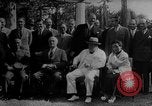
Opening scene shows Chinese Generalissimo Chiang Kai-shek seated with U.S. President Franklin D. Roosevelt, British Prime Minister Winston Churchill, and Madam Chiang in their Cairo meeting at a residence of the American Ambassador to Egypt, Alexander Kirk, on November 25, 1943, during World War 2. Foreign ministers of the countries stand behind their leaders. Closeups of the three Country's leaders. Scene jumps to Teheran, with Soviet Leader, Joseph Stalin, President Roosevelt, and Prime Minister Winston Churchill, seated on a veranda of the Soviet Embassy. Suddenly scenes of tanks, trucks, and Soviet troops moving on the Eastern front are seen. Some of the troops move by horse-drawn sleighs through the snow. A line of U.S. Army Air Forces B-17 bombers taxiing on an airfield. View from a B-17 in flight. View f as a cluster of bombs falls from B-17 and explodes on the ground. Animated map illustrating paths of aircraft attacks against the German Atlantic Wall from England. Landing craft underway in an amphibious assault. Brief view from a ship of a post-war test atomic explosion in the Pacific ocean
U.S. shuttle-bombing of German positions and military installations under Operation Frantic during World War II.
Film title slate indicates "Operation Titanic" but it, in fact, depicts "Operation Frantic" with U.S. shuttle bombing operations over Germany from bases in Great Britain, Italy and Russia during World War II. United States Army Air Force B-17 Flying Fortresses in flight. Aerial view of bombers in flight with several aircraft flying in formation leaving behind contrails. View inside bomber aircraft with bombardier preparing to drop bombs. View of bomb bay door opening and closeup of hand near bomb drop switch. Bombs awawy view as bombs are dropped from American aircraft. German defenses are bombed along the invasion coast of France (just prior to D-Day) on June 2, 1944. Aerial views of B-24 and B-17 bombers also in flight bombing German military installations in German-occupied northwestern Europe. Aerial view of a target area. Smoke rising up from bombardment. Two different U.S. Army Air Force B-17 Liberator aircraft are seen falling from the sky toward crashes after being hit by German enemy fire. One of them has smoke trailing from it, and the other is in a free fall. Railroad and marshaling yards are also bombed over Debrecen, Hungary on June 2, 1944, with aircraft continuing on (shuttle bombing) rather than returning to base. United States Army Air Forces B-24 Liberator flying in formation on June 21, 1944. Aerial view as they bomb the Focke-Wulf Fw 190 engine aircraft factory near Basdorf, Germany. German factories are bombed. B-17 aircraft on the same date are seeing in formation and bomb railway stations, freight yards, and factory targets, along with the Nazi German Ministry of War, Ministry of Propaganda, and Gestapo headquarters in Berlin, Germany. Heavy flak bursts seen in the air near the aircraft. Dogfight scenes as several German airplanes are shot down. Machine gunners aboard U.S. bomber aircraft firing at German fighter aircraft and shooting down 43 of them, according to narrator. Aerial view of ball turret rotating below bomber and firing guns at German fighter aircraft. The B-17s and B-24s bombing the targets. Synthetic oil plants and refineries are bombed at Ruhland Germany, east of Leipzig. Planning for the operation was done on December 7, 1943. A document about the operation is typed. Animated map shows Nazi positions and method of shuttle-bombing, allowing American aircraft to bomb from Soviet bases, and allies broadly to bomb German targets from bases in the United Kingdom, Italy, and Soviet Ukraine.