


 Francais
 Deutsch
 Italiano
Refine Your Search
+"European theater" +1944 stock footage and images
- Showing 295 to 300 of 368 results more
more Hide
Hide
U.S. 8th Air Force plane piloted by Lieutenant R. Frederickson attacks a German Focke Wulf Fw-190 aircraft in World War II.
Enemy plane attacked by U.S. aircraft on 2nd December 1944 in World War II. Aircraft of 8th Air Force is piloted by Lieutenant R. Frederickson of 63rd Squadron. Aircraft attacks a German Focke Wulf Fw-190. Shows hit on aircraft, aircraft explodes.
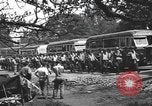
Allied forces assemble in England and depart for the invasion of Normandy in World War II
American paratroopers of the 82nd Airborne Division, boarding hired British commercial buses that take them to a marshaling point, in preparation for the invasion of Normandy, France, in World War 2. Views from below of U.S. Army Air Forces C-47 transport aircraft in formation, carrying paratroopers toward Normandy, France, on June 5, 1944. Aerial view of British and American invasion ships en route to rendezvous off the Isle of Wight. U.S. Army Air Forces B-26 and B-17 bombers in flight. B-17 dropping bombs on lines of communications in Normandy, to hinder German movements of reinforcements. Allied warships and transports beginning their move toward the coast of Normandy. British landing craft underway under cover of barrage balloons.
Navy film about amphibious assaults. German films about the building of the German coastal defenses known as the "Atlantic Wall."
U.S. Navy film entitled, "the Battle for the Beaches." Several Higgins boat landing craft arrive at a shore and U.S. soldiers leave them to run ashore. Scene is then overlayed by the title slate. View of the White Cliffs of Dover, England. British civilians preparing defenses during World War 2. Civil Youth loading sand bags and erecting sand bag parapets around buildings. Home guard troops march up a road carrying rifles. British defenders occupying fortified positions They stand along a coastline looking out at sea. Street scene in an English village. Guards walking up along a barbed wire fence erected on the outskirts of the village. Film shifts to the German coastal Atlantic Wall defenses. German troops march along sandy shores containing all manner of obstacles at the water's edge. German officers stand on an overlooking cliff, and peer through binoculars. German sentry and large coastal gun barrel under camouflage net are silhouetted against light sky. Three German officers confer over plans for coastal defenses. View from above of slave laborers working and shoveling sand as they build defenses. German soldiers dismantling wooden forms around completed concrete fortifications. Glimpse of a huge German coastal gun being raised by a crane with heavy steel cables, as it is steadied by dozens of workers with hands on its barrel. German troops manning a machine gun in coastal defense position where a twin mounted antiaircraft gun is also seen. Momentary view of two German soldiers walk past rotating barrel of a huge coastal defense gun under a camouflage net. Workers, with shovels, placing fresh concrete to build up a section of concrete barriers along the coast. Allied troops storming a sandy shore from landing craft, as shells explode near them; possibly related to 1944 D-Day. One contingent are British soldiers. American troops landing at a beach from landing craft. Dead allied soldiers lying in the surf. Film shifts abruptly to U.S. Lieutenant General Mark Clark with some officers in Italy. In another switch of war theaters, General Douglas MacArthur is seen congratulating crew of a B-25 named "Smiling Jack." U.S. troops, in a training exercise, storming ashore from Higgins boats directly and closeup at the camera. They take up defensive positions in the sand, and move a jeep towing a field artillery piece.
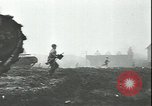
The U.S. Army Signal Corps in War and Peace. Descriptions and demonstrations of VT (proximity-fused) munitions
Opening scene shows troops of the U.S. Army 101st Airborne Division engaged at Bastogne, Belgium, during the Battle of the Bulge, in 1944, during World War II. They advance through fires and set up defenses in buildings, firing rifles from apartment windows. Outside, riflemen fire from behind a concrete barrier. Closeup of one firing his M1 Garand rifle. Glimpses of infantry firing mortars and walls falling to mortar fire. Gun crews firing heavy field artillery pieces, some under camouflage nets and others in the open. Intervening slate reads: "VT." and introduces postwar discussion of Signal Corps-developed proximity fuse, using animated cartoon. Shows how it proximity shells increase their explosive envelope compared to regular time fused munitions. U.S. Army gunner fire a number of proximity shells that burst above ground targets in the distance. A cartoon shows the proximity fused munition being used by a fighter aircraft. A Republic P-47 fighter plane is seen firing VT munitions from guns in its wings. Aerial bombs falling. A line of VT bombs exploding above ground.
African American soldiers engaged on all fronts in World War 2
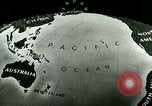
Film opens with map of the world showing the various theaters of operation in World War II. Narrator refers to Allies liberating town after town, as they advance. View of American troops being welcomed in a European town during an advance (probably Italy in 1944). Next, African American troops are seen boarding troop transport ships. A huge convoy of ships is seen from the air. Huge piles of war materiel on a dock. Ammunition being delivered by landing craft from the transport ship USS Hunter Liggett (APA-14) to American troops at a beachhead in the Pacific. An African American sailors directs the lowering of a piece of artillery from a ship into a landing craft. Construction equipment being used to clear the way for a new landing field. Docks, roads, and bridges being built as the Allies advance. American troops in the swamps of the South Pacific. American Army engineers clearing trees to build the Alaska Highway (ALCAN Highway) in 1942. Corps of Engineers building the Ledo Road (from India to China) during the war. African American soldiers building a bridge across a river in Europe. A U.S. Army truck under fire, driving along a dirt road in Europe as shells burst all around it. U.S. troops firing various kinds of field artillery and tank guns. U.S. infantryman using a flame thrower. Closeup of African American soldier using a bayonet and others firing small arms. A tank being blown up by artillery fire. A Japanese Mitsubishi A6M3 Zero aircraft maneuvers overhead in the Pacific theater. An African American soldier runs to man his Browning .50-caliber, water-cooled antiaircraft machine gun, and begins firing as the Zero fighter plane strafes his position. Closeup of Japanese pilot in his cockpit and his machine guns firing from leading edges of his plane. His rounds strike all around the U.S. gunner, who turns and follows him with more fire. His tracers show behind the plane. Closeup of the African American gunner as he continues firing. View of the Japanese airplane rolling over and diving. Next the Japanese plane, aflame, crashes on a tropical island and explodes. (Note: It is apparent that some of these combat scenes have been made up of clips from other sources, edited into this film.) (World War II; WW II; World War 2; World War Two)
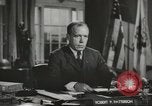
American Undersecretary of War speaks to difficulties facing Allies in confronting Germany and Japan in World War II
Undersecretary of War, Robert Porter Patterson, Sr. speaks about a report from the General staff outlining the needs for combating Germany and Japan in World War 2. He cites Operation Husky, the invasion of Sicily, as an example of what will be needed. He continues to narrate in the background as an animated map appears showing the buildup of supplies and Allied forces in North Africa; Allied air forces flying 60 thousand sorties over Sicily and, the direct amphibious assault using 3,200 vessels. Map also depicts opposing forces of 12 (“unwilling”) Italian Divisions and 3-1/2 German Divisions. View of Allied troops carrying some of their 31 thousand casualties on stretchers from field ambulances. Allied medics attending to the wounded. Some are seen lying on stretchers in a row on the ground near a wall. Interior of a field hospital where surgeons and other medical personnel treat the wounded. Animated map shifts to Europe with Germany at its center, showing , in contrast to Sicily that was only an “outpost,”, the heavily fortified perimeter of Axis controlled areas; the axis industrial might; and the disposition of 300 German Divisions (mostly on the Eastern front) defending the region. Next, the map illustrates Japan’s defended regions in the Pacific Image returns to Undersecretary Patterson i n his office, speaking of the Allied offensives planned for next year (1944), and emphasizing their challenge and difficulty. Scene shifts to General Jonathan Wainwright and his garrison at Corregidor, in the Philippines, surrendering to Japanese forces in 1941. Japanese military camera pans over the Americans being taken prisoner. Other Americans and Filipinos are seen being marched together under guard. Scene shifts to classic views of the Japanese attack on Pearl Harbor, Hawaii, on December 7, 1941. View of Japanese soldiers executing two Chinese civilians in 1937. Dangling bodies of persons hung by Nazis during Operation Barbarossa in Russia, in 1941 A Russian soldier comforts a little girl as he escorts her across a snowy landscape. Time bomb left by German forces retreating from Naples, Italy, in 1943, blows up a Post office building . Views of damage to building and bodies of victims. American Military Police assisting a victim. American soldiers carrying an injured civilian on a litter. Scene shifts to British Foreign Minister, Anthony Eden, Soviet Foreign Minister, Vyacheslav Molotov, and U.S. Secretary of State, Cordell Hull, entering a hall in the Spiridonovka Palace, during the 1943 Moscow Conference in Russia. Close-up of the American, Soviet, and British flags on a table. View of many delegates seated around the table. Close-up of Molotov, Eden, and Hull signing conference document.