


 Francais
 Deutsch
 Italiano
Refine Your Search
+"European theater" +1944 stock footage and images
- Showing 31 to 36 of 368 results more
more Hide
Hide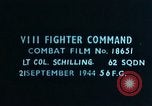
A U.S. aircraft of VIII Fighter Command chases an enemy fighter plane in the European Theater during World War II.
An enemy fighter is chased by a U.S. aircraft of VIII Fighter Command piloted by Lieutenant Colonel D.C. Schilling of 62nd Squadron. The aircraft chases the enemy fighter aircraft on 21st September, 1944.
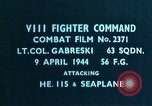
U.S. aircraft of VIII Fighter Command and 63rd Squadron strafes a German Heinkel He 115 torpedo bomber in the European Theater.
A German seaplane is attacked by a U.S. aircraft of VIII Fighter Command piloted by Lieutenant Colonel Gabreski of 63rd Squadron. A German Heinkel He 115 torpedo bomber (seaplane) reconnaissance is being attacked by a 63rd Squadron plane on 9th April, 1944. Smoke rises from the target. (World War II period).
German Chancellor Adolf Hitler and Prime Minister of Italy Benito Mussolini discuss strategies for war in the European Theater.
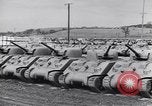
Officials confer during World War II. Allied war material stacked on a port in England, including U.S. tanks, trailers, razor wire, fencing, and trucks in preparation for invasion of Europe in 1944. American and British soldiers work and load the supplies for their shipment to the war front. U.S. soldiers unload at a beach site. British Army soldiers roll a covered artillery piece . It has a chalk handwritten label on the gun barrel that says, "Slim's Deadly Poison" and an image of skull and cross bones. Laborers building a German fortification in coastal France. German General viewing English Channel from coastal fortification along the Atlantic Wall. German Chancellor Adolf Hitler and Prime Minister of Italy Benito Mussolini confer in a meeting. The officials discuss strategies for the war over a large map. Newspapers with English headlines speculating about the coming Allied invasion. George Marshall and other Allied officers of the War Council of the united nations assembled at a large conference table and in discussion for the Invasion of Europe (D-Day invasion of France).
U.S. Signal Corps officers and soldiers use mine detectors, modern radars, and meteorological equipment during World War II.
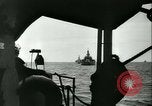
The role and contribution of the U.S. Army Signal Corps in combat and war. U.S. shuttle ships loaded with signal communication supplies for U.S. and Allied troops in the European Theater make their way in the Atlantic ocean. The Squier Laboratory at Camp Alfred Vail in Fort Monmouth, New Jersey. A technician works on signal communication equipment in the laboratory. U.S. soldiers use mine detectors in the European Theater during World War II. The mine detectors detect metallic, non-metallic mines, wooden box mines, and mines in glass containers. Artillery soldiers bury large microphones into the ground in advance zones. The microphones relay back information on enemy artillery. Soldiers receive the information on radio sets. U.S. aircraft on a training flight simulating real combat situation: The aircraft lost in heavy rain and rough weather, looking for the location of Boston. The pilot switches on a modern advanced radar. The radar waves pierce thick clouds, are reflected by Earth's surface and display an image on the scope. The image shows the clear location of Boston harbor directly under the aircraft. U.S. bombers attack over the Channel coast on D-Day (6 June, 1944). U.S. soldiers employ meteorological equipment for long range weather forecast in the European Theater during World War II. Soldiers release a hydrogen balloon into the sky. Another soldier uses an apparatus to take readings of atmospheric conditions behind enemy lines. An aircraft drops an automatic weather station called SCM-18-TI by parachute into enemy territory. The timed mechanism sends out weather data in codes. The interior of the automatic weather station lying open in a field.
U.S. Signal Corps employ the Eureka/Rebecca transponder system during the American airborne landings in Normandy, France.
The role and contribution of the U.S. Army Signal Corps in combat and war. Parachute drop-markers with radio signals guide an airborne operation in the European Theater. U.S. airborne troops board a U.S. Army Air Forces Douglas C-47 Skytrain or Dakota transport aircraft. A woman soldier greets the paratroopers as they prepare to board the aircraft. The paratroopers jump out and descend towards the ground. The paratroopers are furnished with markers for every dropping point. A paratrooper with a radio beacon hooked onto his belt. The beacon is the ground section of the Eureka/Rebecca transponder system. The paratrooper fixes the Eureka extension including the cable and the receiver transmitter. Animation depicts the working of the Eureka-Rebeca system. An aircraft unloads paratroopers over Normandy in France during World War II. Allied troops, landing crafts, landing ships arrive at Normandy on D-Day (6 June 1944). Soldiers wade through the water towards the shore and advance inland across the beach during Allied invasion of France.
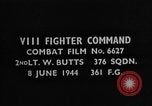
High altitude view of strafing of trucks on road.
The Operations of the 8th Fighter Command in the European Theater. 08-June-1944; 2nd Lieutenant W Butts of 376th squadron 361th fighter group flies the aircraft. Ground target attacked. High altitude view of the area. Strafing of trucks on road. Smoke arises due to the explosion. (World War II period).