


 Francais
 Deutsch
 Italiano
Refine Your Search
+"FRance" +1918 stock footage and images
- Showing 997 to 1002 of 1022 results more
more Hide
Hide
President Woodrow Wilson, Mrs. Wilson, and General John Pershing at Hotel De Ville in Paris.
Outer view of Hotel De Ville. United States President Woodrow Wilson, Mrs.Edith Bolling Wilson and General John Pershing seen standing at a window of Hotel De Ville. They are on their visit to Paris for the Paris Peace Conference. A huge crowd is gathered in front of the hotel to greet them. (World War I; World War 1; WWI; WW1)
The British 10th Hussars entering Arras during World War I.
The British 10th Royal Hussars Cavalry Regiment entering Arras, during World War One.
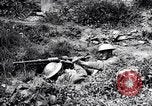
U.S. AEF soldiers set up machine gun defenses North of Villers-Tournelle, during World War I
Two U.S. soldiers in a foxhole, set up a French Hotchkiss Model 1914 heavy machine gun, North of Villers-Tournelle, during World War I. Several American soldiers crawl across a field and set up another Hotchkiss machine gun on a tripod. One of the supporting soldiers runs forward to give the gunners two ammunition cannisters. Scene shifts to another team setting up a Hotchkiss Model 1909 light machine gun, on a tripod. Soldiers with ammunition are seen in background. Several American machine gunners step through their own barbed wire defenses to set up another Hotchkiss Model 1909 light machine gun. A machine gun crew firing a Hotchkiss Model 1914, pointed skyward. One feeds strips of 8mm lebel ammunition into the gun. (World War 1. WWI. WW1)
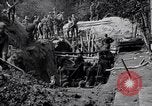
U.S. Army (AEF) troops establishing base camp North of Villers-Tournelle, during World War I
U.S. troops excavating for a deep dugout as part of their defenses North of Villers-Tournelle, during World War 1. Another scene shows troops in their bivouac area performing routine maintenance around their dugout shelters. Lines of wash are seen drying. Some prepare meals over camp fires. One soldier emerges from his dugout to scan the skies for enemy aircraft. An officer sits at a table and examines charts. Soldiers relax at entrance to a large dugout field kitchen, where a slab of meat sits on a butcher table. (WWI. WW1)
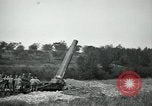
French gun crew firing a Schneider Obusiers de 520 (520mm howitzer) rail gun, during World War I
French artillerymen fire a Schneider Obusiers de 520 (520mm howitzer) rail gun, partially entrenched. The barrel is lowered after firing. The camera then records the French crew preparing to fire, again, as an American soldier takes photographs. They convey a shell on a moving platform (which they also ride). The gun crew partially cranks the round forward, and then all push it into the gun breech. The next scene shows the round being fired. (World War I; World War 1; WWI; WW1)
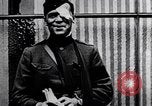
Mr. Floyd Gibbons, World War 1 war correspondent, wounded at the front, passes through Paris enroute to the U.S.
Mr. Floyd Gibbons, war correspondent for the Chicago Tribune during World War I, standing in uniform and talking. He is seen following his wounding at the front. He is passing through Paris enroute to the United States. Gibbons is seen with a patch over his injured eye (permanently lost) and his hand fractured. He had been hit by German gunfire while attempting to rescue an American soldier during the Battle of Belleau Wood.