


 Francais
 Deutsch
 Italiano
Refine Your Search
+"FRance" +1918 stock footage and images
- Showing 97 to 102 of 1022 results more
more Hide
Hide
Allied forces hold air superiority in battle of Saint Mihiel during World War I.
This film shows numerous types and models of World War One aircraft in operation. It opens showing Allied airplanes preparing for a maximum air campaign in the battle of Saint Mihiel. View from inside a hanger as its flap opens and men push a Sopwith Camel airplane out onto airfield. Map of St Mihiel. American planes warm up on flight line in predawn, with flares burning at wingtips. Huge numbers of allied airplanes are marshaled on airfields throughout the theater of operations and begin taking off. Among them is a French Morane-Saulnier low wing monoplane. German fliers are seen loading small hand held bombs into the cockpit of their Albatross aircraft. Soldiers in combat on ground in "no man's land" during the battle of St. Mihiel. They take refuge in large shell and bomb craters and try to advance running between them.. Germans fliers dropping bombs, by hand, from airplane. Numerous Allied and German airplanes in aerial dogfights. American planes over clouds. American Observation balloon attacked in sky. Balloon in flames, and trailing black smoke as it falls to the ground. French flag flies at an airfield, where a nosed-over airplane sits, by a hangar, as airplanes fly overhead. Aircraft taxiing about in close quarters at airfield. Large formations of American airplanes flying overhead in a grand formation, following the Armistice, November 11, 1918 Then the film shifts dramatically from World War One to the post-WWII year of 1947. It illustrates the dramatic advances in warplanes since WWI by showing U.S. B-36 bombers and straight-wing F-84 Thunderjet fighters is formation.
President of France Raymond Poincare arrives in a recaptured village in France, in World War I
House in a recaptured village in France, during World War One. President of France, Raymond Poincare, arrives in the village with other dignitaries. Vehicles parked on the street in front of the house. He shakes hand with another person. They talk amongst themselves. They sit in a car.
Embattled veterans of France and Britain form honor escort to the comrades and march off to war in France during World War I
Troops disembark ship in France during World War I. Ship underway at sea. It arrives at harbor. Troops disembark ship. They hold their belongings. The embattled veterans of France and Britain form honor escort to the comrades and march off to war
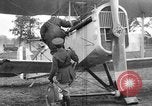
U.S. Army Army Service pilots in France, including Eddie Rickenbacker in a Spad VIII; aircraft taking off in France during World War I.
Activities of United States 94th Aero Squadron in France during World War 1. Several American pilots are shown in their aircraft. Opening scene shows pilot clad in heavy flying suit, helmet and goggles, climbing into cockpit of a De Havilland DH-4 aircraft, as another officer stands nearby. An army ground crewman steps to the propeller and slowly rotates it to clear any hydraulic lock. He then stands ready to pull it through for a start. Closeup of pilot in the cockpit. Another ground crewman joins hands with the first to help him as they pull the prop through and the engine starts. The aircraft taxis out, with a rear gunner also aboard. Halfway through the film, Eddie Rickenbacker is seen in a Spad VIII. Rickenbacker in the cockpit. Plane taxis before take off. Aircraft takes off with hangar in the background. Men push a plane with a pilot in the cockpit. Pilot in the cockpit of a DH-4 aircraft, the aircraft takes off. Plane in flight. Pilot in the cockpit of a Nieuport aircraft. Aircraft seen taking off and in flight.
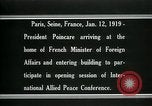
President of France Raymond Poincaré, arriving at Quai d' Orsay in Paris, France (WW1)
Outer view of Quai d' Orsay (37, Quai d'Orsay - 75007 Paris) or the French Ministry of Foreign and European Affairs. President of France Raymond Poincaré arrive in a motor car. He has arrived to attend the preliminary meeting of the International Allied Peace Conference in Paris. (World War I; World War 1; WWI; WW1)
Soldiers affected by gas attack in a trench in France during World War 1.
United States Army soldiers fire from a trench dug out in France. They put on protective mask and fire. Snow covered field. A soldier affected by gas comes out of the dug out. Another soldier puts a protective mask over his face. Soldiers help the affected soldier. Stretcher bearers carry gassed man into gas proof dug outs in France. Soldiers clear the trench with Ayrton fans in France. Soldiers fire from the trench in France. They remove the masks from their faces. After testing they put on the masks again. They clean their rifles.