


 Francais
 Deutsch
 Italiano
Refine Your Search
+"Fairbanks Alaska USA" +1934 stock footage and images
- Showing 1 to 6 of 8 results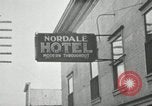
Fliers of the 1934 U.S.Army Air Corps Alaska Flight, spend time in Fairbanks, Alaska
Members, of the 1934 U.S. Army Air corps Alaska Flight, patronizing local hotel and shops in Fairbanks, Alaska. A sign identifies the Nordale Hotel (Slate notes the extreme high cost of things in Fairbanks, Alaska, such as: 25 cents for a cup of coffee and one dollar for a haircut, much higher than in the lower 48 in 1934.) Some of the fliers eat at the lunch counter of a local tavern. One leaves the tavern and poses for the camera, in front of a barber shop. He holds up a silver dollar, and walks into the shop.
The U.S. Army Air Corps Alaska Flight of 1934, reaches Fairbanks, Alaska 5 days after leaving Washington, DC.
The U.S. Army Air Corps Alaska expedition flight of 1934. YB-10 aircraft of the Alaska Flight are parked at an airport in Fairbanks, Alaska. Hangars are seen in background. One of the aircraft is starting its right engine. Camera pans the grass field where YB-10 are parked (and a dog stands in the center of the field). The Pan American Airways logo is painted on front of a hangar and "Pacific Alaska Airways" below it. A wind sock is atop the hangar. Scene shifts to Lieutenant Colonel Henry "Hap" Arnold, standing with his aviators in front of a YB-10 airplane. He is receiving a large symbolic "Key to the City," from Fairbanks Mayor, Ernest B. Collins. They shake hands, and Mayor Collins takes his hat off to Colonel Arnold and his fliers. Arnold and Collins pose for a closeup. Camera pans across the Alaska Flight airplanes parked on the field
Views of Fairbanks Alaska, as seen during visit by U.S. Army Air Corps' 1934 Alaska Flight
Views of Fairbanks, Alaska, taken by cameraman with the USAAC 1934 Alaska Flight. View of an antique steam locomotive of the Alaska Railroad displayed in front of the Fairbanks railroad station. Glimpse of an Alaskan Railroad passenger car. View from a high point above some rooftops, of waterfront. Camera pans along river, showing riverfront buildings, a steel bridge, and areas of the Fairbanks downtown.
Scenes of Fairbanks Alaska, taken during visit by Army Air Corps' 1934 Alaska Flight
Fairbanks Alaska as photographed by cameraman with the U.S. Army 1934 Alaska Flight. Views of private float planes parked in the water along the banks of the Tanana river, in Fairbanks, Alaska. A small covered barge loaded with 55 gallon drums has "Damfino" written on its bow. It is being pushed by a tugboat. Glimpse of a bridge over the river. Scene shifts to commercial signs in downtown Fairbanks. One reads: "Palace Bath House Open Day and Night." Signs identify the Model Cafe, Cann Studio, and John F. Lonz Furnishings. Cars are parked along the street. A drug store is seen further along the street at the approach to a steel bridge. Closeup of sign on side of a truck,reading: "Natural Milk, Bentleys Dairy." Man riding in a horse-drawn wagon, labeled "Fairbanks Garden."
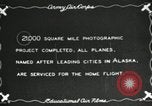
Members of the U.S. Army Air Corps 1934 Alaska Flight complete their photo-mapping mission and are ready to fly home
The U.S. Army Air Corps (USAAC) Alaska Flight of 1934. The YB-10 aircraft of the project after completing their photo-mapping of 21 thousand square miles of Alaska. The aircraft have each been named for leading Alaskan cities and are fueled and ready to fly home. View of the YB-10 flown by Expedition Commander, Lieutenant Colonel Henry Arnold, displaying painted name "City of Fairbanks" and flag containing stars of Big Dipper and Polaris (North Star). The symbol of the expedition is also painted on the fuselages of all the airplanes, consisting of a totem pole topped by an Eagle with two arrows, superimposed on a map of Alaska. Names: Anchorage, Fort Yukon, Tanana, and Kodiak, are seen painted on airplanes. Aviators of the USAAC Alaska Flight pose for a picture in front of a YB-10 aircraft. Lieutenant Colonel Henry Arnold, Commander of the expedition, is in the center of the first row of men. To his right, is a pipe-smoking officer in a campaign hat, holding a puppy Husky dog. Arnold pets the puppy
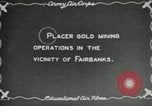
The Alaskan Flight crew visits a gold mine in operation near Fairbanks, Alaska.
(Soon after passage of the Gold Reserve Act in the United States, establishing a much higher price for gold): Alaskan scenes photographed by cameraman with the U.S. Army Air Corps' 1934 Alaska Flight. Placer mining for gold, near Fairbanks, Alaska. Heavy stream of water directed at edge if a stream, to wash away loose dirt and expose more stable layers of gravel, where gold may be found. Views of channels cut from the high pressure hose. A giant dredge that operates 24 hours a day, digging up riverbed to depth of 30 feet, sifting out heavier material (gold) and discharging the tailings behind, as it moves along. Closeup of the dredge. Steel buckets connected to a conveyer, being raised in the process. A pet black bear cub playing in a tub of water and later, in a tree. Two Bear cubs playing in a tree.