


 Francais
 Deutsch
 Italiano
Refine Your Search
+"France" +1915 stock footage and images
- Showing 7 to 12 of 38 results more
more Hide
Hide
British ship Patagonia is sunk by the German U-Boat, UB-7, during World War I
Opening slates indicate how seriously Britain views the German U-Boat campaign against Allied shipping in World War 1. Captain Wilhelm Werner of German U-Boat, UB7, is seen on deck with his officers consulting navigation charts. Their navigator sights the sun with a sextant to determine their latitude. Slate tells of their sinking of the British Steamer, "Patagonia." View of the Patagonia, stopped, in the Atlantic, and then listing and sinking. (This occurred on September 15, 1915, in the Atlantic ocean, off the coast of France.) Change of scene shows a crewmember of the UB-7 next to the conning tower, putting on his boots as a wave washes over his feet. Another slate about the seriousness of the U-Boat operations. (World War i; World War 1; WWI; WW1)

Newspaper headlines relating to World War I.
View of picture of 1908 McLauglin-Buick and 1915 sedan auto. Map of Europe with German Iron Cross superimposed. Newspapers running off presses. Headline on paper reading, 'Arch Duke Assassinated.' Headline reading, 'Germany Declares War; All Europe is in Arms.' Headline reading, 'Germany Invades France', superimposed over German troops marching in background. Headline, 'French Resist at Marne.' Headline, 'Lusitania Sunk' with picture of the ship. Newspaper presses running. Printer reading paper with headlines 'U.S. Declares War.' Paper reading, 'U.S. At War.' Headline, 'U.S. Troops Land in France.' Billboard sign, 'Beat Back the Hun With Liberty Bonds' superimposed over picture of troops marching in background. Ships under construction. Destroyer underway.
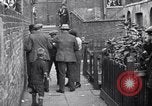
Events that initiated World War I and animated map showing involvement of nations from 1914 through 1918
Opening scene shows a man being roughed up by a group of men in an alleyway with pushing and shoving as they fight. A slate comments (in French) that when nations are bellicose, an assassination can cause a world war. Next, a slate shows picture of the world and states (in English) "One murder may start a world war." Another slate (in French) states that In 1914, while Europe's armies and fleets were more powerful than they had ever been, the nephew of the Emperor of Austria (Archduke Ferdinand) was assassinated. A front page is shown of newspaper, "Journal De Geneve" carrying the story. Next scene is a view of the city of Sarajevo. The ancient Emperor's Mosque dominates the scene. A slate appears asking Where is Sarajevo? It is followed by a map of Europe in 1914, which zooms in on Austria and Serbia and identifies and labels Sarajevo,in Austria, close to the Serbian border. Slates (in French) says Austria accused Serbia of War and other nations enter the melee. Animated World map shows the nations getting involved, starting with the German Empire in 1914, including its African colonies, and then successively showing Russia, France, Belgium,Great Britain, Japan, and the Ottoman Empire. Map advances to 1915, showing the Italian empire, Bulgaria,and Central Arabia. In 1916 it adds Portugal, Roumania. Next, the U.S.A. is added in, 1917, along with Central and South America, Greece, Siam, and China. Finally, the slate shows the war ending in 1918. Slate shows Armistice Day, the 11th hour of the 11th day of the 11th Month (November), with time shown on hands of Big Ben in London.
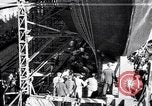
Launch of the French Cruiser, "Languedoc," replacing the "Leon Cambetta," during World War I
Launching of the new French Cruiser, "Languedoc," to replace the "Leon Cambetta," torpedoed during World War 1, by the Austrian submarine U-5, on April 26, 1915, in the Adriatic Sea. Shipyard workers in unison, knock out supports holding the new ship in place, and she slides down the ways into the water. (WWI; WW1)

Effects of World War I in Poland and France. Scenes from before war and during war in Polish countryside and in French villages
Turkish peasants (refugees) en-route to Greece during World War 1. Destroyed homes in Germany. Devastated plains of Poland. Pre war scenes of Poland showing farm fields in snow. Polish peasant civilians flee an area due to war. They walk across a snow covered field towing a sled with a woman on the sledge. A group of Polish children stand together with English children outside a simple hut in the snow. The boys and girls smile. Pre-war scenes of France: View of a French village from high on a hill side overlooking the valley, town, and farmland. Scene from French village streets in the 1910s, before World War 1, with people shopping in busy food markets and market square area. A woman selling grapes at a stand holds up the grape bunches and smiles for the camera. French children and adults seen shopping in the market. Buyers inspect wares being held in wicker baskets by French women. Contrasting view of war torn France shows barren land with all trees destroyed, wrecked and destroyed towns and villages caused by battles in World War 1.
French Cavalry in new uniforms, in France, during World War I
French regiment of cavalry in new uniforms. They rides their horses on a road in France. ( World War 1; WWI; WW1)