


 Francais
 Deutsch
 Italiano
Refine Your Search
+"France" +1917 stock footage and images
- Showing 25 to 30 of 218 results more
more Hide
Hide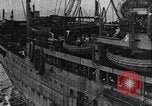
Soldiers march on streets holding rifles during World War I and veterans return to farming and dairying in United States.
A United States troop transport ship at sea during the first World War. U.S. Army troops (aka dough boys) aboard the ship. U.S. Army soldiers march in formation in a large city square area in Europe (likely France) holding rifles during World War 1. United States troop ships being loaded with American soldiers for World War I, and scenes of U.S. troops in WWI marching in the streets of a European city. Scenes from earlier during combat in the war. World War I allied soldiers on battle front in France. Soldiers run to a bomb crater area for shelter when crossing no man's land. Soldiers fire artillery. Artillery shells explode. Allied soldiers running across a battlefield as tanks run beside them toward the German enemy. People wave U.S. flags as First World War war ends with Armistice. Large crowd gathers in New York celebrating WWI armistice. Newspaper held high by a man with headline "Germany Surrenders". Views in the United States of hard times in American towns after World War I ended and war industries were no longer providing money. View of forests. Girl draws water from a well. Man and a boy operate a grindstone sharpening a saw. Farmers plowing fields with horse drawn plows during great depression era. People do agricultural works at fields. White farmer tilling a field. African American farmers working in fields and harvesting hay with help of a horse. African American farmers at cotton office. Cattle in field. Man and a woman milk cows with hands. Man pours milk in vessels. Milk processing before bottling including pouring milk through a cooling device. Men on tractor at fields. A board reads 'For the common defense'. Views of a factory. A man operates a switch on a switchboard for generating electricity. Views of a power generation plant. Narrator describes how America will prevent a slide into hard financial times again after World War 2 ends. From a 1942 production with footage from 1917 through 1942.
America mobilizes for World War I and confronts demobilization afterwards
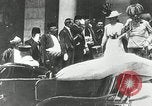
Opening scene shows Austrian Archduke Franz Ferdinand and his wife, Sophie, Duchess of Hohenberg. Newspaper swirls into the image, with headline announcing their assassinations. Glimpse of railways guns firing. View of a ship's bow as it sinks beneath the ocean, is covered by newspaper headline announcing the sinking of the RMS Lusitania, by a German submarine. U.S. President Woodrow Wilson at his desk. Newspaper headline reads: "U.S. Declares War !!" U.S. soldiers marching in Washington, DC, with U.S. Capitol building in background. Newspaper announces: "Yanks are Coming!" American General John Pershing on horseback leading a contingent of the American Expeditionary Forces (AEF). American troops going "over the top" (charging out of their trenches) in France during World War 1. Troops firing French 75 artillery pieces at point blank range. A formation of Allied Airco (de Havilland) DH9 aircraft in flight. Bombs bursting near trenches on the front lines. Renault FT-17 tanks accompanying American infantry on the Western Front. Persons playing roles as employees in the Department of Labor when they served as the War Labor Administration in World War 1. Women in the War Labor Administration working with long paper rolls of personnel records. Women in various war effort endeavors including airplane and arms manufacturing. Men working in a wartime steel plant. Marchers and a band demonstrating for the rights of workers to organize. People celebrating the at the end of World War 1, by gathering in the streets, throwing tickertape, dancing in the streets and waving effigies of the Kaiser. Stern view of the U.S. Army Transport Ship, President Grant filled with American soldiers returning from France at the end of the war. Lettering on stern reads, "U.S.A.T. President Grant" (The ship, AP-29, was originally the German ocean liner Konig Wilhelm II, and seized from Germany on 6 April 1917.) Views of United States soldiers returning home, disembarking, and assembling on a wharf home on American soil. Department of Labor persons assisting returning soldiers and prospective employers. Views of workers on farms, and in factories.
America embraces marksmanship training after Spanish-American War. American troops fire weapons in World War I
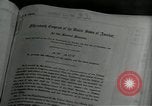
The uses and importance of weapons since ancient times in the United States. Pages showing U.S Congress Act creating the National Bureau for the Promotion of Rifle Practice, 1903. Exteriors of the 71st Regiment National Guard Armory building in New York City at Park Avenue and 33rd Street. People enter the building. German troops on parade circa 1914. American troops mobilized for World War 1, and traveling on troop trains in 1918. Troops moving along a muddy road, with military supplies in wagons being pulled by horses. American soldiers firing their 1903 Springfield rifles, from a bunker in France. Americans firing a M1914 Hotchkiss air-cooled machine gun and another U.S. gun crew firing a Browning M1917 water-cooled machine gun. U.S. troops wearing gas masks, firing a trench mortar. American gun crew firing a 155mm howitzer (as some hold their ears).French troops walk past destroyed buildings above which a blimp is seen flying with French observers in a gondola suspended underneath.
Events that initiated World War I and animated map showing involvement of nations from 1914 through 1918
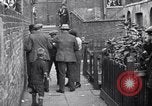
Opening scene shows a man being roughed up by a group of men in an alleyway with pushing and shoving as they fight. A slate comments (in French) that when nations are bellicose, an assassination can cause a world war. Next, a slate shows picture of the world and states (in English) "One murder may start a world war." Another slate (in French) states that In 1914, while Europe's armies and fleets were more powerful than they had ever been, the nephew of the Emperor of Austria (Archduke Ferdinand) was assassinated. A front page is shown of newspaper, "Journal De Geneve" carrying the story. Next scene is a view of the city of Sarajevo. The ancient Emperor's Mosque dominates the scene. A slate appears asking Where is Sarajevo? It is followed by a map of Europe in 1914, which zooms in on Austria and Serbia and identifies and labels Sarajevo,in Austria, close to the Serbian border. Slates (in French) says Austria accused Serbia of War and other nations enter the melee. Animated World map shows the nations getting involved, starting with the German Empire in 1914, including its African colonies, and then successively showing Russia, France, Belgium,Great Britain, Japan, and the Ottoman Empire. Map advances to 1915, showing the Italian empire, Bulgaria,and Central Arabia. In 1916 it adds Portugal, Roumania. Next, the U.S.A. is added in, 1917, along with Central and South America, Greece, Siam, and China. Finally, the slate shows the war ending in 1918. Slate shows Armistice Day, the 11th hour of the 11th day of the 11th Month (November), with time shown on hands of Big Ben in London.

World War 2 film promoting public investment in War Bonds and stamps to aid the war effort and temper inflation
World War 2 era film that also includes some World War 1 scenes. Show girls or chorus girls in follies-like show, costumed as U.S. silver dollars and marching to tune and lyrics alluding to dramatic increase of currency in circulation, over the years. Animation with stacks of coins shows increase in national income from $46 billion,in 1933, to $71 billion, in 1939, and $142 billion in 1943. Back to the "follies dollars," a boy asks why, and then scenes of the Japanese attack on Pearl Harbor,are shown, with U.S. battleships being sunk. Wartime arms plants are shown. An M2A3 Light Tank rolls off a production line. Ships being constructed in a shipyard. B-24 Liberator bombers being built in a factory. Artillery shells being produced. Defense workers receiving their pay. The "follies dollars" group themselves to illustrate the fractions of income devoted to taxes and savings. But other spending is curtailed by wartime shortages. A woman talking with clerk in a drug store. U.S. Army troops crossing a pontoon bridge in open trucks, towing 75mm M1A1 howitzers. Infantry on the march. Animation showing industrial production devoted to war materiel and lots of dollars chasing few civilian goods. A grocery clerk offers to sell a woman customer butter for more than the established price, and she agrees. The "follies" performers then introduce the idea of an "inflationary dollar," and some history of past U.S. inflations. Animated examples of price inflation are shown. Glimpses of World War I scenes are seen, circa 1917 -1918, including: a 12-inch railway gun firing; a huge explosion from shell bursting near the camera; various scenes of United States infantry soldiers and French soldiers in battle action, running to bomb craters for cover and emerging from trenches to go up "over the top" into no-mans land during combat. Meanwhile, singing narration refers to the home front inflation due to competition for limited civilian goods. Map shows Europe and singing narration cites rising prices for food in occupied France and other countries suffering ravages of World War II. Montage of scenes showing needy civilians obtaining food in those countries. Animation shows increases, by 1944, in cost of U.S. civilian goods since the Pearl Harbor attack. "Follies" character called "Double-duty dollar," appears explaining he serves the war and curtails inflation on the home front by being saved through investments in War Bonds and stamps.
America enters World War I against Germany
A ship blows up at sea (presumably torpedoed by a German submarine). Newspaper of April 2, 1917 announces the United States and Germany at War. U.S. Secretary of War, Newton D. Baker, speaking on a public platform, outdoors.. General John J. Pershing, Commander of American Expeditionary Forces in World War 1, is seen seated behind Secretary Newton. Scene shifts to U.S. President Woodrow Wilson signing papers his his desk at the White House, Washington, DC. Next, Red Cross women are seen serving coffee into the mess of American soldiers about to embark for Europe. Another Red Cross woman carries a basket of baked goods. The soldiers are checked off by officers at the pier, and then embark on a troop ship. View of the troop ship in camouflage paint, moving away from the pier Scene shifts to glimpse of a town in France, where an American officer and some soldiers are seen walking past French inhabitants on a street corner Other American soldiers stand near a large canvas covered army truck. They salute as the American officer passes them.