


 Francais
 Deutsch
 Italiano
Refine Your Search
+"France" +1918 stock footage and images
- Showing 775 to 780 of 1022 results more
more Hide
Hide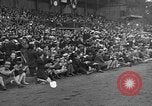
French military hold a track event in a stadium in France, with some American participation, in World War I
French civilian spectators fill a grandstand and ground in front of it to watch a French military track meet (with some American participation) during World War 1. Longer distance runners are cheered by some spectators as they cross the finish line, one by one, in front of the grandstand. contestants run a shorter race with a close finish. The winner is congratulated by a French military officer. Scene shifts to closeup of Lieutenant Paul Rene Fonk, French Air Ace credited with over 59 enemy planes. He stands in center of stadium, being recognized by the crowd. An American officer is seen standing behind him. Next, a large group of youths perform calisthentics in unison for the crowd. Lieutenant Leonard, of the U.S. Air Service (in athletic garb) converses with Lieutenant Fonk. Other athletes, another U.S. flyer, and a French civilian official stand with them. As they move away, Lieutenant Fonk and other French officers remain to confer with the French civilian official. Another race is seen, next, as runners come past in single file around the track.
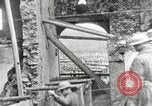
U.S. troops of the AEF entrenched in France during World War I.
U.S. troops of the American Expeditionary Forces (AEF) on their way to the front lines during World War 1. They descend a stairway beneath damaged bridge and proceed through a town. One soldier slogs into a trench filled with debris, mud, and water. Then more troops work to clear it of mud. One soldier smoking a cigar as he reads a letter from home. He has some care packages at his feet in brown paper wrapping. A view across No Man's Land, where Germans hold a hill nearby. U.S. soldier uses a periscope to look at the area. Closeup of the soldier and periscope. Other views of the U.S. troops in the trenches. One using a pair of binoculars. View of the German-held hill across No Man's Land. Barbed wire and obstacles outside the trench. Army cooks working at a field kitchen under camouflage nets. A cook stirs soup, stew, or a hot drink in large vats of a portable, wheeled kitchen. (World War I; World War 1; WWI; WW1)
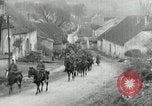
U.S. artillerymen of the AEF passing through a town in France on the way to the front in World War I
U.S. troops of the American Expeditionary Forces (AEF) passing through a French town on their war to the front during World War 1. Mounted Artillerymen accompany horse-drawn caissons and artillery pieces. View through archway of town building shows canvas covered Army wagons moving through the town.Teachers and school children watch as the American troops pass on a roadway.Closeup of the children waving at the soldiers. The artillerymen passing through a village. (World War I; World War 1; WWI; WW1)
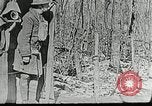
U.S. soldiers under gas attack in France during World War I
A U.S. soldier of the American Expeditionary Forces (AEF) standing near a hut, hears a gas alarm and dons his gas mask. View of a U.S. camp with huts. The soldiers assemble in response the the alarm and all don gas masks. They run up a hill. View from a trench, at a tree, line of gas shells exploding in a field. Soldiers crawling across the trench. Gas drifting across the tree line and soldiers walking through the area. Camera pans across the wooded area, showing the tops of most trees blown away and many trunks laying on the ground. Two couriers carrying messages run through the drifting gas. Scene shifts to a field hospital dug into a hillside. Several soldiers sit on benches. Two medical corpsmen carry a wounded soldier out of the hospital, on a stretcher. (World War I; World War 1; WWI; WW1)
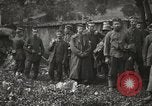
German prisoners of war under the guard of American soldiers and officers at a stockade in France during World War 1
U.S. soldiers during the Grand Offensive on the Western Front during World War I. Prisoners of war, mostly German, in a stockade. Close-up views of German prisoners of war. Buildings in the background. Medics, soldiers and officers standing. Carts passing across a field in the background.
Arrival of Indochinese colonial troops in France (WW1)
Map showing French territories around the world. Map of “Indo-Chine” (Indochina) showing Tonkin, Laos, Cambodia. A French colonial soldier from Indochina stands beside a statue. Indochinese soldiers and volunteers wearing conical Nón lá hats on board a ship arriving at a French port during World War I. Indochinese troops disembark at a French port. The colonial troops leave the port carrying their supplies and rifles.