


 Francais
 Deutsch
 Italiano
Refine Your Search
+"France" +1939 stock footage and images
- Showing 13 to 18 of 77 results more
more Hide
Hide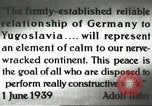
Tripartite Pact signed by Germany, Italy and Japan in Berlin, Germany. Ensuing attacks by Germany and Japan in World War II
This film is a scattering montage of World War 2 scenes from 1939 through 1945. Part of an agreement between Nazi Germany and Yugoslavia is shown in English. It is dated June 1, 1939 and ostensibly signed by Adolf Hitler. Next, German Ju 87, Stuka dive bomber aircraft are shown peeling off from formation, on April 6, 1941, to attack Yugoslavia. Bombs bursting on the ground. Closeup of a Stuka airplane in a dive, making its characteristic whine, and dropping bombs. Bombs exploding just outside some concrete walls. German infantry running along railroad tracks and entering backyard of house in a village. German soldiers observing from overlooking hill; climbing over rubble; and marching along a road toward a village. Animated map showing German invasion areas early in World War II, extending through most of Europe and into Norway, by 1941. Animated map shows further invasions into France, Belgium, low countries, the Balkans, and Eastern front towards the Soviet Union. Map highlights Tokyo, Rome, and Berlin. Delegations walking in hall of Reich Chancellery in Berlin, to sign Tripartite pact, on September 27, 1940. The group is led by by Count Galeazzo Ciano (Italian Foreign Minister, and Mussolini's son-in-law); Joachim von Ribbentrop, Germany's Foreign Minister and Japan’s Ambassador Saburō Kurusu. The diplomats are seen, next, standing near a table as Adolf Hitler enters rendering Nazi salute. He shakes hands with Count Ciano and Ambassador Kurusu. Hitler is seated to watch the proceedings. Von Ribbontrop is seen signing for Germany. Next scenes show German armored units heading East in Operation Barbarossa (June of 1941). A sign identifies the town of Eydtkau (Eydtkuhnen) on the German-Lithuanian border. German armor and artillery moving eastward. German troops destroying international crossing barriers. German troops firing siege guns. Montage with glimpses of German battle scenes showing tanks, guns, rockets in action with attendant explosions, fires, and destruction. Formations of German warplanes in flight, including Junkers Ju-52s that carry troops, including paratroops. View from above of Junkers Ju-87 Stuka dive bombers in formation. Battle of Britain scenes, with view of St. Paul's Cathedral in London, England (which miraculously survived the Blitz). The Tower Bridge in London, seen through a haze following blitzkrieg. German Junkers 87 Stuka dive bombers peeling off from formation to attack. British anti-aircraft searchlights shining beams skyward. Diving bombers illuminated by the lights. Anti-aircraft guns firing. Nighttime scenes showing gunfire flashes, explosions, tracer bullets and fires in London. British fire brigades fighting fires in London buildings as some collapse from the German bombing during the so-called "Blitz." Scene shifts to Pearl Harbor, December 7, 1941, as a Japanese bomb explodes on a U.S. Navy warship. The USS Arizona billowing smoke and listing as it succumbs to Japanese bombing. Another view of the Arizona sinking. Smoke rising from Battleship Row, at Pearl Harbor. Glimpse of postwar Nuremberg trial.
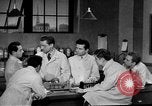
U.S. Anti-Fascist propaganda film during World War 2 depicts Axis leaders and Allied forces fighting in both World War 1 and World War 2.
Mix of actual footage and scenes with actors. Professor in laboratory extolling virtues of international research and researchers, in science and medicine. Voice-over with German accent speaks about inferior peoples and the scenes darken. Images of Nazi, Fascist, Japanese leaders and their followers including Fuhrer Adolf Hitler, Pierre Laval, Oswald Moseley, Fritz Kuhn, Japanese Emperor Hirohito, Rudolf Hess (or Heß), Julius Streicher, Joseph Goebbels, Heinrich Himmler and Benito Mussolini. Footage from World War I era shows rubble from bombing in French cities and towns, and French citizen refugees leaving homes with hand pulled wagon carts. German Kaiser Wilhelm II descends steps and reviews cheering German Army forces in 1914. French poster calls for military mobilization. Mobilized French soldiers march in France as citizens cheer them off to war. Explosions of shells on World War 1 battlefield. French "taxicab army" of French military vehicle line leaving Paris. Battles of Verdun and Chemin des Dames showing French artillery and French soldiers. David Lloyd George confers with Clemenceau. Close ups of General Foch and then of General Joffre. Armament factory in France manufacturing arms in World War 1. British battle scenes at Passchendale and Ypres. Scenes of U.S. battles at Chateau Thierry, the Argonne. U.S. Marines battling at Balleau Wood and Cantigny. Lloyd George greets citizens in England. Close up of British General Haig. American General John J Pershing greets French Generals in World War I. U.S. President Woodrow Wilson is shown. World War II era events: Adolf Hitler addressing a crowd. Brownshirt SA soldiers and other German Army soldiers march and goosestep. Remilitarized Germany invades Poland in 1939, and then France in 1940. Hermann Goering reviews marching troops. Elevated, overhead view of German troops marching with hands raised in Nazi salute, and shadows of their salutes are cast on the ground in front of them as they march. Close up side view of Hitler giving Nazi salute to cheering troops. German artillery and railroad guns fired and tanks advance during invasion of France. French Army soldiers fighting the invading German soldiers; French soldiers fire artillery. French civilian women and children refugees flee in carts as Luftwaffe aircraft fire guns and strafe their path.
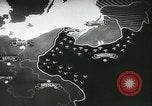
British officials meet in England as Adolf Hitler prepares his troops in Germany during World War II.
The first phase of German assault on France and the Low Countries during World War II. Animated maps illustrate Czechoslovakia and Poland defenses against Germany, and the East Prussian Corridor. Civilians including children flee war violence. German troops and tanks parade. England: UK Prime Minister Neville Chamberlain addresses a gathering. Britain's Foreign Secretary Lord Halifax (Edward Fredrick Lindley Wood, 1st Earl of Halifax), Winston Churchill, Leon Blum, and other officials. Germany: Hitler arrives at the Reichstag in Berlin. He addresses the Nazi officers and officials. A sign for the custom border district at Kreis. Bullet ridden walls and bomb damaged buildings. German troops load and fire artillery. German Panzer tank units invade Poland in 1939. Hitler looks through an artillery periscope. Black smoke rises due to numerous explosions.
The invasion of Poland, Dunkirk evacuation, Second Armistice, and London Blitz during World War II.
'50 Years of Cinematography' depicts the role of military and news cameramen during World War II. Germany starts the War. Invasion of Poland in 1939: German Nazi Luftwaffe bombers in flight over Warsaw. Explosions due to the bombardment. Burning and damaged buildings in the war torn city. Civilians amidst rubble and ruins. Soldiers and civilians look at corpses on a sidewalk. A woman with her child cries. A man walks on a street. Dunkirk Evacuation in 1940: Allied troops evacuated from the Dunkirk coast. Allied troops on ships. Smoke rises from a ship under German attack. Soldiers wade through the water towards waiting ships. Burning ships. The Second Armistice at Compiegne after the German victory in the Battle of France, 1940: German troops stand at attention. German Fuhrer Adolf Hitler, President of the Reichstag Hermann Goering, German Field Marshal Wilhelm Keitel and other German officers arrive at the venue. The leaders and officers walk past the soldiers at attention. Hitler gives the Nazi salute. The Blitz, London in 1940-1941: Bomb damaged buildings. Cars and pedestrians amidst ruins and rubble on the streets. A train over a collapsed wall. Civilians in a horse cart. A wrecked bus in a damaged building. Rescue workers among the rubble. Clouds over the city.
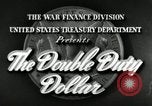
World War 2 film promoting public investment in War Bonds and stamps to aid the war effort and temper inflation
World War 2 era film that also includes some World War 1 scenes. Show girls or chorus girls in follies-like show, costumed as U.S. silver dollars and marching to tune and lyrics alluding to dramatic increase of currency in circulation, over the years. Animation with stacks of coins shows increase in national income from $46 billion,in 1933, to $71 billion, in 1939, and $142 billion in 1943. Back to the "follies dollars," a boy asks why, and then scenes of the Japanese attack on Pearl Harbor,are shown, with U.S. battleships being sunk. Wartime arms plants are shown. An M2A3 Light Tank rolls off a production line. Ships being constructed in a shipyard. B-24 Liberator bombers being built in a factory. Artillery shells being produced. Defense workers receiving their pay. The "follies dollars" group themselves to illustrate the fractions of income devoted to taxes and savings. But other spending is curtailed by wartime shortages. A woman talking with clerk in a drug store. U.S. Army troops crossing a pontoon bridge in open trucks, towing 75mm M1A1 howitzers. Infantry on the march. Animation showing industrial production devoted to war materiel and lots of dollars chasing few civilian goods. A grocery clerk offers to sell a woman customer butter for more than the established price, and she agrees. The "follies" performers then introduce the idea of an "inflationary dollar," and some history of past U.S. inflations. Animated examples of price inflation are shown. Glimpses of World War I scenes are seen, circa 1917 -1918, including: a 12-inch railway gun firing; a huge explosion from shell bursting near the camera; various scenes of United States infantry soldiers and French soldiers in battle action, running to bomb craters for cover and emerging from trenches to go up "over the top" into no-mans land during combat. Meanwhile, singing narration refers to the home front inflation due to competition for limited civilian goods. Map shows Europe and singing narration cites rising prices for food in occupied France and other countries suffering ravages of World War II. Montage of scenes showing needy civilians obtaining food in those countries. Animation shows increases, by 1944, in cost of U.S. civilian goods since the Pearl Harbor attack. "Follies" character called "Double-duty dollar," appears explaining he serves the war and curtails inflation on the home front by being saved through investments in War Bonds and stamps.
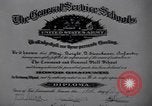
The military career of General Dwight D Eisenhower from 1926 to World War II
Film starts showing Dwight D. Eisenhower's diploma as honor graduate of the Army Command and Staff School, in 1926. Image of Major Eisenhower (in civilian clothes) Narrator says he was assigned to France, to prepare a guide book on American battlefields in Europe. Image of Eisenhower as a member of General Douglas MacArthur's staff in the Philippines, where MacArthur was Commander-in-Chief of the Philippine army. Glimpse of headquarters building there. MacArthur in his office helping the Commonwealth of Philippines work out a plan for its military defense. Image of Lieutenant Colonel Eisenhower in 1939, serving as Executive Officer of the 15th Regiment, at Fort Lewis, Washington, View of the Regiment's Headquarters building. Scene shifts to 1940, showing German forces invading Holland and Belgium. German tanks are seen in action. German Junkers 87 Stuka dive bombers and Heinkel 111 bombers drop bombs. After passing of the Selective Service draft act, President Franklin D. Roosevelt is seen at a public ceremony on October 29, 1940, where Secretary of War Henry L. Stimson drew from a bowl the capsule containing the first draft number of World War 2. Views of Lt. Col. Eisenhower as Chief of Staff of the Army 3rd Division and later as Chief of Staff of the Ninth Corps. Next, he is seen as Chief of Staff to General Walter Kreuger, who in 1941 led the Third Army in the most realistic maneuvers held by American troops (The Louisiana maneuvers). Views of American troops engaged in those maneuvers. Image of Eisenhower as a Brigadier General. Views of the Pearl Harbor bombing during Japanese attack on December 7, 1941.