


 Francais
 Deutsch
 Italiano
Refine Your Search
+"France" +1944 stock footage and images
- Showing 139 to 144 of 1897 results more
more Hide
Hide
Captain Don M. Beerbower, 353rd Fighter Squadron, and his P-51,
U.S. Army Air Forces 354th Fighter Group in Normandy. Ground crew run to pull camouflage from P-51 at advance air strip Criqueville (A-2) in Normandy during World War 2. The P-51 prop turns,engine starts, and it taxis forward. The name "Bonnie B II" is painted on the fuselage, and 17 swastikas are painted below the cockpit. A Mustang is painted on the tail. It's serial number is 43-12375. The aircraft stops. The name, Captain Don M. Beerbower,is painted below the cockpit. He stands up and climbs out of the airplane, wearing his oxygen mask and helmet. Scene shifts to a loudspeaker in a control facility.A soldier is seen talking on the radio in a plexiglassed enclosure. A flight of P-51s approaches the field. They break off and proceed to buzz the field. (Note concerning Captain Beerbower,of Hill City, Minnesota, seen in this clip. He served as acting Commander of the 353rd Fighter Squadron and was later promoted to Major. He was Commander of the 353rd Fighter Squadron when killed in action, by ground fire while flying his P-51, Bonnie B II, leading an attack on a German airfield near Reims, France, on August 9, 1944. His decorations included: the DSC, Silver Star,DFC (3), Air Medal (26), British DFC, Purple Heart, Distinguished Unit Citation and Campaign Medals.)

German forces resist and counter attack in Caen region during Normandy invasion in World War II
Film opens showing destruction being inflicted on city of Caen, France, from fighting between the British Second Army and German Panzergruppe West for control of the city and vicinity, during the World War 2 Battle of Normandy in June, 1944. Walls of a building collapse from shell fire. Refugees, flee the city carrying belongings in cart. Numerous destroyed buildings seen in the background. Retreating German soldiers are seen, most carrying M42 machine guns. Next, German troops, assembled for a counter offensive, are lined up informally and briefed by an officer. Their helmets are covered in netting. Closeups of some, one shouldering an M42 machine gun, and a junior officer briefing them. A Tiger I tank rolls along a dirt road towards the camera. This is followed by a DW19 Katzchen APC, another Tiger I tank, a motorcycle, and several heavily camouflaged half tracks, and a tracked APC. A Panzer tank and another Tiger I continue the column. Closeup of a bearded junior officer, who is then seen from short distance walking a bicycle past a column of smiling troops. Some soldiers shouldering M 42 machine guns as they walk past a field of grain. Others in column carry small arms. One carries a panzerfaust anti tank weapon. Glimpse of soldier placing foliage into netting of his steel helmet. German soldiers begin running as shelling and gunfire from American Army forces are heard. They seek cover at side of a berm as a shell explodes nearby. Soldiers lying prone as shells burst all around them. Some German soldiers smoke cigarettes as barrage abates. German officer communication by field telephone. German Self-propelled gun (8.8cm Pak43 Geshtzwagen III Sd.Kfz.164) moves into firing position at a tree line. Gun crew includes one tending large supply of shells. Closeup of shells stacked in the vehicle. Gun commander signals and crew fires the gun. Other guns also firing from the tree line. Officer looks through binoculars. A knocked out U.S. Army Sherman tank. German soldiers moving quickly and cautiously along the side of a road. One hunkers down over the body of a dead German soldier. Brief view, between a building and a tree,of a Sherman tank passing in the background. German troops, carrying antitank weapons (Panzerschreck and Panzerfaust), moving among damaged buildings. A Sherman tank passes in background. Soldier fires a Panzerschreck which explodes. Sherman tanks continue to pass on dirt road in background. German soldiers rush to a damaged Sherman tank. German soldier throws a hand grenade. A dead American soldier is seen in the turret. German soldiers release an unmanned, remote-controlled Goliath Tracked Mine, or Leichter Ladungsträger Goliath, also known as a "beetle tank" to Allied forces (or German robot tank). Watching from tree line, German soldiers see an explosion across the field. Closeup of destroyed Sherman tank. German officer signals for soldiers to follow him. A German soldier, carrying a Schmeisser Mp40 submachine gun, points to a dead American soldier lying beside the road. Views of the site as soldier examines it. Camera focuses on a small round hole in the earth. Scene shift entirely to American soldiers at side of a road. They examine a spot where a trenching tool and some soldier's gear is seen. Scene changes showing knocked out armor atop a hill. Closeup of a knocked out German Tiger I tank, with American soldier looking out through a lower porthole. Closeup of American soldier with foliage topped helmet and belt of machine gun ammunition around his neck. Closing scenes show ambulatory wounded German army prisoners, including some assisting others, as they proceed away from the battleground.
D-Day invasion of Normandy during World War II.
Allied Invasion of Normandy, France during World War 2. British Armstrong Whitworth Whitley bomber in flight. Allied paratroopers of 6th British,and American 101st and 82nd Airborne Divisions jumping from aircraft. Allied troops in gliders being towed across the English Channel. A British pilot in cockpit of aircraft towing a glider. Several gliders descending over French farm fields.Formations of Martin B-26 bombers overhead. Allied Navy warships underway. Scenes on decks of the warships. Navy heavy guns being loaded and fired from Battleships and cruisers. American B-26s and British Armstrong Whitworth Whitley bombers in flight overhead. British spitfire fighter aircraft overhead. U.S. B-26 in D-day stripes. Bombs exploding on German enemy targets. Navy ships bombarding shore. Allied infantry descending rope nets from troop ships. B-17 bombers aloft.Gunner in a B-17. British warship in camouflage bombarding French coast. British spitfire zooming low over landing craft. Allied American and British soldiers in landing craft going ashore at several different Normandy beaches. London, with streets quiet, in early morning, June 6, 1944. Journalists assemble at British Ministry, and a U.S. Army Colonel tells them the invasion at Normandy is underway. The reporters run from the room to file their stories. People reading about it in their newspapers in various cities of the world.
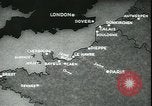
German forces fire at Allied vessels. Battle of Villers-Bocage in World War II
German soldiers in France during the Battle of Villers-Bocage of World War 2. A pictorial map showing cities along French coastline. A German soldier looking through binoculars. Allied ships at sea. German soldiers prepare artillery and fire. Smoke rising from explosions. German soldiers beside artillery. Smoke rising from Allied vessels at sea. Explosions on land and smoke rising. Two German soldiers talking. A wrecked landing craft at a beach. Debris of wreckage spread on the beach. A bomb wrecked U.S. LST (Landing Ship, Tank) on the beach and armored vehicles aboard the ship. Vehicles moving along a road. recked British Cromwell tanks and M3 Halftracks along the side of a road. A German soldier beside a damaged tank. Wide shot of a Stuart light tank. A damaged signboard which reads 'Villers Bocage'. Damaged buildings on the street of Villers-Bocage and a wrecked Tiger tank beside the buildings. Debris strewn on the ground and a damaged tank among the debris. A damaged tank with its front part into a building. A British helmet in the debris on a Cromwell tank. (Note: During this battle, On June 13th, 1944, German tank commander, Michael Wittmann, in a single Panzerkampfwagen VI Tiger tank reportedly destroyed up to 14 tanks and 15 personnel carriers along with 2 anti-tank guns. Many were of the British 22nd Armored Brigade of the 7th Armored Division, AKA the 'Desert Rats'.)
General Omar Bradley with other generals, United States soldiers before the start of Operation Cobra (WW2)
United States General Omar Bradley emerges from a bunker with other generals in Normandy during World War 2. United States generals walking as a group, with General Bradley speaking with General Eisenhower. Television host Alexander Scourby says with regard to Operation Cobra, “No plan in war is fool-proof. But this one is bold, and if it worked it would enable the Allies to break the stalemate in which they have become bogged down”. “Brittany was still the eventual goal” says Alexander Scourby as he points to the region of Brittany in France on the map. United States troops resting and doing chores during their free time. A soldier gets a haircut. A young soldier reads a letter. A soldier doing laundry using a washboard and metal tub. A soldier polishes his leather boots. Soldier cleaning a spot from his uniform. A United States soldier wearing a bowler hat reads a newspaper. Daily News headline reads “OWN OFFICERS BOMB HITLER; PURGE STARTS” after the 20 July plot to assassinate Hitler in 1944. German Chancellor Adolf Hitler speaks to a crowd at rally. A group of German military troops, with an officer wearing the Iron Cross, convene for a meeting in a forest. A German soldier with machine gun rounds slung over his shoulders smoking a cigarette. German soldiers smoke cigarettes while resting. Shirtless German soldiers digging a trench. German soldier spreads butter on bread. A German soldier drinks water from a bucket. A group of German troops, with close ups showing tired faces. United States General Omar Bradley shakes hands with another officer before boarding a Jeep. Soldiers sitting beside a hedgerow. United States soldiers sitting in a ditch next to a hedgerow and smoking. A soldier holds a pocket watch. A soldier lights up another’s cigarette. A formation of B-17 flying fortress bombers in flight. Close view of bombs dropping towards ground. Aerial view of explosions on ground. A German soldier uses binoculars. A tank on the field. Soldiers creep up beside hedgerow. Soldiers hiding while wearing camouflage. German commander commands troops to fire. German soldiers firing artillery. German soldier puts shell into artillery. Artillery fires behind shrubs. General Omar Bradley observes battle from afar. General Omar Bradley listens to Major General J. Lawton Collins, who is describing how the city of Cherbourg was taken. German armored vehicles covered in camouflage driving. German half-tracks moving.
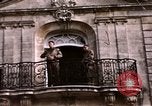
U.S. Army officers and war correspondents at the bombed, abandoned French Chateau de Pont-Rilly during World War II after D-Day
Uniformed U.S. war correspondents and U.S. Army officers explore the house and grounds of the French Chateau de Pont-Rilly, in Négreville near Normandy France, soon after the Invasion of Europe. (The chateau was designed in 1765 by architect Pierre-Raphaël de Lozon for the Marquis d'Ourville). U.S. Army officers in the balcony of the mansion overlooking the entrance. Exteriors of the palatial chateau. A large bomb hole is visible in the roof, right of the main entrance. A French boy points out something distant on the grounds of the Chateau. A swan in a pond. Exteriors of the mansion. At the end of July 1944, near the time this footage was shot, the chateau became the headquarters of Advance Section of Com Z, also known as "ADSEC" (Advance Section, Communications Zone).