


 Francais
 Deutsch
 Italiano
Refine Your Search
+"France" +1944 stock footage and images
- Showing 175 to 180 of 1897 results more
more Hide
Hide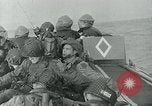
U.S. Army troops wade ashore from landing craft during D-Day invasion of Normandy in World War II
U.S. soldiers in a landing craft approaching Omaha Beach, Normandy, on D-Day, June 6, 1944, in World War II. Support ship firing rockets in background. Barrage Balloon overhead in distance. smoke rising from hillside and many troops already on the shore. View from beach as U.S. troops wade from landing craft and make their way around numerous steel obstacles placed on the beach. Two soldiers felled by German gunfire. U.S. troops of the 16th Infantry Regiment sheltering by an overhanging ledge of chalk cliff at the edge of the beach. Warships and landing craft offshore. View from base of protecting chalk cliff as more troops wade ashore. Troops huddled at base of cliff, some still wearing personal flotation gear. They begin to dig in. Soldiers preparing explosives. View from cliff base of fallen soldiers at waters edge and damaged landing craft in the water. Distant view of bodies of some U.S. soldiers floating in surf at edge of beach.
The Allied invasion of Normandy on D-day, during World War II
U.S. Army Air Forces C-47 aircraft painted in D-Day stripes, seen taking off at nightfall on June 5, 1944, carrying Airborne troopers from a base in England, during World War 2. Large formations of U.S. B-17 bombers en route to targets in Europe. Clusters of indendiary bombs falling from a U.S. bomber. View from a bomber of explosions on the ground from bombing at a coastline. Allied paratroopers fill the sky with their parachutes as they jump from formations of C-47 transport aircraft. Thirty minutes before the amphibious assaults at Normandy, Allied warships bombard the shore with heavy naval guns. Troops leave their transport ships and board small landing craft (Higgins boats). Soldiers try to stabilize the rope nets for others climbing down, as their small craft pitch in choppy seas. The boats speed away from their transport ships, and head toward the shore. Smoke rising from the shore where naval shelling has caused explosions and fire. Troops from landing craft of the USS, Samuel Chase (APA-26), wade ashore under enemy machine gun fire, at "Fox Green" section of Omaha Beach. They are far away from the beach itself, because of steel and concrete obstacles placed by the Germans, and relatively low tide.
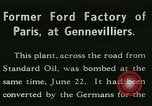
The Ford factory at Gennevilliers used by the Germans bombed during World War II.
Results of air assaults by the British Royal and U.S. Eighth Air Forces over industrial areas in and around German-occupied Paris during Wolrd War II. The former Ford factory at Gennevilliers used by the Germans for military vehicles production and maintenance, bombed on June 22, 1944. The aerial attack destroyed an estimated 50% of the factory. Allied officers inspect the bombed factory. Damaged structures, tanks, machinery and war equipment inside the factory.
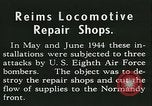
Damaged locomotives and repair installation at the Reims locomotive repair shops after Allied bombings during World War II.
Results of air assaults by the British Royal and U.S. Eighth Air Forces over industrial areas around German-occupied Paris during Wolrd War II. The Reims locomotive repair shops attacked by the U.S. Eghth Air Force in May-June 1944. Allied soldiers and workers on tracks inside the repair shops. Damaged locomotives. Wrecked turntables and repair installations lie partially buried in debris. Men near an overturned locomotive on tracks. They survey the damage. Damaged equipment and material.
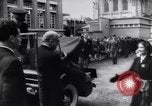
Renaming of Paris Street in honor of Général Philippe Leclerc de Hautclocque
French official arrives by car to officiate at ribbon-cutting ceremony renaming the Avenue d'Orleans as Avenue du General Leclerc, in honor of Général Philippe Leclerc de Hautclocque, who formally liberated Paris, entering along this street, at the head of his French 2nd Armored Division, in 1944. The French official is greeted by a young woman wearing a sash. Members of the French 2nd Armored Division are seen holding unit flags. The official unveils the new street sign on the corner of a building decorated with tricolor bunting. A member of the French 2nd Armored Divison poses on top of a sherman tank, parked in the square. The official cuts a ribbon..
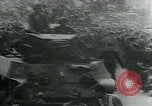
Gunfire from pockets of German resistance cause panic among Parisians near the Notre Dame cathedral after Free French General Philippe Leclerc's 2nd Armored Division enters Paris during World War II.
Opening scene shows crowds of Parisians surrounding tanks of Free French General Philippe Leclerc's 2nd Armored Division and elements of the U.S. 4th Infantry Division enter Paris, on August 25, 1944, during World War 2. General Charles de Gaulle is seen with French officials in the crowd during liberation of Paris. A Free French soldier speaks to a tank driver and points to the source of some lingering German resistance gunfire. The crowds drop to the ground as gunfire erupts. A French tank fires its gun at a building harboring the German resistance elements. Some persons take shelter behind jeeps. People scramble for shelter in the courtyard of the Notre Dame cathedral. Smoke rising from targeted buildings. People lying down en masse on the ground as gunfire continues.