


 Francais
 Deutsch
 Italiano
Refine Your Search
+"France" +1944 stock footage and images
- Showing 259 to 264 of 1897 results more
more Hide
Hide
Fragmentation and incendiary bombs are dropped over an airfield outside Caen, France (WW2)
Allied bombers drop bombs near Caen, France during World War II. Consolidated B-24 Liberator bombers of the United States Eighth Air Force in flight, passing over surface vessels bound for France six days after D-day. Aerial view of a French city, bombed by another group. Pillar of smoke rises up from the bombed city. Moving engine propeller of a bomber. small fragmentation and incendiary bombs are released over French airfield and railroad bridges outside Caen. Aerial view of Norman countryside. Craters from bombs are seen in aerial view.
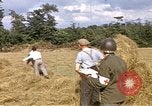
Farmers work in a field in France while U.S. artillery is fired at German positions during World War II
U.S. troops in France soon after the Allied Invasion of Europe, in World War 2. An American Army medic in a field. French Farmers stack hay with hay forks. Hay stacks on the field. Big U.S. artillery gun camouflaged in the same field. The artillery fires at German positions while the farmers continue moving hay, uninterrupted.
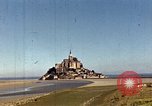
American troops and war correspondents at Mont Saint Michel and Saint Malo in France during World War II
American troops and war correspondents in France, during World War 2. They visit Mont Saint Michel, a small rocky island at the mouth of Couesnon River in Normandy, separating Normandy and Brittany. View of the island with a monastery at the top. War correspondent Robert Capa (of Life and of Time Magazines) looks on and takes pictures. Military jeeps leave the island. Madam Poulard stands under a sign at her Hotel Poulard. Sign for the Hotel and its reputed omelette. Soldiers on the street. Shops and French flags. GIs at the Benedictine Abbey and steepled church. An old French man points. U.S. Soldiers take a tour of the monastery with a woman guide. Steeples, towers, arches and other architectural features of the abbey and monastery. War correspondents including Charles Collingwood, Chicago Daily News' Helen Kirkpatrick, New Yorker Magazine's Joe Liebling (Abbot Joseph Liebling) and Warden Becker. Helen and Charles pose for the camera. Ernest Hemingway, covering for Colliers Magazine, drinks and talks to Bill Walton. War correspondents including Bill Stringer seated and walking on the street. They visit the monastery and take pictures. Civilians on the streets. Tall sticks in sand placed by German forces around the island to prevent Allied planes from landing at low tide. Three war orphan brothers whose parents were killed at the battle of St Lo, play on the beach as their grandmother looks on. Views of the island and patterns on the sand around the island from the receding waters of low tide. St. Malo, Brittany: Field near Saint Malo. American soldiers bathe and swim in a lake. They fool around in the water, taking a break from battle.
Damage caused during World War II and German prisoners at a prison camp in France.
Damage caused during the war between Allied forces and the German troops in France. Wrecked vehicles, artillery and other equipment. Wounded German soldiers. Soldiers carry wounded on a stretcher. German prisoners emerge single and then in small groups. German prisoners at a prison camp built by them for the French. The prisoners sit, stand and talk. A soldier talks to a man. Soldiers talk to a boy who was made a slave after his parents were killed by the Nazis in Ukraine. Prisoners eat and drink.
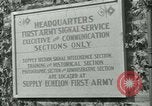
Messages are encoded and decoded at the First Army Signal Service Headquarters in France during World War II.
The First Army Signal Service Headquarters, Executive and Communication Section in France during World War 2. A soldier takes a message from the check post at the entrance. He delivers the dispatch message to the 'Master Message Center'. View of an American cipher machine ( SIGABA or Converter M-134 or ECM Mark II, akin to a German enigma machine) used to encipher or encrypt the message. Another soldier decodes the incoming messages and encodes the outgoing messages using an automatic code machine. Soldiers operate teletypes, wirelesses, telephones and radios at the Headquarters. Officers near telephone carrier equipment that provides 7 channels in all and has 2 ground simplex circuits. A messenger plane lands near the Headquarters. The pilot hands over a map to the messenger. The map is cleared through the Message Center, sent by facsimile to Intelligence. Officers then forward the information to the artillery. The designated target area on the map. Soldiers fire artillery and shell the target area.
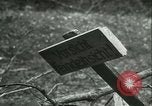
German panzer division soldiers use flamethrowers during night fighting and attack Allied crafts on the coast of France.
German troops advance to target Allied landings in France during World War II. A damaged sign post reads 'Caution. Enemy in Sight!'. German Army panzer division troops advance under cover of artillery fire. Soldiers take cover. German stick grenaded or stick hand grenades (Stielhandgranate) on the ground near soldiers in a wooded area. Soldier readies a Panzerfaust weapon. Explosions on the battlefield. Wrecked Allied tanks and vehicles on the road. Soldiers load shells and fire artillery. Camouflaged artillery fired. Soldiers in the undergrowth. Soldiers greet each other and talk. German Panzer tanks advance. Black smoke due to explosions. Soldiers use small arms and flamethrowers during night fighting. Scene changes to coast, with view of Allied ships and craft seen off shore from German Atlantic Wall fortifications. German soldiers behind defense lines and fortifications on the beach. Smoke rising from ships off shore. A German officer inside a fortification bunker surveys the beach and ships at sea using binoculars.