


 Francais
 Deutsch
 Italiano
Refine Your Search
+"France" +1944 stock footage and images
- Showing 37 to 42 of 1897 results more
more Hide
Hide
U.S. B-24 aircraft drop bombs on Bicy airfield in Orleans, France during World War II.
Allied air attacks against France during World War II. A map of France shows the location of Orleans. Aerial view of bombs being released by U.S. Army 8th Air Forces B-24 Liberator aircraft. The bombs drop and strike Bicy airfield, Orleans, France, on May 23, 1944. Billows of smoke rise from the airfield. Bombs being dropped on revetments. Smoke and fire occur.
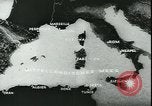
Views of Southern France, under German occupation in World War 2
Film opens with map showing lower France and Mediterranean areas. However, it shows images covering primarily the French Riviera (or Côte d'Azur) under German occupation during World War II, in 1943 or 1944. German infantry march along a road. A flight of German FW-190 Fighter airplanes flies inland from the Mediterranean Sea and crosses low above a harbor. Change of scene shows a single fighter plane buzzing the Marseille Port. (It looks like a P-47 with invasion stripes. But It does not draw any anti-aircraft fire.) Camera tracks it from vantage point at the Marseille Basilica, high above the harbor. Brief view of the Basilica as the aircraft passes. A glimpse of the Marseille Port below from the Basilica. View of the Marseille Transporter Bridge designed by Ferdinand Arnodin and built in 1905. (It was destroyed after these films were made, in 1944.) A German soldier peering through binoculars in front of a 2 cm Flak 30/38/Flakvierling, quad anti-aircraft gun position. Another one is seen in the background. Several more views of German anti-aircraft and other gun emplacements protecting the Marseille Port, including 88mm guns, heavy machine guns, and Atlantic Wall coastal defense guns. Scene shifts to German soldiers marching near the French Riviera beach and palm trees. Italian cavalry are seen riding in formation, ostensibly from Nice. Italian soldiers in trucks are being transported along the Riviera waterfront. A road sign points toward Toulon at 6.3 kilometers away. (So this location is probably near Sanary-sur-Mer.) View of the Toulon harbor, where the French battleship Provence, scuttled in 1942, is seen settled low in the water at a pier.
U.S. war correspondents and 101st Airborne Division mingle with citizens of a coastal French town after Allied Invasion of France in World War 2
U.S. war correspondents traveling with the 101st Airborne shortly after the Invasion of France by Allied forces in the summer of 1944. Allied officers aboard a ship. Soldiers on a beach of coastal France. Town buildings rising up from the shore. A French woman holds a cat. A war correspondent and a soldier from the 101st Airborne look at pictures and smile. Town buildings along a street of a coastal French town. A barbed wire fence with a beach in the background. A Red Cross flag on an American jeep. Massive seawall fortifications separating the beach and the coastal French town. Children play, walking on the sea wall and playing in the sand of the beach. Allied soldiers confer inside a tent. Ships on the coastline. An American flag aboard a ship.
Allied troops invade and advance in France during World War II.
Allied invasion of France during World War II. 4,000 Allied ships underway at sea towards the Cherbourg peninsula. Allied soldiers move down a net onto landing crafts on D-Day, June 6, 1944. Allied planes bombard the area and Naval artillery fires heavily. Scenes of various Allied Soldiers landing at Normandy beaches, including U.S. Army forces and British and Canadian forces. (Canadian forces landing at Juno Beach.) Troops wade through water. German assault from gun emplacements kills Allied soldiers during landing. Dead U.S. Army soldiers on the beach. Wounded soldiers provided medical aid by. German Prisoners of War marched away. A french man carries a U.S. flag near a group of U.S. soldiers at the "BERNIERES" station in the town of Bernières. Allied aircraft drop bombs over bridges and explosions occur. Heavier military equipment moved in by Allies. Allied troops advance in various towns of France. Captured German equipment piled up high. Supreme Commander General Eisenhower visits the area and is seen together with General Bradley and British Field Marshal Montgomery.
Consolidated B-24 Liberator bombers dropping bombs during an aerial raid of Mulhouse, France (WW2)
Allied bombers bombard railways in Mulhouse, France a month before the Normandy invasion (World War 2). Animated map shows the location of Mulhouse, near the Franco-German-Swiss border. Bombers flying to Mulhouse. United States Consolidated B-24 Liberator heavy bombers in flight. Lockheed P-38 Lightning, Republic P-47 Thunderbolt and North American P-51 Mustang fighters escort the heavy bombers while flying over France. A German fighter aircraft is shot down by a P-47 as seen from a distance. A German pilot is very faintly seen parachuting after ejecting from fighter. Two United States fighters fly away. Aerial view of Mulhouse, Belfort, and surrounding communes. Bombs dropping over Mulhouse and its freight yard. Pillars of smoke rise from Mulhouse. Another aerial raid to Mulhouse took place on May 25, 1944, two weeks after the initial raid. Aerial view of bombs dropping over Mulhouse. Thick clouds of smoke forms over Mulhouse freight yards. A formation of Consolidated B-24 Liberator bombers in flight.
Montage of scenes related to role of 101st and 82nd Airborne Divisions and 9th Troop Carrier Command before D-day, World War II
U.S. soldiers wade ashore at Omaha Fox Green Beach on D-Day, from landing craft of USS Samuel Chase (APA 25). during the Invasion of France. Preparations for invasion underway in an idyllic village in England, United Kingdom on June 5, 1944. U.S. Army Air Force C-47 aircraft towing a Waco CG-4 glider over shelters made of wooden shipping containers. "Shanty Town" written atop one tall structure. Glider being pulled out a shipping container. Soldiers moving into empty shipping container. Glimpse of their homemade barrack. Soldiers eating a meal inside a shipping container shelter. Soldiers at barber shop. German defenses of the Atlantic Wall on the French coast. German Army gun crews drilling. German rail gun. Animated map of German fortifications of the Atlantic Wall. Allied officers, including U.S. Major General Lewis Hyde Brereton, Commander, 9th Air Force and British Air Marshal Arthur Coningham, Commander, 2nd Tactical Air Force, in D-day planning. Airborne troops board buses and arrive at restricted airfields. Troops playing musical instruments in jazz band; exercising on field; and playing volleyball. Paratroopers reading mail. Airmen painting invasion stripes for D-day on C-47 aircraft. French francs issued to paratroopers. Soldiers sharpen knives and bayonets. Chaplains conduct religious services. General Dwight D. Eisenhower visiting 101st Airborne troopers. Airborne Pathfinders. Paratroopers march to C-47s, and put on parachute packs. Troopers of the 101st Airborne, 506th Parachute Infantry Regiment, Headquarters Company Demolition Section ("Filthy 13") in their Mohawk Indian haircuts. Clarence Ware puts war paint on Charles Plaudo, using still-wet paint from their C-47's D-day stripes. Heavily laden paratrooper help one another board airplanes. Pathfinder C-47s taking off at dusk, followed by all others, on June 5, 1944. formations of C-47s. Closeup of several planes. Paratroopers exiting C-47s. Formation of towed gliders. Gliders landing in field. Troops from gliders engaging in fire fights. Naval gun barrage.