


 Francais
 Deutsch
 Italiano
Refine Your Search
+"France" +1945 stock footage and images
- Showing 19 to 24 of 324 results more
more Hide
Hide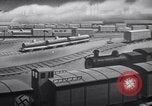
Allied bombing missions to destroy railroads and marshaling yards in occupied France and Germany during World War II
Cartoon representation of German rail yards and war factories, opens the film. Cities of : Anklam; Bremen; and Frankfurt are highlighted as critical factory and railroad junctions. Animated map shows Allied air strikes against French marshaling yards in Spring of 1944 in preparation for the invasion at Normandy. In February, 1945 Allied officers use large wall map to discuss and plan the destruction of all railroad operations in the Ruhr and surrounding areas. View of U.S. bombers in formation (with fighter cover overhead) on bombing missions in Operation Clarion, against all small and medium rail junctions in Germany. View from Allied bomber of Bombs falling and exploding at a rail junction. More aerial views of bombs exploding in numerous places during this operation. An American B-17 Flying Fortress bomber dropping bombs on a railroad marshaling yard. Aerial view of bombs exploding on targets in Essen. Views of wide destruction wrought at German railroad facilities. A US Army Air Forces P-51 fighter plane descending to strafe a target. Gun camera views of aircraft strafing lines of communication in Germany, including road and barge traffic. Closeup of runs firing from P-51 aircraft. Railroad trains being strafed and dramatic explosions at target rail sites.
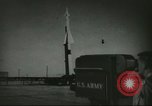
Atomic bomb scenes WWII; atomic testing at U.S. Army atomic experiment station 'Camp Desert Rock' in Nevada, United States
Episode of "The Big Picture", a U.S. Army series of news release programs. U.S. Army cameraman recording Nike missile launch. Atomic cannon fires shell creating atomic explosion and classic mushroom cloud.. Army troops spill out of Sikorsky YH-19 helicopters. U.S. Army infantry soldiers ascend hill firing their rifles. Atomic experiments at Camp Desert Rock in Nevada, United States. U.S. Army Master Sergeant Stuart Queen seated at a desk in his office. He speaks about a series of atomic experiments ("Desert Rock 6") held in barren lands of Nevada at Camp Desert Rock. Celebrating victory in Europe, during World War 2, American troops parade down the Champs Elysees in Paris, France, with the Arc de Triomphe behind them. Happy Parisians watch the parade. War scenes in Japan: footage of explosion and mushroom cloud rising after atomic bomb blast over Nagasaki on August 9, 1945. Barren land on the ground in Hiroshima after the August 6, 1945 atomic blast there . B-29 bombers in flight. Atomic bomb test detonation. Atomic artillery gun M65, also called the Atomic Cannon or Atomic Annie, fires and creates nuclear explosion on distant target.Viking missile launch. U.S. soldiers on parade. Headquarters sign at U.S. Army atomic experiment station at Camp Desert Rock, Nevada, displaying 6-pointed star with "A" in center.. Several atomic test explosions. Soldiers on hillside witness a non-nuclear explosion. Buses carry troops along a road past a sign warning of radiation hazard. Army captain, instructor, briefing troops before the start of atomic maneuvers.. Maps of planned maneuvers. Engineer surveyors lay out ground zero target. View of the ground zero area which is the target area for testing. Signal men lay communication lines to receive and transmit teletype messages. Men operate machinery and dig trenches in which troops will take cover. Other men cover them with sand. [Note: According to the U.S. Department of State, Office of the Historian, from February 18 to May 15, 1955, the United States conducted Operation Teapot, a nuclear test series at Yucca Flat and Frenchman Flat on the Nevada Test Site in the continental United States. During the test period 14 nuclear shots and 1 non-nuclear shot were detonated. Several thousand scientific, military (army, air force, navy, marines), and civilian contract personnel participated in the organization, planning, and execution of the test series. Military exercises undertaken during and following the shots took place under the name Desert Rock 6.]
1st Allied Airborne Army troops take off from a field in the European Theater during Operation Varsity of World War II.
A film titled 'First Allied Airborne Army in Operation Varsity, 24 March 1945' about the successful airborne crossing of the Rhine river by the 1st Allied Airborne troops during World War II. Aerial views of aircraft and gliders on ground in areas the narrator describes as East Anglia (England, United Kingdom) and in the Paris, France area. U.S. Army Air Forces C-46, C-47 aircraft and CG-4 gliders on a field. British Halifax and Sterling bomber aircraft. A glider with nose art name, "Texarkana Belle." U.S. Army soldiers of the U.S. 17th Airborne Division near the glider aircraft. Soldiers load equipment into gliders and aircraft. Jeeps, vehicles and other equipment loaded onto gliders. Airborne troops waiting near the aircraft, smoking cigarettes and talking as they await takeoff time. Aircraft lined up on a field. Troops put on gear and board the gliders and towing C-47 Skytrain aircraft. Propellers turn as towing aircraft prepare to take off. Men ensure slack lines are taken up properly and engage the gliders being towed. Aircraft tow gliders as they take off. Gliders and aircraft in flight and ground crews waving to the aircraft in the sky.
U.S. Army soldiers guard German SS-Totenkopfverbände (SS-TV) prisoners of war being held near a village.
United States Army soldiers guarding a group of German SS prisoners of war who are being held near a village. Cameraman slate indicates location of "Wittring" (presumably Wittring France, just outside the German border, in the Moselle region), but U.S. government record accompanying the film indicates "Wittring, (?) Germany" (sic). A wheel cart is seen on the street. The German prisoners of war have SS markings on their right lapel and also the SS skull insignia on the cap, identifying them most likely as part of the SS-Totenkopfverbände or SS-TV; also called Death's Head units. (Theories on these captured soldiers include: 1) SS-TV units were primarily in charge of administering the Nazi Concentration Camps in World War II. Hinzert Concentration Camp was possibly the closest camp to Wittring. Perhaps these soldiers came from it or another camp; 2) They may have been part of the 3rd SS Panzer Division. Reportedly, whole platoons and elements of the 3rd SS Panzer division were not following orders and were giving up prior to the Budapest and Vienna battles to avoid Soviet captivity, as early as Jan 1945). Prisoners rub their hands to warm them in the cold. Camera shows a close-up view of one of the prisoners, as an American soldier attaches a Prisoner of War identification tag over around the neck of the prisoner.
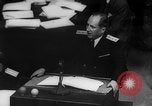
View of the Nazi Concentration Camps and its victims, and other atrocities committed by Nazi forces in World War 2.
Images and testimony related to the Nuremberg Trials held at the Palace of Justice in Nuremberg, Germany in October 1946. Flashbacks of a variety of Nazi crimes against humanity during the years of World War II. Reference to testimony of Kenaris and Hans Frank in describing Nazi policies and methods for exterminating Poles and others. Pictures recording the implementation and results of Nazi policies; atrocities and murder of victims in Ouradour Sur Glane in France, in Bande in Belgium, in the Catacombe of San Callisto in Italy and in Czechoslovakia. Nazi German soldiers seen leveling and destroying the town of Lidice in Czechoslovakia in 1942, after massacre of many residents, in retaliation for the assassination of SS Reich Protector Reinhard Heydrich. Corpses of the victims of the Nazi concentration camps, including Auschwitz, in 1945. Bones of humans in crematory ovens. Cramped starved women camp victims inside barracks. Stacks of luggage and suitcases of victims at a concentration camp, along with locks of hair, stacks of toothbrushes. Shaving cream brushes, shoes, clothing, and finally, piles of bones of camp victims. Testimony of Rudolf Franz Ferdinand Höss (sometimes spelled Höß or Hoess or Hess) describes concentration camps at Auschwitz in Poland. As scenes of victims in hospitals are shown, testimony of Rudolf Hoess is read, describing medical experiments include lowering the body temperature, injecting the body with poisons and infectious diseases and subjecting the body to high altitude pressure chambers. Shows pile of mutilated corpses.The "Arbeit Macht Frei" sign over the camp entrance of Auschwitz. Scenes of dead victims of Nazi brutality in the concentration camps.
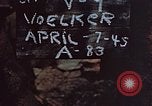
Activities of U.S.airmen in 323rd Bomb Group, at Denain Airbase (A-83) near end of World War II.
A number of Martin B-26 Marauder aircraft of 323rd Bombardment Group (9th Air Force) are lined up for takeoff. As they taxi past camera, tail number of one: 43-34344, is visible. All aircraft display the distinctive White Tail identifying the 323rd BG. (The Group is known to some as Wood's Rocket Raiders, so-named for their Commanding Officer, Lieutenant Colonel Wilson r. Wood.) The location is Denain Airfield (A-83), near the City of Valenciennes, France. The time is April, 7,1945, a month before VE Day. Several airmen are pitching horseshoes, while others watch. They use a shoe to measure how close one came to the pin. Two airment use a two-man saw to saw a timber while a third sits on it to hold it still.