


 Francais
 Deutsch
 Italiano
Refine Your Search
+"France." +1917 stock footage and images
- Showing 199 to 204 of 218 results more
more Hide
Hide
Several aircraft used for observation and other missions during World War I
French airplanes used for observation in World War 1. A twin engine Caudron airplane parked, with engines running, on a grass field. A Sopwith two-place 1-1/2 strutter airplane with Scarff ring-mounting for Lewis gun in rear cockpit. Tail number P I-A2 visible on rudder which is being moved by an aviator in the cockpit. Another person stands next to the aircraft, which is parked in front of a hangar. Next scene show ground crewman turning propeller on a Salmson 2 airplane parked in front of a hangar. Closeup of the airplane with engine running and two aviators on board. Closeup of the aircraft engine.
French military flying students receive basic instruction about flight controls in World War I
Student pilots gather around as French military instructor in World War 1. He shows basic controls to student in cockpit of a non-flyable training airframe. The instructor stands on a permanent ladder affixed to the fuselage and wing. The student moves the flight controls as the instructor tells him. A metal sign hangs on the fuselage warning students to perform acrobatic maneuvers safely. (WWI. WW1)
French Navy hydro-aeroplanes (flying boats and float planes) in World War I
During World War 1, a French naval aviator climbs into the hull of a Franco-British Aviation Type H flying boat, marked F.B.A. #8. Another crew member is already aboard and the engine is running. They taxi out in the water and take off in the aircraft. As they taxi for takeoff, a Breguet 14H float plane lands in background. Aerial views from the airborne F.B.A. Type H, showing boats in the water below. Next are seen two voisin 3 float planes taxiing slowly in water. A Viosin 3 float plane taxis rapidly up onto a wooden ramp. (WWI. WW1)
French troops return to Home Base, while others proceed to the front, during World War I
French Regiment marches into its home garrison town, returning from the battlefields, during World War 1. People walk along with the soldiers. Houses on the street side. The Regiment is assembled on a field, as local citizens watch. Upon order from their Commanding Officer, the soldiers afix their bayonets to their rifles and come to attention. Officer salutes the soldiers. Elsewhere, French troops proceed toward the front, in armored cars and trucks, passing through a town with some war-damaged buildings. .
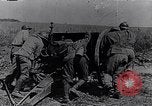
French gunners setup, load, and rapid-fire a 75mm artillery piece, during World War I.
French artillerymen push a 75mm artillery piece ("French 75") into position, during World War 1. They open bundles of shells. They dig earth to provide level area for the artillery piece. Then they commence to load and fire the gun with many shells in rapid succession.
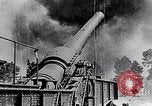
Allied heavy artillery firing during World War I battle
French forces fire a 370mm railway howitzer during World War I. The recoil moves the train backwards several feet. British fire 60 pounders and 9.2 inch howitzers. British occupying and entrenching in area formerly held by German troops. Bodies of dead German soldiers are seen in various places.