


 Francais
 Deutsch
 Italiano
Refine Your Search
+"Gardelegen Germany" +1945 stock footage and images
- Showing 1 to 6 of 7 results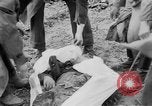
German Civilians wrap dead bodies in shrouds and place them in individual graves during a mass burial in Gardelegen, Germany.
A mass burial in Gardelegen, Germany during World War II, for victims of the Gardelegen massacre. German civilians wrap dead bodies in shrouds and place them in individual graves. They pour dirt in the graves with shovels. Burned barn building in background.. They are burying concentration camp and slave laborer victims of nazi atrocities who died after being locked in the barn that was then set on fire, in Gardelegen, Germany, on April 13, 1945. The atrocity was discovered by the U.S. Army 102nd Infantry Division on April 14, which directed the German civilians to properly bury the victims from April 21-25, 1945.
Civilians place burned bodies of Gardelegen massacre victims on stretchers and carry them to burial grounds in Gardelegen, Germany.
Mass burial at the site of the Gardelegen massacre, in Gardelegen, Germany, late in World War II. View of the barn on the Isenschnibbe estate in Gardelegen where 1016 prisoners had been barricaded by Nazi forces and civilian accomplices on April 13, 1945, and then died after the barn was set on fire. German civilians walking among dead bodies outside the barn. Germany civilians walk carrying stretchers. They place burned bodies of Nazi atrocity victims on the stretchers. They carry the bodies to burial grounds. (Many of the dead were concentration camp prisoners and slave laborers in transit from the Mittelbau-Dora Concentration Camp and the Hannover-Stöcken Concentration Camp. The massacre was discovered by the U.S. Army 102nd Infantry Division when they entered the area on April 14, 1945, finding corpses in the barn and in nearby hastily dug mass graves. The U.S. Army ordered German civilians in the area to transport the bodies and dig graves for proper burial, from April 21-25, 1945.)
German civilians dig graves and bury Nazi atrocity victims in Gardelegen, Germany.
German civilians forced by U.S. Army soldiers in World War 2 to dig mass graves for Nazi atrocity victims of the Gardelegen Massacre, in Gardelegen, Germany. Bodies of slave laborer political prisoners on the ground, including Russians, Poles, and French, many of whom had come from the Mittelbau-Dora Concentration Camp and the Hannover-Stöcken Concentration Camp . A large barn in the background on the Isenschnibbe estate, showing evidence of fire damage, where many victims were found by the U.S. Army 102nd Infantry Division on April 14, 1945, after having been locked in the barn which was then set on fire on April 13, 1945. German civilians uncover nearby existing hastily dug mass graves containing piled victims. Dead bodies placed in new graves and covered with dirt. Civilians under U.S. Army direction dig long, mass grave trenches to bury the dead.
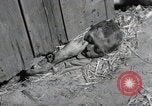
Mutilated and burned bodies of Nazi prisoners, including Russians, Poles and French at a barn in Gardelegen, Germany.
Aftermath of the Gardelegen Massacre: German civilians dig grave for Nazi atrocity victims in Gardelegen, Germany. Mutilated and burned bodies of one thousand political deportee prisoners, including Russians, Poles and French, in and around a large barn. United States Army Infantry troops view and inspect the bodies, and supervise German civilians being forced to dig mass graves for the victims, who had been transported to the barn from the Mittelbau-Dora Concentration Camp and the Hannover-Stöcken Concentration Camp during World War 2.
Victims of the holocaust being liberated and receiving medical aid at Nazi German concentration camps
Evidence of holocaust atrocities in Germany near end of World War 2 in Europe. German civilians in Gardelegen Germany carrying crosses for 1,100 fresh graves for victims of the holocaust at Gardelegen. The German citizens walking on the streets carrying the crosses. Buildings in view. Scenes from various liberated concentration camps in Germany. A crowd around a liberated concentration camp building. The Allied army soldiers enter a gate of a camp. Soldiers enter through gates of several different camps with sign "Arbeit Macht Frei" on Dachau Concentration Camp gate. Scenes of happy liberated inmates at various camps. Two men walk in front of a crowd entering a liberated camp. Liberated concentration camp inmates in striped prison uniforms smile and some wave. Some of them appear to be very young men or older boys. Men cheering. U.S. Army soldier leans head out of watch tower and looks down on concentration camp field and barracks. Freed inmates around and on top of a concentration camp barracks building. Allied soldiers escort horse drawn wagon with potatoes in it through camp as inmates scramble to gather food. Starved man on a street scraping spilled food of some kind from the ground and eating it. Soldiers bring out body of liberated prisoners from barracks and dungeons. A soldier carries an injured person in a stretcher. Men carry emaciated and injured victims into a vehicle. A victim man lying on the ground. Physicians provide medical aid to victims of Auschwitz Concentration Camp. Doctors examine a man, a woman, and several starving child victims.
Liberated concentration camp victims receive medical aid; evidence of gross mistreatment and atrocities in concentration camps.
Citizens in Gardelegen Germany carry 1100 crosses for graves of Concentration camp victims at a camp near Gardelegen. Scenes from various concentration camps in Germany. A crowd around a liberated concentration camp building. Soldiers and officials enter through gates at numerous camps marked with "Arbeit Macht Frei" on gates. Liberated victims who are able smile and cheer. Liberated prisonsers grab food from a container. U.S. soldiers bring out bodies of gravely ill and emaciated men from barracks and torture areas Gaunt victims carried away in stretchers. A man carries an emaciated victim to a waiting vehicle. An injured man lying on the ground. Physicians examine physical torture evidence and provide medical aid to vicitims of Auschwitz Concentration Camp. Doctors examine a man, a woman, and several starving children and infant victims. (World War II period).