


 Francais
 Deutsch
 Italiano
Refine Your Search
+"Germany" +1916 stock footage and images
- Showing 7 to 12 of 26 results more
more Hide
Hide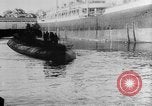
German Commercial merchant submarine Deutschland, departing New London, Connecticut following repairs from tugboat collision
Following repairs after it rammed the tugboat T.A. Scott Jr on November 16, the German merchant submarine "Deutschland" departs New London Connecticut, carrying silver bullion, for the voyage back to Germany, on November 21, 1916. At this time, it was a North German Lloyd Shipping Company merchant submarine evading the Entente Powers naval blockade of shipping lanes.
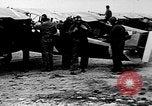
Recruiting and training American fliers for World War I. Support from President Wilson and Secretary of War, Newton Baker
In 1916,The Lafayette Escadrille, a group of American airmen who fought for France before American entry into World War I, with Indian chief's head in war paint and headdress painted on fuselage of their Nieuport aircraft. Newspaper headline reads 'United States and Germany at war'. in 1917, American civilian recruits responding to World War One: training with wooden guns, marching in uniform, and moulding practice bombs of plaster. Airmen train with real Lewis machine guns. Pilots who completed training are issued leather flying coats, helmets and goggles. Pilots make preflight checks by testing tautness of wing struts and cables. Crew takes off in a DH-4 airplane and drops practice bombs. Explosions on the ground. Pilots receive orders for advance training overseas. American troops march and drill. Supporter of airpower, Secretary of War, Newton Baker, speaking on podium, with General John J. Pershing sitting behind him. President Woodrow Wilson, another aviation supporter, signs a document at his desk. Red Cross women distribute refreshments to American troops as they deploy overseas. View of the Ocean Liner, SS Leviathan, converted to a troop ship, and camouflaged. American soldiers seen in French village square. View of Army barracks and muddy streets. Outdoor gunnery practice, using model airplanes. Experienced pilots demonstrating control stick techniques. Pilots taking off, in flight, and landing in Sopwith Camel airplanes. A nosed-over Sopwith Camel airplane with pilot unhurt, in cockpit.
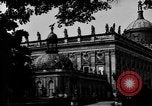
Neues Palais and Sanssouci Royal Park, Potsdam, Germany
The Neues Palais (Am Neuen Palais, 14469 Potsdam, Germany) in Potsdam, Germany. Exterior of the palace. Trees in the foreground of Sanssouci royal park. Exterior of Sanssouci Palace (Maulbeerallee, 14469 Potsdam, Germany) also located in the royal park.
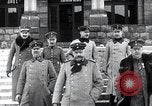
Marshal Paul Von Hindenburg with staff officers, Germany, during World War I
First pictures of Marshal Paul Von Hindenburg, the Iron man of Germany, during World War 1. Marshal Paul Von Hindenburg with staff officers descending steps of a government building in Germany. It is winter, with snow on the ground.
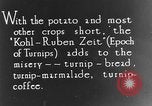
A German soldier eats bread with turnip marmalade in Germany during the epoch of turnips.
Slate notes heavy reliance on turnips for use in many foods while potatoes and other crops were in short supply in Germany during World War I. "Kohl-Ruben Zeit" (Epoch of Turnips): a German soldier eats bread with turnip marmalade. Two German officers standing beside a tree as the other soldier eats behind them, seated.
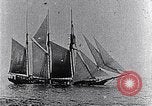
Germany undertakes U-boat campaign in North Sea and Atlantic Ocean to break Allied blockade in World War I
German World War 1 U-boat campaign accelerates in 1915. A three-masted schooner (the "Miss Morris Miss Morris, in route from Genoa to Malaga) slowly sinks in Mediterranean Sea after being attacked by the German submarine U-boat U-35. A German UB-III class submarine underway on the surface emitting smoke from a stack on the stern deck. A small one-stack merchantman sinking after U-boat attack. Slate refers to German food shortages due to allied blockade, and states U-boat warfare is Germany's answer. Another view of the German UB (coastal torpedo attack boat) submarine. Captain of a U-boat at his periscope. View from periscope of several Allied warships. A submarine slowly submerging to periscope depth. Naval guns in triple turrets of a British dreadnaught fire salvos. Explosion from depth charge raises large column of water. A torpedo leaving a bubble trail as it moves through the water. Starboard aft view of British battle cruiser underway. She has two turrets of heavy guns mounted on her aft deck and two smaller ones in sponsons on her aft starboard side. A British 4-stacker destroyer underway.