


 Francais
 Deutsch
 Italiano
Refine Your Search
+"Germany" +1917 stock footage and images
- Showing 25 to 30 of 57 results more
more Hide
Hide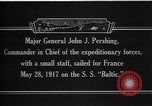
American Expeditionary Forces (AEF) arrive in France during World War I
The United States declares war against Germany during World War I. On May 28, 1917 Major General John J. Pershing, Chief of American Expeditionary Forces aboard the S.S. Baltic on its way to France during World War I. Nearly 2,000,000 American soldiers disembark at a port in France. The troops disembark from the ship. A ship at the harbor. Ships underway at sea. Sailors on the deck of a ship. A German U boat underway. Naval gun being fired at the U boat. Explosion occurs at sea. A man waves signal flags from a ship. The troops disembark from the ship. Soldiers at a rail road station and a train pulls up to carry them to the war front. (World War I; World War 1; WWI; WW1)
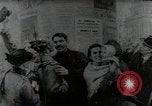
Nations in various stages of mobilization before and during World War I
Nations mobilizing for World War 1 (The Great War).from 1914 through 1917-18. Civilians in a Slavic country react to information fastened on a large circular post. Closeup of British Mark II tanks moving near the camera, followed by view of British Whippet tank in front of army trucks. Uniformed, armed, German troops assembling in a town square. German General Paul von Hindenburg leading members of his staff and a diplomat, on inspection of troops. A Russian officer on horseback with troops assembled in a city park. Unusual grouping of Military officers from Germany (wearing Picklehaube helmets); France; and Russia (including a Cossack), gathered in front of a Russian Orthodox Church (presumably somewhere in Russia) prior to World War 1. Anachronistic view of middle-aged Winston Churchill giving an address, before numerous microphones. U.S. Marines hurrying along a waterfront pier, past a variety of boats docked in a city marina. American soldiers looking at a U.S. Connecticut-class battleship docked at a pier, displaying a large American flag, during World War 1. Camera pans across the pier. Crew members seen on Japanese battleship, Settsu. Japanese troops disembarking from a transport ship covered with ice.
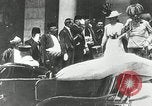
America mobilizes for World War I and confronts demobilization afterwards
Opening scene shows Austrian Archduke Franz Ferdinand and his wife, Sophie, Duchess of Hohenberg. Newspaper swirls into the image, with headline announcing their assassinations. Glimpse of railways guns firing. View of a ship's bow as it sinks beneath the ocean, is covered by newspaper headline announcing the sinking of the RMS Lusitania, by a German submarine. U.S. President Woodrow Wilson at his desk. Newspaper headline reads: "U.S. Declares War !!" U.S. soldiers marching in Washington, DC, with U.S. Capitol building in background. Newspaper announces: "Yanks are Coming!" American General John Pershing on horseback leading a contingent of the American Expeditionary Forces (AEF). American troops going "over the top" (charging out of their trenches) in France during World War 1. Troops firing French 75 artillery pieces at point blank range. A formation of Allied Airco (de Havilland) DH9 aircraft in flight. Bombs bursting near trenches on the front lines. Renault FT-17 tanks accompanying American infantry on the Western Front. Persons playing roles as employees in the Department of Labor when they served as the War Labor Administration in World War 1. Women in the War Labor Administration working with long paper rolls of personnel records. Women in various war effort endeavors including airplane and arms manufacturing. Men working in a wartime steel plant. Marchers and a band demonstrating for the rights of workers to organize. People celebrating the at the end of World War 1, by gathering in the streets, throwing tickertape, dancing in the streets and waving effigies of the Kaiser. Stern view of the U.S. Army Transport Ship, President Grant filled with American soldiers returning from France at the end of the war. Lettering on stern reads, "U.S.A.T. President Grant" (The ship, AP-29, was originally the German ocean liner Konig Wilhelm II, and seized from Germany on 6 April 1917.) Views of United States soldiers returning home, disembarking, and assembling on a wharf home on American soil. Department of Labor persons assisting returning soldiers and prospective employers. Views of workers on farms, and in factories.
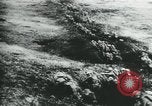
Numerous scenes showing evolution of mechanized warfare emphasizing World War I. but including footage as late as 1934
Montage of scenes illustrating development of mechanized warfare beginning with American Expeditionary Forces (AEF) engaged in World War I. U.S. Army infantry soldiers moving out of trenches going "over the top" into "no man's land" and advancing on battlefield. U.S. troops firing Browning M1917 machine gun,1903 Springfield rifles, and Stokes mortar from trench positions. Soldiers firing mortar are wearing gas masks. AEF trucks and other vehicles ostensibly an improvement over horses, but seen having difficulty in mud. A truck pulling a large artillery gun. A German 80cm K (E) rail gun (developed in 1934) shown at the Rugenwalde Test Range in Germany. It moves along curving rails and is elevated to its maximum elevation (65 degrees). Two World War 1 rail guns firing. An American World War I Naval 14-inch rail gun firing. Allied heavy howitzers firing in World War 1 (one with gun crew in gas masks). American gunners with a French 75 field piece and caisson. French soldier advancing in no-mans-land. The Wright brothers brought warfare into the air with their Wright Flyer airplane, seen being maneuvered on the ground by U.S. Army personnel at Fort Myer, Virginia in July 1909. A De Havilland DH-4 airplane taking off in World War I. A German Fokker D.VIII aircraft in flight. Three U.S. Army Air Service Curtiss P-1B Hawk pursuit aircraft in flight, circa 1926. Aerial dogfight scene including view from behind a pilot in open cockpit biplane (from feature film, circa 1927). Brief view of Renault FT tank maneuvering in World War I. Narrative and clips shift to historical perspective of warfare, showing use of horse and chariot, starting in ancient Assyria and use of elephants in later years by Hannibal. Pictures of mounted soldiers, in the middle ages, waging war in armor, and being transported in a wagon. Shift to World War I showing British Mark IV tanks maneuvering in a field.
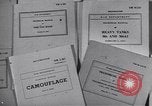
Army Service Forces recruits undergo training in the United States.
images of Army Technical training manuals dealing with gas masks; camouflage; heavy tanks; and machine guns. U.S. Army Service Forces (ASF) recruits rushing down a hillside into waters of a swift river and swimming across. They undergo Live Fire Exercises near \end of their training. The must crawl while trainers fire rounds from a Browning M 1917 machine gun over their heads. An explosive charge goes off as the recruits crawl past. ASF troops are briefed about invasion techniques, by an instructor using a realistic small scale mockup of a port city. Recruits crouch over a model of front line terrain. Model trains operate as a training aid. Students at doorway of the U.S. Army School of Military Government. Numerous student studying in the library. In a classroom, a military officer instructor discusses the mission of governing an occupied country with cooperation of the existing governing officials. Closeups of officers discussing the occupation of Germany, at length. (World War II period).
United States troops move against German counterattacks, Belgian civilians flee during the Battle of the Bulge (WWII)
Allied troops move against German counterattacks in Belgium and Western Germany during World War II. United States troops move along a muddy road in Belgium. Incendiary explosion. Tire on fire from incendiary. A soldier looks at wrecked American military jeeps and ruined buildings. Heavy smoke rises from a pile of wreckage. Fleeing civilians and refugees walk on the road on foot. Some of the civilians bring bicycles. Belgian Roman Catholic priests wearing Cappello romano hats are seen moving with the group. African American motorized infantry moving into Belgium. An African American soldier smoking cigarette on passing truck. Soldiers in the Ardennes Forest. A soldier plants M1 anti-tank mines in the Ardennes. He places a mine in a hole in the ground. The soldier covers the mine with a pile of dried leaves. Soldiers setting up roadblocks and covering tanks with foliage for camouflage. An M3 Stuart light tank is covered with hay to disguise as a haystack. United States soldiers carefully search the field for Nazi paratroopers. A soldier finds abandoned parachute equipment and white snow cape. Soldiers inspect passing trucks at an intersection between Bastogne and Martelange in Wallonia, Belgium. Belgian civilians fleeing a German advance on Highway 15. American Military Police personnel diligently searching for disguised German soldiers to prevent infiltration. A Military Police officer inspects a Belgian man’s identification paper. Military Police personnel questions a driver of a Jeep. Soldiers digging a dugout. Soldier with an M1917 Browning Machine gun. Artillery crew firing a M101 105 mm Howitzer. A pile of shells stands beside the Howitzer. An officer gives out orders to fire over telephone. Howitzer Motor Carriage M8 tanks firing in the Ardennes. A soldier inspects with binoculars. Infantry troops moving across a field and village. Soldiers firing rifles from behind a stone fence. A soldier deposits a charge into a basement window, followed by explosion. Soldier fires bazooka in haze. Soldiers looking up to the sky searching for air support. Allied bombers flying over Belgium. British Royal Air Force bombers dropping bombs over a road junction as seen from bomb bay view.