


 Francais
 Deutsch
 Italiano
Refine Your Search
+"Germany" +1919 stock footage and images
- Showing 55 to 60 of 60 results more
more Hide
Hide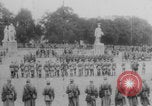
Allied dignitaries arrive at the Palaces of Versailles for the Treaty of Versailles (WWI)
Statesmen arrive at the Palace of Versailles for the signing of the Treaty of Versailles, which ends the state of war between Germany and the Allied Powers in World War 1. Dignitaries such as French Prime Minister Georges Clemenceau arrive by car. World leaders and dignitaries walking on the palace grounds of Versailles. United States President Woodrow Wilson is seen in between Georges Clemenceau and Italian Prime Minister Francesco Savero Nitti as they walk to the Palace of Versailles. Delegates seated and talking to each other inside the Hall of Mirrors, where the treaty is signed. View of hand leafing through the Treaty of Versailles affixed with the official seals.
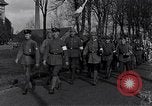
Post World War I German Home Guards (Einwohnerwehr or Freikorps) in training exercises; German troops return home
Einwohnerwehr or Freikorps (German Home Guard militia) marching and training, firing rifles, and climbing obstacles. Some militiamen wear white arm bands displaying Maltese Cross. Young officer salutes the marching guards as he stands next to a militiaman holding white flag with Maltese Cross on it. Next scene is on busy city streets, with German soldiers, returning home from World War 1, as they parade down a city street, accompanied by a military band and surrounded by civilians. Cavalry soldiers ride horses. They are surrounded by a marching crowd, so thick, it almost obscures them.
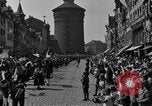
Many different groups parade with different flags in German City. Prussian officers participate
Large crowds of spectators watch a parade through streets of a German City, on a pleasant summer day. Citizens in old-fashioned traditional costumes carry bicolor flags. View of parade below from window of high building.Marchers fill street and spectators fill sidewalks. Many kinds of flags are carried and flown from buildings bordering the street. Prussian Officers stand in a group. Men in business suits, with armbands, parade carrying flags similar to German Naval Ensigns, but with dark field. Prussian officers ride through town in open car.
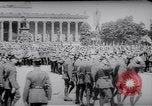
Germans celebrate formation of the Weimar Republic and their new President, Friedrich Ebert.
Germans celebrate formation of the Weimar Republic after World War 1. Soldiers parade as spectators watch. Their new President, Friedrich Ebert, is escorted by a Berlin Police officer, and followed by two statesmen, as he prepares to address the crowd at the Lustgarten. They walk past the Berlin Cathedral, where a woman speaker stands, slightly above the crowd, next to a large effigy of a woman. The President and statesmen tip their hats as they are saluted by a military officer. Army troops are assembled in formation. Cavalry on horseback parade, as spectators watch from the park. Scene shifts to President Ebert delivering remarks to assembled soldiers and spectators.
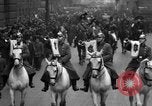
The police force in Berlin parades before the citizens of Berlin
A parade of Policemen on the streets of Berlin. Slate early in clip reads, "Die Polizei - unfer Schutzer und helfer." Policemen on horseback carrying German eagle flag lead the march along with several policemen playing trumpets. The policemen wear a variety of ornate uniforms across varying ranks and functions. Following the leadership, a police band marches carrying a variety of instruments, in turn followed by policemen on foot. Large crowd of civilians gather to witness the march. The citizens are reserved; not boisterous. A policeman on horseback carries a cup close to parade watchers so they can contribute money to the police force. He crosses from one side to the other of the parade route. Police with dogs (K-9 or canine unit) parade on roads. The troops march past the Brandenburg Gate; the Quadriga visible atop. Ambient sound of the parade in the background.
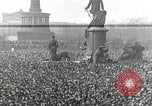
Germans in Berlin demonstrate against the Treaty of Versailles, after World War I
Germans demonstrate in Berlin, at the Reichtag and in the Lustgarten, against the Treaty of Versailles, after World War 1. A crowd of Germans demonstrating in front of the Reichstag in Berlin, The Bismark memorial and the Monument of Victory are clearly visible. As the camera pans, men raise their hats in unison (presumably prompted by the cameramen). One person holds a poster reading "98.Abt." (referring to 98th Abteilung, the German Army 98th Division). Others hold banners that are pointed away from the camera. Demonstrators also fill the Lustgarten. Men sit on a lamp post above street sign reading "Lustgarten."