


 Francais
 Deutsch
 Italiano
Refine Your Search
+"Germany" +1937 stock footage and images
- Showing 25 to 30 of 90 results more
more Hide
Hide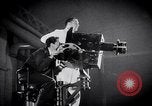
German science fiction movie. Animation and special effects depict preparation for launch of a spaceship.
Weltraum Schiff I Startet Eine Technische Fantasie. 1937 German science fiction film. View of a motion picture camera man filming a fictional launch of a spacecraft. Cameraman and narrator on elevated platform televising space crew as they proceed to huge hangar in which their spacecraft is housed. Large audience watching the event in real-time on screen at a theater. Door of hangar slowly drops down revealing the spacecraft. Project director and reporters go to balcony to watch the event. Audience applauding as the spacecraft begins to move from hangar. A large launch ramp and the moon are visible against night sky. The Crew Commander holds telecast interview from within the spacecraft.
Rocket motor designs by International scientists and inventors, reflecting early work by German rocket researchers
Designs by various international scientists and inventors who have contributed to solving the problems of rocket motor development, based on the German preparatory work. Their combustion chamber designs owe much to the German pioneers in the field. Shown are design sketches by Russian scientist, Konstantin Tsiolkovsky (Ziolkowsky) in 1914; French inventor Henri Melot, in 1920; German Friedrich Zander, in 1931; Bull, 1932; The American Rocket Society, with several designs from 1932; and The Cleveland Rocket Society. Views of rocket combustion research activity by Ernst Loebell of the Cleveland Rocket Society in 1933. He is seen outdoors in the snow with his apparatus. View of Loebell's test firing stand, and a picture of an actual test firing, outdoors. Ernst Loebell with model and rocket motor from his spaceship projects of 1934 and at the International Exposition dedicated to Art and Technology in Modern Life held in Paris, 1937. Cutaway views of the spaceship. The rocket motor wrapped in cooling coils. Rocket motor design by John Shesta of the American Rocket Society, from 1934. Design by Rene Armengaud of France, in 1934 and Deich in 1935.
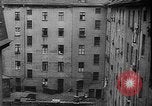
Idle children in Germany before Hitler's rise to power; Adolf Hitler speaks to a crowded stadium in Germany.
Changes in Germany before during Adolf Hitler's leadership. View of German youth idle and in poor slum housing areas during great depression years of hyperinflation between the wars, and before Hitler's rise to power. German boy children stand outside their houses and are seen idle. They run in an abandoned warehouse. Scene shifts to Hitler youth marching in front of a camp in 1935, holding Nazi flags. Adolf Hitler speaks to a crowd in an outdoor mass meeting (likely 7th Party Congress in September 1935). A large crowd assembles at a stadium. Sign for a Adolf Hitler Jugendherberge (youth hostel). Girls and young women of Hitler youth dance in pairs in traditional German clothing. Tents in the background for the girls camping. Views of a boys encampment for Hitler Youth with tents in the background. Boys in uniform gathering in camp, shining shoes, and working. Children work seated on ground. Workers enter industrial factories. Young men working in a factory producing goods in Germany using machines. Young men of the Reich Labour Service (Reichsarbeitsdienst or RAD) march in formation carrying shovels.
Berliner Dom, Altes Museum, Imperial Palace, Reichstag Building, University Of Berlin and Unter Den Linden in Berlin, Germany
Scenes of famous tourist destinations and architecture in Berlin, Germany, before World War 2. Views of Berliner Dom also known as the Berlin Cathedral (Am Lustgarten, 10178 Berlin, Germany), and the Altes Museum (Bodestraße 1-3, 10178 Berlin, Germany), also known as the Old Museum in Museumsinsel (Museum Island) Berlin, Germany. The Löwenkämpfer (English: The Lion Fighter) bronze equestrian statue by Albert Wolff in front of the Altes Museum. Double decker buses move in front of the Former Imperial Castle, also known as the Berlin Imperial Palace or City Palace Berlin (Stadtschloss Berliner, Schloßpl., 10178 Berlin, Germany). View of the Reichstag (Platz der Republik 1, 11011 Berlin, Germany). Trams pass by in front of the Brandenburg Gate (Pariser Platz, 10117 Berlin, Germany). A crowd around the statue in front of the Humboldt University of Berlin (Unter den Linden 6, 10117 Berlin, Germany). Police officers stand near cars on Unter Den Linden boulevard. Trams, vehicles and people on the streets of Berlin.

Marienplatz, the Town Hall, St. Peters Church, Charles Gate, German Museum and the University of Munich in Munich, Germany.
Famous tourist destinations, landmarks, and architecture in Munich, Germany before World War 2. View of Marienplatz with the Town Hall to its right (Marienplatz, 80331 München, Germany). The Frauenkirche is seen in the background. View of St. Peters Church (Rindermarkt 1, 80331 München, Germany) and the Karlstor or Charles Gate (Karlstor Neuhauser Str., 80331 München, Germany) while looking west on Neubauer Strasse. A tram moves under the gate. Cars and people on a street. Shops on either side of the street including the Hamburg-Amerika Line office. Views of the Former Royal Palace, also known as the Munich Residenz or Munich Residence (Residenzstraße 1, 80333 München, Germany) with streetcar trams, horse carts, and pedestrians in the foreground. The Deutsches Museum or German Museum (Museumsinsel 1, 80538 München, Germany), Ludwig Maximilian University of Munich or LMU Munich (Geschwister-Scholl-Platz 1 D-80539 München) and the National Theater Munich (Max-Joseph-Platz 2, 80539 München, Germany). The east fountain in front of the Ludwig Maximilian University of Munich. A young girl feeding pigeon.
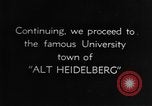
The University Of Heidelberg, the Old Bridge, the Heidelberg Castle and the Church of the Holy Spirit in Heidelberg, Germany.
Famous tourist destinations and architecture in Heidelberg, Germany, before World War 2. Views of Heidelberg and the Old Bridge (Am Hackteufel, 69117 Heidelberg, Germany). Trees in the background. A statue of Pallas Athena on the Old Bridge. Trees around the Heidelberg Castle (Schlosshof 1, 69117 Heidelberg, Germany). A ruined building in the castle seen. A view of the Church of the Holy Spirit or Heiliggeistkirche (Marktpl., 69117 Heidelberg, Germany) from the castle.