


 Francais
 Deutsch
 Italiano
Refine Your Search
+"Germany" +1939 stock footage and images
- Showing 1 to 6 of 162 results more
more Hide
Hide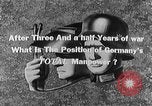
The comparison of Germany's total labor and military manpower from 1939 to1943.
Estimation of Germany's total working manpower. People walk with their equipment towards a factory. They read a notice pasted on the wall. They work in the factory. Vehicles parked on the street. Soldiers walk. Comparison of the military manpower from 1939 to 1943. The number of soldiers missing is also estimated. Destroyed military vehicles on the battlefield. Soldiers advance with tanks on the battlefield. Dead body of a soldier lay on the field. (World War II period).
Analysis of the German labor force from 1939 to 1943 (WW2)
Analysis of the Germany's labor force, military strength and effects of World War II on manpower. German soldiers march. Men work in factory on equipment and machinery. Women work in factory. A cemetery of World War 1 soldiers in Germany. Narrator explains how loss of man power from world War 1 deaths, and subsequent lower birth rate leads to war production worker needs being filled by many young German women and even German boys and girls working in industrial factories also. Wounded German soldiers being treated in field during World War 2. A map points Germany, Sudetenland and Austria. Graphs examine labor force by sex, age and military replacement availability; compare the labor force according to sex from 1939-1943; detail the increase of work force through the women part time workers and the veterans. Women weld equipment in a factory. Men do mining work. Narrator speaks of foreign workers (such as from Poland, Netherlands, Czechoslovakia, Yugoslavia), and how some now serve "under economic pressure and compulsion" (as forced labor or slave labor). Views of forced labor crews working digging earthworks. Laborers also work on building or repairing railroad stations and track work. Lines of prisoners of war, also used for labor, walk under German guard as lines of German uniformed troops walk in the opposite direction. Graphs compare the labor force in agriculture, industry, trade services, transport and government.
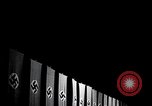
Adolf Hitler giving speeches at various venues in 1938 and 1939.
Illuminated masses of Nazi swastika flags. Hitler speaking at outdoor event. Hitler evoking laughter in the Reichstag (Kroll Opera House), on April 28, 1939, as he reads aloud a long list of countries from Franklin Roosevelt's letter which Roosevelt asks Germany not to invade. Scene changes to a welcome parade on March 16, 1938 in Berlin after Hitler's return from Austria at the time of the Anschluss. Hitler and Hermann Goering walking along street in Berlin, reviewing German troops. Huge crowd of cheering German citizens packed tightly in the Wilhelmplatz to hear Hitler speak. Hitler and Goering on a balcony overlooking the crowd.
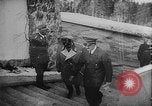
Events leading to World War II in Europe and German attack on Poland in 1939
Adolf Hitler and Hermann Goering walk together up the steps of Hitler's Berghof residence in Berchtesgaden, Bavaria, Germany. Inside the two walk about and converse. Views of them in several different rooms of the building. Hitler and Goering silhouetted against the large windows in one room, containing a long table and a world globe. Change of scene showing Nazi foreign minister, Joachim von Ribbentrop, being greeted by Soviet Union Minister of Foreign affairs, Vyacheslav Molotov, in Moscow, Russia, where they negotiated a Nazi–Soviet non-aggression pact (also called the Molotov–Ribbentrop Pact) in August 1939. Von Ribbentrop is seen seated with Soviet negotiators. Various newspapers reflect mixed world wide views. Some question whether war or peace is ahead. Another notes that the Reichstag supports the diplomatic initiative. Another suggests that England and France must decide. One headline says Chamberlain will want war. Next, Polish forces are seen on parade being reviewed by General Władysław Bortnowski. Among forces parading are mounted cavalry, marching infantry, a formation of PZL P.11 fighter planes, Tk-3 tankettes (Tankietka), 120 mm wz. field guns, CP7 Ursus artillery tractors pulling wagons, antiaircraft guns mounted on trucks, and army trucks carrying soldiers. Scene shifts to German airmen loading bombs on aircraft; arming machine guns; refueling; and testing functionality of aircraft elements, such as turrets. Pilot in cockpit as engines start on a Dornier Do 17 bomber. Ground crew pull chocks and aircraft taxis out. A Heinkel He 111 bomber taxiing. Two of them take off. A Do 17 takes off, followed by more He 111s. Closeup of one flying low over the camera on takeoff. A mixed formation of German aircraft aloft, including several fighters flying top cover; nine Dornier Do 17s; and other bombers. Aerial closeup of a Do 17 seen from adjacent wingman. Closeup of several He 111s in formation. Closeup of gunner in turret. View from above of three camouflaged Do 17s flying far below. Closeup of pilot in cockpit of He 111 with wingman off to left side. More views of Do 17s flying over patchwork of farmlands. Gunner preparing in his turret. Clouds from antiaircraft fire seen from plane cockpit. Bombs falling and exploding on city below. Succession of bomb craters in a line across a flat area of land. View from aircraft of damaged Polish aircraft on an airfield. Scenes of devastation on the ground including destroyed buildings and Polish aircraft. Waves of German Junkers Ju 87 (Stuka) dive bombers taking off; in formation; and peeling off to dive on targets. View from cockpit of one, through rotating propeller, as it dives to bomb a railroad marshaling yard, and view back as it pulls out, showing clouds of smoke rising in its wake. Several German officers peruse damage at rail site. Destroyed Bridge and shipyard. The German battleship, Schleswig-Holstein bombarding the Polish base at Danzig's Westerplatte on September 1st, 1939. German artillery firing in Poland. Formation of Do 17 bombers overhead. Damaged and abandoned wooden wagons at side of road traveled by Polish civilians evacuating in a horse-drawn wagon and herding their cattle to safety. Destroyed Polish artillery and equipment and horses during German invasion. Men dig graves and bury dead Polish soldiers. Vies from air of bombed out part of Warsaw. Polish citizens gathered in places seeking assistance. German forces on parade in Warsaw, including German soldiers goosestepping. Closeups of Adolf Hitler reviewing them.
Scenes of destruction from late 1939 in Finland during the Russo-Finish war
Film opens with a map of Europe showing black-shaded region of the Soviet Union, and pointing out Germany and Finland. Next, are shown moving images of rural buildings on fire in Finland, late in 1939, during the Russo-Finish war (or "Winter War"). (The Narrator comments that Finland's population was only 4 million while that of the soviets was 180 million.) Soviet bombers are seen high in the sky. A lone woman hurries along a street in Helsinki, Finland, past rubble of a bombed building. Smoke rises in the background. Finnish fire fighters man a hose to fight numerous huge fires in Helsinki.Various views of fires blazing in the capital.
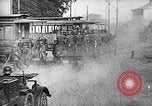
Germans take 120,000 prisoners in Poland and huge caches of arms and equipment during invasion of Poland in 1939.
120,000 prisoners of war taken by Germany during invasion of Poland in 1939. Large amounts of Polish Army equipment are abandoned and surrendered to German forces. Aerial views of abandoned weapons and military supplies, including artillery pieces, machine guns, gas masks, and small arms. German soldiers piling up surrendered rifles.