


 Francais
 Deutsch
 Italiano
Refine Your Search
+"Germany" +1941 stock footage and images
- Showing 67 to 72 of 100 results more
more Hide
Hide
German coastal guns at English Channel. Bomb damage in German town. Germany Navy in Norway. World War II
German Kriegsmarine Grand Admiral Erich Raeder inspects coastal artillery units along the English Channel during World War 2. He arrives and is greeted by German Naval officers. They study maps on a table. He inspects the guns. A coastal gun raises its barrel, while under a camouglage net. Scene shifts to residents of a German town that had been struck by British RAF bombers. Local residents work to clear up the rubble. Views of bomb-damaged homes, with entire front walls missing. View of damaged kitchen in an apartment. Teams of men working to clear rubble. German children fill a town square to watch the demolition of an unsafe structure. Sign with skull and crossbones next to an unexploded bomb, warning that it is a dud and life threatening. German workers pouring concrete for an airfield. Scene shifts to Kriegsmarine activity in Norway. View of a fjord, and then to many German float planes in a bay near a city. German warships come under attack by British warplanes. German ships antiaircraft guns are brought to bear. German Focke Wulf FW-190 aircraft scrambled to engage the British. Views from German aircraft in flight over the area. Snow covered mountains. View from German ships in the North Atlantic. The German battleship, Gneisenau, underway. Formation of German warships underway. Two German U-boats moving on the surface. A motor torpedo boat. German Stuka, Junkers JU-87 dive bombers, in formation flight. Motor torpedo boat dropping depth charge.
Soviet people endure during invasion by Germany during Operation Barbarossa in World War II
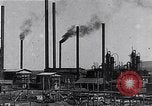
Film begins showing Soviet industrial complex with many smoke stacks emitting dark fumes. A banner is raised in front of a statue of Joseph Stalin. Soviet workers turn wheel and use wrench to install a large shaft into a machine in a factory. A large number of Soviet people descend stairs from an electric distribution network at a hydroelectric dam. Soviet head of state Mikhail Kalinin is among the persons seen in the group. Spectators stand on a platform above the dam where a large sign is displayed. View of the dam with gates open and water pouring through to the lower level of the river. Scene shifts to military parade on Red Square in Moscow. during World War 2. A formation of trucks carrying anti-aircraft guns drive along the street. Soviet T-34 tanks are also in the parade. Joseph Stalin waves from a balcony on the Kremlin as the parade passes. Soviet workers also join the parade, carrying banners and marching in a dozen parallel columns along Red Square. They exit in columns around both sides of Saint Basil's Cathedral. Soviet heavy artillery batteries fire at night creating great flashes of light. A shell strike destroys a building. Soviet troops fighting in close quarters among debris in a Russian city. Dead German soldiers lying in debris on a city street. Some are surrounded by weapons and belts of ammunition. A Soviet soldier removes a swastika from the top of a steel bridge. Soviet citizens walk about the ruins of a city during a lull in combat. A child emerges from an underground bunker. Russian sailors walk together along a street. Soviet people gather at an outdoor market, where they purchase foods.
Young men in the Soviet Union train to fight against Germany during World War II
Young men stand in a formation in the USSR during World War 2. They are all wearing dark trowsers and white sweat shirts. At a signal from their leader, they all reach down and each picks up two simulated hand grenades from the ground. Closeup of the "grenades." The then run through woods and jump over a rustic fence. Some pair up and use their joined hands to boost others into the air and over the fence. They leap over a fallen tree and then jump down a steep hill and up another. They run into a river, wade rapidly across it, and climb up the opposite bank, where they flop down throwing their "grenades" as they do so. They get up again and continue running.
Germany bombs London during Blitz, and United States sends Lend-Lease war materiel to England (WW2)
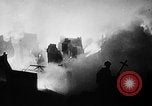
The London Blitz. Sections of London ablaze from German bombing during Battle of Britain. US President Franklin Roosevelt signing H.R. 1946, Lend-Lease legislation in World War II. View of last page of H.R.1946, signed by Sam Rayburn, Speaker of the U.S. House of Representatives, and by President Roosevelt. United States sends war material to England. 'USA' written on Lend-Lease boxes being loaded on lorry after arrival in Britain. Huge crates of Lend-Lease war materiel on railroad flat cars pulled by locomotive. Smoke rises up from the engine. 'Machine tools, BULLARD, Bridgeport Conn.' written on crate in transit.
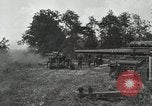
Germany invades Estonia during World War II
German invasion of Estonia in World War 2. Film opens showing German artillery batteries firing 15 cm schwere Feldhaubitze 18 or sFH 18 (heavy field howitzers) at zero elevation from hills overlooking a river valley. Next, some troops and equipment are seen crossing a pontoon bridge, and others walk across an ordinary undamaged bridge over a stream. One German soldier checks for enemies under the bridge, as some motorcycles drive past. In a field, German soldiers watch, as others fire a 75mm field piece (7.5-cm Feld Kanone) downward from a hill overlooking a pond, some farm houses and trees. Scene shifts to shell exploding on a building in a village, causing dense white smoke to rise. German infantry firing and moving cautiously among trees at side of road. Others, firing from shelter in a ditch near pile of heavy timbers. Several duck down in a ditch under a Signpost pointing to Pankjavilsa-18Km and to Trboska-11Km, in opposite direction.Residential houses are behind them. They advance from that spot. Two German soldiers move near a damaged bus and burned wood. One throws a hand grenade that explodes in foundations of an old stone house. A pair of German soldiers fires a machine gun. Several German troops jump into an inflated rubber raft and paddle across a river. a damaged wooden bridge is behind them. View from above, of troops in several rafts. Some pass by a tall seemingly undamaged bridge. Views of several shelters in a field, that appear to be improvised by German soldiers. Troops standing on a dock as a large barge arrives, carrying light armored cars (Leichter Panzerspähwagen) of SdKfz series, which they offload and drive away. Other troops cross several sets of parallel railroad tracks. Views of destroyed rail cars. In a town,itself, one house in a block has been totally destroyed. and is on fire. Several civilians huddle near a doorway and one walks slowly across the street. Two dead horses lay in the street. German soldiers moving at intersection of a dusty road. Some ride bicycles. Some ride in a light utility car (Volkswagen Kübelwagen). A heavier army utility car is parked at the intersection. Next, a long line of German soldiers is seen riding bicycles. Change of scene shows a dozen German soldiers riding atop a Sturmgeschütz III (StuG III) assault gun. It is followed by a light halftrack (SdKfz 7) with a canvas cover and soldiers riding in an army utility vehicle. Final scene shows an 18 Ton Half-Track, Schwerer Zugkraftwagen (Sd. Kfz. 9) "Famo," raising lots of dust as it drives along a dirt road. It is camouflaged with tree branches and is towing a 15 cm sFH 18 field gun.
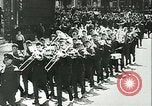
Legion Unit of France soldiers (LVF) march through streets of Versailles and board train bound for eastern front in World War II.
View of collaborationist French soldiers from the Legion of French Volunteers Against Bolshevism (Légion des volontaires français contre le bolchévisme, or, Légion des volontaires français, or LVF.) The LVF soldiers, made of of right-wing French and French prisoners, are marching through the streets of Versailles, in Vichy France, toward the Versailles Chantiers train station, to begin their trip to the Soviet Union where they will fight together with Germany against Soviet forces in World War 2. To the Germans they were known as Infantry Regiment, or Infanterieregiment 638. Led by a Band, the soldiers march through streets of Versailles and uphill toward the main arched entrance of the Versailles Chantiers station. Civilians line streets to bid farewell, and some women kiss soldiers goodbye. View of black locomotive leading the train. LVF board a train car with chalk inscription on the side "Paris - Moscow, LVF".