


 Francais
 Deutsch
 Italiano
Refine Your Search
+"Germany" +1944 stock footage and images
- Showing 85 to 90 of 598 results more
more Hide
Hide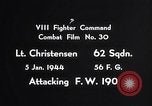
Attack on German aircraft F.W.190 by Eighth Air Force pilot Lt. Christensen of 62nd; 56th FG during World War 2.
A film titled 'VIII Fighter Command Lt. Christensen 62 Sqdn.(Squadron) 56 F.G.(Fighter Group) attacking on 5 January F.W.190 1944'. Attack on Luftwaffe aircraft F.W.190 during World War II in Germany.
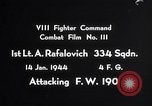
Attack on German World War II aircraft F.W.190
A film titled 'VIII Fighter Command First Lt. A. Rafalovich 334 Sqdn.(Squadron) 4 F.G.(Fighter Group) attacking on 14 January F.W.190 1944'. Luftwaffe aircraft F.W.190 explodes due to attack,during World War II in Germany.
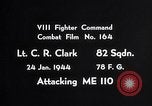
Attack on German World War II aircraft Messerschmit Bf-110
A film titled 'VIII Fighter Command First Lt. C.R.Clark 82 Sqdn.(Squadron) 78 F.G.(Fighter Group) attacking ME-110 on 24 January 1944'. Attack on Luftwaffe aircraft ME-110 during World War II in Germany.
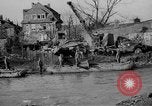
3rd Division fires rocket barrages and First United States Army Infantry advances through German towns east of Inde River
Activities of First United States Army pressing eastward in Germany during World War 2. U.S. engineers and soldiers build a bridge over the Inde River since all nearby crossings had been destroyed by retreating German forces. Army vehicles cross the completed bridge. Soldiers bring heavy artillery and adjust it. View changes to Mausbach area to the South, where rockets are launched by 3rd Armored Division toward the river. Line of 75 U.S. Army rockets seen being loaded by U.S. soldiers and then fired together. Bright flashes and smoke as rockets are fired. Tanks of the 3rd Division moving out from the town. A U.S. vehicle in the advancing column toward Gressenich is hit by German guns. U.S. Army tanks, lined up like artillery, fire on German forces at Gressenich. Continuous line of 3rd Armored Division tanks, armored vehicles, and 6x6 vehicles come to the front and advance on roads of cities and villages moving eastward, and supporting the U.S. First Army Infantry. 1st Army infantry move through Hurtgen forest near Aachen. Ruined German factory is used as an observtion base by U.S. forces to coordinate attack on Gressenich, which was captured on November 19, 1944. 3rd Armored Division tanks move into open fields to continue offensive toward Werth, with U.S. infantry soldiers staying close to tanks for cover. Soldiers carry the wounded U.S. tank commander after German counter fire hits lead U.S. tank in the column. The wounded soldier is dragged to safety. Men of U.S. Army 1st Division Infantry enter town of Werth under German mortar fire and move from house to house clearing enemy snipers and mopping up in the ruins. U.S. Army soldiers guard a column of German prisoners (POW) who surrendered in Werth. View of ruined and destroyed buildings in German towns like Hamich after defeat. U.S. Army soldiers move through the town on foot with a small church in the background. U.S. Army trucks arrive in a rubbled village with food and ammunition for the offensive drive toward the Ruhr.

Funeral, in World War II, for German Major General Adelbert Schulz, Commander of the 7th Panzer Division.
Funeral in Germany for German Generalmajor (Major General) Adelbert Schulz killed in action on January 28, 1944 during World War 2, after taking Command of the 7th Panzer Division, only a month earlier. A brass band can be heard playing the mournful strains of the song, "Ich hat ein Kameraden. Front and rear views of soldiers dressed in black, accompanying a German Panzer III tank, bearing the flag-covered coffin of the diseased. Glimpse of German Field Marshal Erich Von Manstein, saluting with his baton, as pall bearers approach carrying the flag-covered coffin. Brief view of the military brass band playing the funeral music. The coffin resting beside the open grave. Contingent of 7th Panzer Division troops assembled behind the grave. View from rear of Marshal von Manstein and two other officers with bared heads in respect. Soldiers standing in front of the tank. Closeup of some soldiers. Field Marshal Von Manstein salutes with his baton and then with help of a soldier, places a large wreath by the open grave. Banner on wreath includes words "Pz. Rgt. Rothenburg", short for Panzerregiment Rothenburg or Panzer Regiment Rothenburg. (That was the nickname of the 25th Panzer Regiment, part of the 7th Panzer Division, in honor of General Karl Rothenburg, who commanded it until he was killed in 1941.) A large honor guard fires three volleys from their rifles. Film ends with Closeup of General Shultz's military decorations
Montage of German rocketry scenes from 1930s through World War II. Nazi surrender. Atomic bomb. Japanese surrender
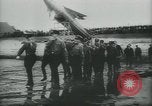
German rocket pioneer, Gerhard Zucker, attempting to develop postal rockets in the 1930s. Location is Wadden Sea off Cuxhaven, on April 9, 1933, where Zucker follows Nazi Sturmabteilung (also called SA or Stormtroopers) carrying the mail rocket across wet sands. The rocket is set up on a launch stand. Zucker and an assistant ignite the 8 side rockets and the mail rocket takes off. It noses up and loops over backwards, falling to the sand. German Stormtroopers lift up the damaged device. Next, is seen a later, more modern, rocket trial ending in failure. Two German engineers display a model similar to the pulse-jet-powered "buzz bomb" (V-1) employed by the Nazis in World War 2. A brief glimpse of similar American machine on sand flat, as narrator states German acknowledgement of knowledge gleaned from Dr. Robert Goddard's work. A German V-1 flying bomb (aka Doodle Bug) being launched in 1944, during World War 2. View of British houses of Parliament, London, England; an air raid shelter sign in City of Westminster. Londoners waiting out a raid in the shelter. Scenes of fire and destruction during German bombing of London, as narrator speaks about the more advanced German V-2 ballistic missiles employed later in the war. Londoners trudging through debris amongst bombed out buildings. Change of scene to U.S. infantry and armor advancing deep into Germany. Narrator refers to them overrunning rocket bases and other vital war-making facilities, near the end of the war. Glimpse of large number of German prisoners of war. Documents of military surrender being signed by Field Marshal Wilhelm Keitel, in Berlin, May 8, 1945. Closeup of Keitel. Scenes of American forces operating in Pacific theater. Aerial view of atomic bomb explosion. Japanese surrender ceremony on September 2, 1945, aboard the battleship USS Missouri. U.S. soldiers and other service personnel return home and greeting loved ones at end of war. Aerial view of Pentagon building and surrounding area in Arlington Virginia near Washington DC. U.S. troops boarding a ship in San Francisco, bound for war again, this time in Korea (1950).