


 Francais
 Deutsch
 Italiano
Refine Your Search
+"Germany" +1944 stock footage and images
- Showing 133 to 138 of 598 results more
more Hide
Hide
German alpine troops train on a snow-covered mountain and skaters perform in Berlin Sportpalast during World War II in Germany.
Sports activities in Germany during World War II. German alpine troops train on a snow-covered mountain. The alpine troops pose. Clouds over mountains. One skier smokes a pipe. Next they are seen speeding down the steep slopes of the mountain. Next scene shows skaters performing at the Sportspalast (Ehemaliger Standort Sportpalast Berlin, Potsdamer Str. 172B, 10783 Berlin, Germany) in Berlin. The solo figure skater is Lydia Veicht. The pair are Ria Baran and Paul Falk. Spectators watch the performances by the skaters. The spectators include army personnel and other civilians. The spectators applaud the performance.

U.S. troops and military vehicles cross the flooded Moselle River and advance in Germany.
U.S. soldiers advance in Germany during World War II. A map locates positions of Allied troops advancing towards Germany. Floods in the Moselle River. Wrecked vehicles in the area. Soldiers marching in the area. They row a boat in the river. U.S. engineers construct a pontoon bridge over the flooded river. Houses in the background. A smoke screen being laid over the bridge. Trucks carrying supplies move across the bridge. Jeeps, tanks and other military vehicles drive across the bridge. The soldiers crossing the bridge under the smoke screen.

Soldiers of the U.S. Army 315th Regiment, 79th Division in Bienwald forest, Scheibenhardt, Germany, during World War II.
U.S. Army soldiers of the 315th Regiment, 79th Division in Scheibenhardt, Germany, during World War 2. They walk in the Bienwald forest. Soldier removes German street marker "Adolf Hitler Strasse" from a building. Soldier with walkie-talkie. Patrol moves along road. Jeep with 'Adolf Hitler Strasse' sign on hood crosses a bridge. A sign board 'Entering Germany' on the side of the road. A group of soldiers sits in a circle. American soldier removes shoes and massages his feet. Soldiers around telephone. Soldier in foxhole cleans weapons.
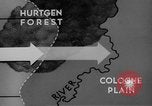
1st Infantry and 3rd Armored Division advance toward Mausbach and 104th Infantry Division advance on Stolberg in Germany.
Activities of American First Army in its invasion of Germany during World War 2. Animated map shows 1st Army moves into the direction of Cologne plain east of the Hurtgen Forest for invasion into Germany. 1st Infantry and 3rd Armored Division move to Mausbach and 104th Division move to Stolberg on November, 16. Two barrage balloons manned by the British on outskirts of Aachen are seen rising up from the ground to be floated eastward marking the line of the German enemy positions. Aerial view of Allied bomber aircraft, both American and British, dropping fragmentary and incendiary bombs on Duren. Reconnaissance group of the 104th Division readies for drive through Stolberg. They are seen removing camouflage from vehicles, and watching the skies for completion of the Allied aerial bombardment of the forward target. 104th Division recon group seen holding a briefing and studying map. U.S. Army infantry advance through a forest area, while assault guns of the 3rd Armored Division cover their movement. Result of German counter fire: Casualties are evacuated from a demolished Allied batallion command post near Stolberg. Wounded American soldiers carried on stretchers and the town's civilians receive first aid.
U.S. 95th Infantry Division troops on vehicles entering Saarlautern, Germany, in World War II
U.S. 95th Infantry Division troops in Saarlautern Germany during World War 2. A sign reads 'you are now entering Germany through the courtesy of 95th Div'. Two U.S. troops stand beside the sign. The soldier on the right is Technician Fourth Grade (T/4) Julian Koentz, of Trenton, Illinois, a member of the 378th Infantry Regiment, 95th Division. A road sign identifies the town of 'Saarlautern'. The troops in vehicles enter the town. A sign posted on a a tree reads 'Danger Beware of Mines and Booby Traps'. The soldier on the left is Sgt Andrew Rauch of Chicago,Illinois, also of the 378th Infantry. (Note: Rauch was identified by Julian Koentz, while looking over still photos of this event with his son Robert L Koentz, who provided this information.)
U.S. infantrymen advance through Siegfried Line near Aachen in Germany during World War II.
U.S. infantrymen in Germany during World War II. Aerial view of road cut through forested area of Germany. Ground-level view of a battlefield through barbed wire. Artillery shell bursts in a field. Factories and smoke stacks in distance. A U.S. Sherman tank moves forward. U.S. infantrymen move and take cover among concrete antitank dragon's teeth of the German Siegfried Line. Views of the many antitank structures in the Siegfried Line.