


 Francais
 Deutsch
 Italiano
Refine Your Search
+"Germany" +1944 stock footage and images
- Showing 511 to 516 of 598 results more
more Hide
Hide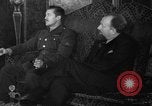
Lord Vanisttart speaks about the Germans as Steve Laird makes remark at Denham Place in Denham, England during World War II.
Press Conference at house of Robert Vansittart, 1st Baron Vansittart, in Denham Place, in Denham, England during World War II. Views of Steve Laird, Time Inc. Correspondent, and George Slocombe, Head of Anglo-American Press Club. Journalists Jacqueline Saix of Time Magazine take notes. Jan Jindrich, British War Correspondent on the staff of the News Chronicle, listen to Lord Vansittart. Mr. Siddall, Lord Vanisttart's campaign manager and Lady Vansittart listen to Lord Vanisttart's speech. Lord Vanisttart, former Under Secretary of State for Foreign Affairs being interviewed by British and American journalists. On Lord Vanisttart's left is seated Steve Laird, next is George Slocombe, next is Jacqueline Saix. On Lord Vanisttart's right is seated Lady Vanisttart, next is Mr. Siddall and next is Jan Jindrich. Steve Laird speaks. Lord Vanisttart speaks on his version of 'what to do with Germany'. Lord Vanisttart being interviewed by journalists, Steve Laird speaks. Lord Vanisttart starts his speech. Lord Vanisttart and Steve Laird. Lord Vanisttart rises and makes a speech. Steve Laird makes a remark.
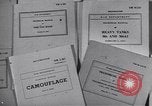
Army Service Forces recruits undergo training in the United States.
images of Army Technical training manuals dealing with gas masks; camouflage; heavy tanks; and machine guns. U.S. Army Service Forces (ASF) recruits rushing down a hillside into waters of a swift river and swimming across. They undergo Live Fire Exercises near \end of their training. The must crawl while trainers fire rounds from a Browning M 1917 machine gun over their heads. An explosive charge goes off as the recruits crawl past. ASF troops are briefed about invasion techniques, by an instructor using a realistic small scale mockup of a port city. Recruits crouch over a model of front line terrain. Model trains operate as a training aid. Students at doorway of the U.S. Army School of Military Government. Numerous student studying in the library. In a classroom, a military officer instructor discusses the mission of governing an occupied country with cooperation of the existing governing officials. Closeups of officers discussing the occupation of Germany, at length. (World War II period).

Private Snafu wastes food by taking too much at a battlefront (WW2)
Private Snafu in the U.S. Army during World War II. Animation shows supply of food and other things to soldiers. A bull and a cow get married. They enter a room. Nazi Germany and the Japan declare war at that time. Guns loaded on freight cars passing on railroads. A ship underway at sea. Periscopes of submarines emerging out of water. The bull aboard a ship and then a boat. It travels by a truck, a dog sled and then a camel. A snow covered area. A truck passing on a bridge. The bridge explodes. U.S. airplanes in flight overhead. Food and other supplies are dropped from the airplanes. Private Snafu seated on his bed in a barrack. A chow call for the soldiers. Private Snafu takes a large quantity of food. He sits near a tree and eats the food. He wastes some of the food and throws it in a dustbin.
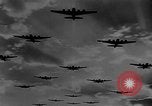
Lt. Gen. Carl Spaatz and Maj. Gen. F. L. Anderson plan 'Operation Frantic' at a USAAF headquarters in the European Theater.
A film on U.S. shuttle bombing operations over Germany from bases in Great Britain, Italy and Russia during World War II. Animated diagram shows the advantages of using Soviet airfields during the operation. United States Army Air Force Lieutenant General Carl Andrew Spaatz seated at a desk in his office. Deputy Commanding General for Operations Major General F. L. Anderson discusses the plans with other officers in his office. They plan 'Operation Frantic' at a USAAF headquarters. Ships at a British port are loaded with supplies including food, gasoline, bombs, ammunitions, trucks, jeeps and other equipment. A man watching through binoculars from the deck of a ship. A convoy passes through the Arctic Ocean. Supplies are unloaded in Russia. These are transported by train to a headquarters in Russia.
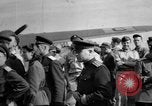
Russian and American pilots and crew talk and shake hands at an airfield in Russia during Operation Titanic.
A film on U.S. shuttle bombing operations 'Operation Titanic' over Germany from bases in Great Britain, Italy and Russia during World War II. U.S. bombers land on an airfield in Russia. Crew disembarks from the airplanes. They shake hands and talk to Russian pilots. Officers interrogate the fliers about the mission. Russian and U.S. crewmen service the airplanes. The crew eat in an outdoor kitchen. They sleep in tents.
American bomber crewmen play games and visit town near Soviet base in Poltava during Operation Frantic.
A film on U.S. shuttle-bombing operations in "Operation Frantic" over Germany, operating from bases in Great Britain, Italy and the Soviet Union during World War II. Aircraft parked at an air base in Poltava, Ukraine, Soviet Union. Nose art and painted insignias on the U.S. Army Air Force aircraft. American crewmen standing near the bomber aircraft. They sleep in tents. They wake up and get ready. A group of Soviet civilian workers walks by with farming tools. A man shaves. Others wash their faces. American Colonel Albert Kepler and Russian officers confer for their next bombing mission. They select target areas for the bombardment. Gasoline, bombs, ammunition and other supplies are provided to the crew. American and Russian crewmen of a bomber aircraft play baseball and cards and interact. Some American soldiers write letters home. Others milk a cow with a Soviet soldier. Crewmen drive in a jeep to visit the nearby town where German bombing campaigns have destroyed many buildings in Poltava. They view a destroyed leather industry factory, and the grave of Ukrainian writer Vladimir Korelenko. They see only rubble remaining of the birth home of Korolenko. Damaged buildings and rubble in the area. People walking on a street. The American soldiers interact with the Ukrainian civilians of the town. Women and children of the town are seen. Closeup view of the hand of a a U.S. Army soldier as he hands out chewing gum candy to eager Ukrainian children. On the way back to the base the soldiers view the Column of Glory in Poltava, honoring the 1709 Battle of Poltava.