


 Francais
 Deutsch
 Italiano
Refine Your Search
+"Germany" +1945 stock footage and images
- Showing 67 to 72 of 2006 results more
more Hide
Hide
General Jacob Devers and other U.S. Generals seated with German delegates at a surrender conference in Haar Germany.
German Surrender Delegation conference at the Thorak Estate in Haar, Germany, to accept the surrender of German Army Group G, towards the end of World War II. United States Army officers at the surrender conference include General Jacob "Jake" Loucks Devers of United States Sixth Army, who says "This is an unconditional surrender" while seated at a table with German and U.S. officers. Other U.S. Generals included in the delegation are: General Alexander McCarrell "Sandy" Patch; Lieutenant General Wade Hampton Haislip; Major General John W. "Iron Mike" O'Daniel; Brigadier General Reuben E Jenkins; Brigadier General William S Ott; Brigadier General Pearson Menoher. German delegation includes: Delegation head, Lieutenant General Hermann Foertsch, Commander of the 1st German Army; Colonel Hermann Zolling; Major Foeker; Major Coelle; Major Murray; Captain Behrendt; Captain Cartellieri and 1st Lieutenant Von Weber. Lt. General Foertsch signed the surrender document, effective 12:00 the next day (May 6, 1945). U.S. Army First Lieutenant John H. Brunswick is seated left of Foertsch. Lt. Brunswick translated General Dever's terms and statements, including "unconditional surrender," into German.
Bombed out ruins of Berlin, Germany, seen at end of World War II in Europe
Bombed buildings in Berlin, Germany shortly after the end of World War II in Europe. Berliners walking along sidewalks past skeletons of bombed out buildings in Berlin, in July, 1945. Rubble has been cleared from sidewalks and streets, but is piled up alongside. Two women ride in a horse-drawn wagon, carrying what appear to be household goods. The damaged Potsdamer Bahnhof railway terminus station. People in the foreground. Ruins of damaged buildings in the area of Potsdamer Platz. Lettering atop the railroad station building reads 'Potsdamer Bahnhof'. Rubble strewn on both sides of the street, and pedestrians pass by along with a few horse drawn wagons. No motor vehicles are seen.
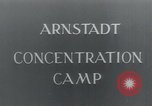
U.S. soldiers watch German civilians disinterring bodies at Arnstadt Concentration Camp in Germany (WW2)
Arnstadt Concentration Camp in Germany captured by American forces in April, 1945 near the end of World War II. Prisoners were mainly Poles and Russians. View from the camp gate to tents which were used to house prisoners. Dogs were used to guard the prisoners. Shown is A dog kennel for a watch dog. Local German citizens had exhumed he bodies of concentration camp victims from their original mass grave, and reburied them in a trench further away from the town because of the stench. Now they were disinterring them again under supervision of United States Army soldiers. A corpse with crushed head. Corpses lying outside the graves from which they have just been exhumed. Bodies laid out on the ground are viewed by several U.S. soldiers
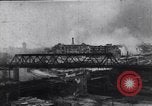
Soviet capture of Berlin and surrender of German Defense forces in Germany during World War II.
Combat footage filmed during the Soviet invasion and Battle of Berlin, Germany during World War 2. Smoke rises from damaged bridges and railroad lines. Ruined buildings of Berlin in aftermath of Soviet air and ground attacks. Piles of captured German weapons. German police officers and soldiers being taken as prisoners of war. Surrendering German troops march along a street. Grafitti on building wall says "Surrender - No." White surrender flags hang from windows and balconies of buildings. (These are contrasted by edited insert of German swastika flags covering the facades of buildings in the past.) German General Helmuth Weidling, commander of the Berlin Defense Area leads other Gernan officers from a bunker in the city, following their surrender to the Soviets on May 2, 1945. Large number of surrendering German soldiers marching, while General Weidling and other Berlin Defense Area officers quietly watch as their troops march past, as prisoners.
Prime Minister of UK Winston Churchill and U.S. President Harry S Truman attend the Potsdam Conference in Germany.
Prime Minister Winston Churchill gets a defeat in the 1945 United Kingdom General Elections. Past events show Prime Minister of UK Winston Churchill, U.S. President Harry S. Truman and other delegates attending the Potsdam Conference in Germany.
Trial of Vidkun Quisling in Oslo and German leaders surrender in Germany at end of World War 2.
The first preliminary trial of Nazi war criminals following end of World War II in Europe. Norwegian leader Vidkun Quisling is tried for high treason in Oslo, Norway. Men are seated during the trial. Vidkun Quisling sits during the hearing. View of the Norwegian ship "Patria" which is now Allied headquarters, in Flensburg, Northern Germany. On May 9, 1945, the Allies arrest all elements of the German shadow government at Flensburg. German prisoners march near the harbor. Ships in the background. High German officials are arrested. Two German Navy officers and a non-uniformed official (who has the appearance of a Hitler doppelganger) stand with their hands behind their heads. Exterior view of Castle at Flensburg. Inside lies the body of General-Admiral Hans-Georg von Friedeburg, after he committed suicide. Picture of Admiral Doenitz, on wall above the body. Colonel General Alfred Jodl, leaving the Germany Army Headquarters at Flensburg, as he is taken into custody. Exterior view of German shadow government headquarters at Flensburg. Grand Admiral Karl Doenitz, successor to Hitler, is taken into custody. Doenitz and Jodl, are escorted by Allied armed guards, through a tunnel in the Flensburg compound. View of house in Luneberg, Germany, where Nazi SS leader, Heinrich Himmler, commits suicide after his arrest by British soldiers. View of cyanide poison pills taken from Himmler, before he succeeded in taking one he had hidden in his mouth. Body of Himmler.