


 Francais
 Deutsch
 Italiano
Refine Your Search
+"Germany" +1945 stock footage and images
- Showing 109 to 114 of 2006 results more
more Hide
Hide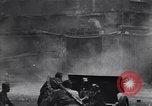
Soviet combat film of the Battle of Berlin during final phases of World War II in Europe
Soviet troops firing field artillery in streets of Berlin, Germany, late in 1945, during World War 2. Closeup glimpse of a Soviet woman tank crew member. Glimpse of Russian tank firing at building. Glimpse through window of building as tank fires across the street. View downward of Soviet infantry running through street below. Another tank firing. Soviet infantry soldier advancing through fire and smoke. A tank crew member carrying a wounded comrade over his shoulder, past several T-34 tanks parked in the background. A tank burning. Medic tends head wound of the injured tank crewman. More views of infantry running through the rubble filled streets. Animated map showing the pincer movements of Soviet forces closing in from outskirts of Berlin toward its center. Glimpse of Soviet soldier scanning across the city with optical equipment. Camera pans across smoke filled city showing the ruins of the Reichstag Building and anther large damaged building. More views of artillery firing in street. A knocked out tank. Huge smoke clouds billow from a shelled building. Infantry scramble over rubble. German civilians hiding in a garden. A Soviet soldier helps a very old German man out of the remains of a building. Soviet machine guns rake the front of a building, causing pieces of it to fall to the ground. An old German woman wanders along a city street. A Soviet ROKS flamethrower is fired from the window of a building creating fire on a building across the street. Infantry run past the burning building. During a pause in fighting, a Soviet female soldier washes the face of a male soldier. An artillery field piece firing in the street. A wounded Soviet soldier with bandaged head, fires a captured German Panzerfaust anti tank weapon. Four Soviet soldiers carrying a wounded on a litter, run through past the camera.
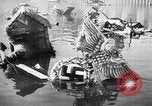
Reenactment of the activities of American and Russian troops after they meet on the River Elbe, near the end of World War II.
From a Russian feature film "Meeting on the Elbe" (dubbed in Korean). Reenactment depicts meeting of the American 69th Infantry division and Russian soldiers at the River Elbe near Torgau Germany on April 25 and April 26, 1945. Reenactment : An American soldier meets a Russian soldier on the shore of Elbe river and the soldiers talk. A tank behind the soldiers. The soldiers sit down and the American soldier takes out a dollar note and scribbles on the note. A bridge over the River Elbe as the raised spans meet and come into place. The Russian troops stand in a line on the bridge. Two of the soldiers holding flags. A banner being displayed on the bridge across the river. An American officer and a Russian officer shake hands. The American officer reviews the troops. The band plays. The soldiers stand in a line. The officers salute and walk past the troops. The American soldier and the Russian soldier on the shore of the river. The officers salute. American tanks with troops move. The American officer views the soldiers through binoculars. Soldiers standing behind the American officer. The officers converse looking at a document. An American officer in a room inside a building. A crowd outside the building. The officer looks at the crowd through the window of the building. Another officer enters the room and approaches the American officer. The American officer hands over a symbolic key to the other officer and both men converse.
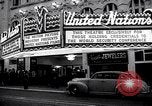
Delegates of United Nations Conference watch motion picture on surrender of Germany and work toward defining UN Charter.
Exterior of a United Nations theater in San Francisco, with movie theater marquee indicating its use exclusively for pass holders attending the United Nations Conference on International Organization. Inside the Delegates of United Nations conference gather during the 2nd week of the conference to watch footage of the German surrender at Reims, signed by General Alfred Jodl. Projectionist and movie projector in booth of theater are shown. View of men and women in movie theater watching movie, including an elevated side view of people watching the movie, and views of the theater screen and movie playing, with backs of heads of people in foreground. Delegates talking and attend meeting in San Francisco, California as they continue work leading toward defining the UN Charter and founding the United Nations organization. Footage from the San Francisco Conference vote, chaired by Anthony Eden of Great Britain, approving the Charter of the United Nations on June 26, 1945
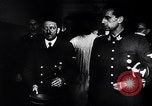
Adolf Hitler and the fall of Nazi rule in Germany, the Nuremberg trials and signing of UN charter after World War II.
Documentary about significant events of the year 1945. German dictator Adolf Hitler visits German hospitals. He talks to and asks well being of Nazi soldiers. The famous Nuremberg trials of the Nazi leaders. Prominent Nazi leaders Hermann Goering, Speer and others facing the trial in a Court of justice. The United Nations Conference with delegates from various nations. Delegates sign the UN Charter.
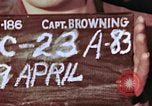
USAAF airmen load bombs on B-26 of 323rd Bomb Group preparing for mission to bomb targets in Germany during World War II
Slate identifies location as A-83 (Denain-Prouvy Airdrome, France) and date as 29 April (1945). Ground crew armorers are connecting wires to bombs and loading them into the bomb bay of a a U.S. Army Air Forces Martin B-26 Marauder aircraft of the 323rd Bombardment Group. View from under the aircraft as a crewman gives signal to close bomb bay doors and they slowly close and lock. Ground crewman removes a metal chock from the aircraft wheel. Flight crew members climb aboard the aircraft. A crew member writes in chalk on a bomb sitting on the ground. The message is: "Happy Boithday Hoimann from Duffy's Tavern," (conveying the New York accent associated with characters in "Duffys Tavern" radio show). World War 2; WWII; WW2.
Trials of war criminals in Germany after World War Two. Belsen local trial.
"The Guilty." Animation depicts person being hanged. View of an angry crowd on a road. People beat captured German soldiers and collaborationists. Mob of Italian partisans in Italy raising dead bodies of Mussolini and others up to hang from their heels in public after their execution. Foreign Minister Vyacheslav Molotov and British Foreign Secretary Sir Anthony Eden signing the Moscow Declaration in November, 1943. The declaration is signed to preserve the authority of law in Europe and to ensure fair and orderly trials for war criminals. Next scene shows Allied soldiers at a liberated Concentration Camp near the end of World War 2 in Europe. Military jeeps in the background. Military photographer takes pictures as officials arrive to tour the concentration camp. Man opens a crematorium oven, revealing bones of a corpse inside. Pile of dead victims of a concentration camp. Elevated view of a room full of documents that are in review for war trials. Officials search documents to identify war criminal suspects. Nazi officers and officials who committed suicide are shown, including a German admiral, the body of Heinrich Himmler, and the bodies of the Mayor of Leipzig and his wife. War criminals being summoned for the various war crime trials. Scenes from the Belsen Trial in September 1945, held in a Lüneburg gymnasium, to decide the fate of German guards and SS officials from the Auschwitz and Bergen-Belsen concentration camps. A defendant being brought to trial on a stretcher. Soldiers guard the court room. View of defendants including many women SS-Gefolge members. German Commandant Josef Kramer during his trial, and German doctor Fritz Klein beside him. The court trial underway for the war criminals. Guilty war criminal brought to the gallows to be hanged, black cover placed over his head and he is hanged. View of dead bodies of concentration camp victims. View of a crowd amassed at a hanging execution of several German officers, possibly in the Soviet Union.