


 Francais
 Deutsch
 Italiano
Refine Your Search
+"Germany" +1945 stock footage and images
- Showing 139 to 144 of 2006 results more
more Hide
Hide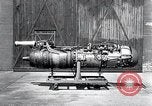
German jet-engine BMW-003 A1 with rocket booster
German rocket-boosted jet engine mounted on a dolly. Number 928 is painted on the engine. This is the BMW-003 A-1 jet engine with additional liquid-rocket motor type BMW 109-178, for boosting during take-off. ( First flight was on March 26,1945, during World War 2.)
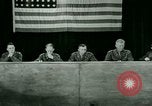
German civilian Pusch testifies in trial of Franz Strasser for shooting of American aviator prisoners; scenes from tribunal in Dachau (WW2)
Excerpts from 24 August, 1945 (World War II) military commission tribunal in Dachau. Swearing in of translator and charges read against Franz Strasser for: "Violation of the Laws and Usages of War. In that on or about 9 December 1944, FRANZ STRASSER, Kreisleiter of Kreis Kaplitz, an Austrian National, did at or near Kaplitz, Czechoslovakia, wrongfully and unlawfully kill an American airman, whose name, rank and serial number are unknown, [by shooting him with a machine pistol]. Strasser replies with a plea of not guilty. Next scene shows entry of German civilian truck driver, Josef Pusch, who is sworn in and provides testimony about the incident. Pusch describes the events of the shooting of the American prisoners by Strasser. United States flag and judges on raised platform. U.S. officials, defendants and civilians in the court room. Shows hearing as it begins. The Nazi commandant seated with other officials. The German civilian is questioned by an interpreter. German civilian Pusch identifies Strasser. Pusch gives his account to the tribunal about the shooting of the American flyers.
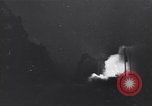
Soviet Katyusha rockets fired in Battle of Berlin; German civilians looting stores
Opening scene shows Katyusha rockets fired by Soviet forces in streets of Berlin at night during World War 2, during Battle of Berlin. They create fires in Berlin buildings leading to fire storm with whole buildings engulfed in flames. Soviet troops are silhouetted against the fire backdrop as they rush through the city streets. Insert of German film showing Adolf Hitler standing on a podium at a torchlight ceremony with Sturmabteilung (Storm Troopers) prior to World War 2. They march carrying torches as Hitler gives Nazi salute from the podium. Views of the torches in formation and glimpse of the Storm troopers marching. Film reverts back to 1945 and German prisoners of war being marched under guard as Soviet troops fire Katusha rockets in the background,during daylight, in Berlin. The Kaiser Wilhelm Memorial Church, on Kurfürstendamm is seen dimly. Soviet troops scamper among ruins of buildings and self propelled gun fires in a street. Desperate German civilians enter a damaged store and loot fabric and clothing as well as small boxes of goods. One man carries a huge pile of clothing and towels on his back.
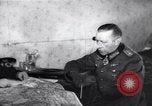
Soviet Field Marshal Georgy Zhukov and other Soviet officers inspect ruins of city after capture of Berlin during World War II.
Film begins showing German General Helmuth Weidling, commander of the Berlin Defense Area, who surrendered his forces to the soviets on May 2, 1945, during World War 2. He is describing to a Soviet officer, interogator, using a pointer and map, the defense tactics of his Berlin defense. He also describes the condition in which he found Adolf Hitler when he last visited him at his Berlin Chancery. He demonstrates the palsy-like shaking of Hitler's hand. German officer being questioned as he sits on a curb. Soviet officers examine charred bodies including a possible Hitler body double or doppelgänger, lying on the ground in courtyard of the German Chancery. The area filled with trash. View of a very tall steel tower. Closeup of the Soviet Red flag flying atop that tower. View of the damaged Quadriga statue atop the Brandenburg Gate. Soviet Field Marshal Georgy Zhukov and other Soviet officer pass under Brandenburg Gate. View of Kaiser Wilhelm monument. Marshal Zhukov and his party walking through central Berlin past various monuments and Government buildings. Several Nazi Eagle symbols are seen displayed on buildings. Crystal chandeliers inside one building. Destroyed interior of building. A cast head of Adolf Hitler in trash outside a building. Other statuary and Swastika symbols in trash. Marshal Zhukov and party stop to examine two damaged German armored cars in courtyard of a building. View of the Victory Column in Tiergarten Park adorned with a Soviet Red flag. Marshal Zhukov looking upward at it and then walking up steps toward the monument base.
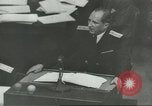
Hans Frank describes the atrocities inflicted on prisoners by the Nazis; Hoess testifies; footage of atrocity evidence.
During Nuremberg trial Hans Frank describes the Nazi policies of exterminating Poles and others. Atrocities inflicted on prisoners in Ourador Sur Glane, France in Bande, Belgium in Catacombe, Italy and in Czechoslovakia. Nazi German soldiers engaged in destruction following massacre of many residents in town of Lidice, Czechoslovakia in 1942 (retaliating for the assassination of SS officer Reinhard Heydrich.) Dead bodies in Nazi concentration camps, including Auschwitz, in 1945. Bones visible in crematory ovens. Victims inside crowded barracks including women prisoners who have been liberated. Large piles of items taken from victims before their deaths, including luggage, hair locks, toothbrushes, shaving cream brushes, shoes, clothing. Bones of victims piled at a concentration camp. Rudolf Franz Ferdinand Höss (sometimes spelled Höß or Hoess or Hess) describes concentration camps at Auschwitz in Poland during testimony. Victims in hospitals are shown, as words of Hess describe medical experiments include lowering the body temperature, injecting the body with poisons and infectious diseases and subjecting victims to high altitude pressure chambers. View of mutilated corpses. Sign that reads, "Arbeit Macht Frei" over the Auschwitz concentration camp gated entrance. Corpses of victims in the concentration camps.
Training film for U.S. troops with the Army of occupation in Germany after world War II
Opens with bell tolling Victory against Germany in World War II. Next, a slate reads: "Victory Leads to Peace," and a farmer is seen with cattle pulling a plow. But narrator says "the problem now is future peace," and a map of Germany is shown overlaid with "Your Job in Germany." A cartoon of a soldier is superimposed on the map, along with one of a World War 1 American soldier and a figure of possible future soldier with similar mission. Camera focuses on parts of German aircraft in a jumbled heap. Closeups of weary defeated German soldiers at end ot World War II. Glimpse of Adolf Hitler speaking and haranguing an audience from a podium in an animated and forceful way. Swastika flags displayed from houses in a quaint German town. Joseph Goebbels, Nazi Reich Minister of Propaganda, at a microphone. Glimpse of a German concentration camp. But as they appear, each of the Nazi elements promptly disappears, showing the scenes without such Nazi symbols and persons. Skeleton remains of bombed buildings. Flower displays. Bucolic German rural countryside and quaint old villages in peaceful settings. Camera focuses on a book titled "German History." Chapter I, titled "Blood and Iron," shows Image of Otto von Bismarck. German troops march in a parade. Narrator states that "under Bismarck, the German empire was built." (He formed the German Empire in 1871, unifying Germany with himself as Imperial Chancellor, while retaining control of Prussia at the same time.) The film shows mounted German lancers as it alludes to Bismarck's campaigns against Denmark in 1867; Austria in 1866; and France, in 1870. Germany's leaders celebrating its status, in 1871, as the mightiest power in Europe. Troops marching and girls dancing nearby. Farmers plowing field with a horse and cow. Classic peaceful rural alpine scenes with local people in agricultural pursuits. A group of local German musicians playing folk music as village people dance outdoors. Back to the book, Kaiser Wilhelm II is shown on Chapter 2, entitled: "Deutschland über Alles." Gathering of German soldiers in Pickelhaube (spiked helmets). A German Big Bertha howitzer firing. German troops marching against Serbia; Russia; and France (with view of war damaged French cathedral). German invasion of Belgium in 1940 (with view of clock tower resting in rubble). German troops seen in Italy, walking past battle-damaged buildings. German Zeppelin dropping bombs on British targets and view of bombed out London neighborhood. Next scene shows a capsized ship with survivors running across its hull. Film slate labels the scene as United States, as if it is a U.S. ship attacked by Germany. (Actually, it is the Austro-Hungarian Battleship, SMS Szent Istvan, torpedoed, by Italian torpedo boats, during World War I.) Next, American soldiers in trench are seen going "over the top" and into "no man's land" on the western front of World War 1. Glimpse through a window of Kaiser Wilhelm II, after defeat of Germany, in 1918. View of Germans in a Beer Garden. Picturesque view of German town. A German orchestra performing. American soldiers marching out of Germany, with flags waving. Back to the history book,as chapter III is revealed, entitled "Today Germany, tomorrow, the world," and featuring Adolf Hitler. German troops invading Austria (where a civilian lies dead on the ground). German troops entering Czechoslovakia (where local people in tears render the Nazi salute). They march into Poland (where a girl weeps over someone, not seen, on the ground). They march into France (where a wounded, bandaged child cries in a bed). Next, is a scene from England, where a British child victim of bombing lies dead in the remains of a shelter. German troops invading Norway, Holland, Denmark, Belgium, Luxembourg and Russia (where a woman tries to rouse a dead woman). They invade Yugoslavia (where women sit near coffins of children) and Greece (where a woman rescues a naked child). A U.S. merchant ship explodes after being torpedoed by a German submarine (unseen). Scenes of destruction with people plucking dead victims from rubble of buildings. American troops invading Normandy, France on D-day, June 6, 1944. Several American soldiers fall to German gunfire on the beach. Wounded American soldiers being transported in jeeps on the battlefield and being placed on landing craft for evacuation. Americans walking past huge piles of destroyed aircraft parts. A landing craft filled with wounded American soldiers. American wounded and dead on a battlefield. Sailors abandoning a burning American ship by jumping into the sea. A sailor picked up in a life boat. A wounded American soldier being dragged from the beachhead at Normandy. Various wounds being treated by U.S. Medical Corps personnel. More scenes of American wounded being moved on stretchers. Scene shifts abruptly to German people folk dancing. Film concludes with question marks about the future.