


 Francais
 Deutsch
 Italiano
Refine Your Search
+"Germany" +1945 stock footage and images
- Showing 1465 to 1470 of 2006 results more
more Hide
Hide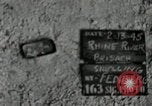
Infantrymen of U.S. 3rd Division,30th Infantry,2nd Battalion resting in a dugout near Rhine River in Vieux-Brisach,Germany.
Infantrymen of U.S. 3rd Division, 30th Infantry Regiment, 2nd Battalion in Vieux-Brisach, Germany, during World War II. Soldiers in a dugout near Rhine River, rest, shave, massage feet and write letters.

French General Marie Emile Antoine Bethouart presents French awards to U.S. officers in Bad Tolz, Germany after World War II.
French awards given to U.S. Generals at U.S. 3rd Army headquarters in Bad Tolz, Germany soon after World War II. U.S. General Lucian Truscott and French General Marie Emile Antoine Bethouart inspect French troops of the 27th Alpine Infantry Division and U.S. 3rd Army, 503rd Military Police Battalion, Company A. General Bethouart speaks before microphone. General Bethouart awards the Legion of Honor and Croix-de-Guerre to Commanding-General of U.S. 79th Infantry Division Brigadier General A. F. Kingman and Commanding-General of U.S. 102nd Infantry Division Major General Frank A Keating.

German prisoners board trucks at U.S. 3rd Army headquarters in Bad Tolz, Germany after World War II.
German prisoners and perpetrators of Dachau Concentration Camp at U.S. 3rd Army headquarters in Bad Tolz, Germany after World War II. Building with sign reading 'War Crimes Branch, Judge Advocate Division'. German prisoners arrive at courthouse in truck. Prisoners exit from enclosure in courthouse yard and board truck.
Film juxtaposing German defeat in World War 1, with its defeat in World War II, and comparative postwar impacts.
Film begins stressing the historic aggressive military traditions of Germany. A brief view of thousands of Adolf Hitler's Nazi troopers assembled in dramatic formation at the Nazi party rally grounds in Nuremberg, Germany. Explosion of the Nazi eagle, with swastika symbol, atop the Zeppelintribüne grandstand at Zeppelinfeld in Nuremberg, being blown up by U.S. Army soldiers at the end of World War 2 in Europe. Germans celebrating the armistice ending World War One. German soldiers captured, in unconditional surrender, ending World War Two. Huge open field filled with defeated German soldiers in the second world war. German armies parading through Berlin at the end of World War One. American troops occupying the entire country of Germany after the second world war. A Nazi eagle being destroyed on a German government building at end of the second world war. Old photograph of the German general staff, led by Helmuth von Moltke the Younger, that was still intact, after World War I. In contrast, after World War 2, the entire Nazi military was held and subject to trials at Nuremberg. Großadmiral Erich Raeder seen being taken in custody. Closeup of Field Marshal Wilhelm Keitel. German industry unimpaired by World War I, contrasted with utter destruction in the second world war. American officer coordinating resumed operation of of a postwar plant. View of German diplomats remaining in office after WWI. Proclamation barring Nazi party members from all offices after WWII. German Kaiser Wilhelm II in peaceful exile in Holland after the first world war. A Nazi officer war criminal, is taken in custody by American Military Policemen, and executed by a firing squad. World War 1 did not affect German schools and curriculums. After World War 2 all Nazi doctrines were destroyed. New text books and curriculums were prepared by the Allies for German use. Map shows small area of post World War 1 occupation, in contrast the the entire Germany after WWII. Weimar Republic government, post WWI is contrasted with post World War 2 government by the Allied military powers. British Marshal Bernard Montgomery, American General Dwight D. Eisenhower, Soviet Marshal Zhukov, and French General Charles de Gaulle, are shown. Views of American soldiers interacting with German citizens during their occupation of Germany. Images of Germans: Frederick the Great, Otto von Bismarck, and Kaiser Wilhelm. Views of German farmer sowing seed, postman delivering mail, policemen escorting children. Normal activities resumed in Germany, in areas of culture such as orchestral concerts, etc.
Tactics used by the Nazis to prove and sustain their theory of racial supremacy.
U.S. Army training film depicts racial theories used by the German Nazi party. Clip includes mix of actual footage and actor portrayals. Actors portraying Nazi leaders Adolf Hitler, Hermann Goring and others at their office. Next scene is authentic footage of book burning by Nazi soldiers. Actor portraying prisoner in jail cell. Actual view of people in Germany migrating with their belongings. Several views of University students crossing a bridge over River Lahn, and buildings of Philipps University of Marburg in Marburg Germany during the late 1930s or early 1940s. View of news commentator speaking at microphone of BBC radio. Cover page of an edition of The New York Times as example of media banned in Nazi Germany. Actual footage of Goebbels speaking and addressing a group. Footage of champion African American boxer Joe Louis fighting in the boxing ring. His fights were banned to be seen in Germany. View of scientist Albert Einstein walking in a garden area outdoors and then on a footpath toward what appears to be Nassau Hall of Princeton University in New Jersey, USA. Remainder of clip shows dramatized scenes with actors, as follows: Catholic priest and a judge express fear from hatred spread by Nazis and oppose Nazi theories. They were put into concentration camp. A teacher in class disapproves Nazi theory of racial supremacy. Nazi soldiers arrest him. (World War II period).
Representing the life of a typical Japanese soldier and celebrating the defeat of Germany in United States.
Germany and Japan defeated in World War II. The defeat of Germany is celebrated in United States. Scenes represent the life of a typical Japanese soldier: a flag is raised to celebrate his birth; boys in uniform play war; troops sack Nanking; and in1944 he is killed to attack over harbor in America. In a dramatization, a soldier with an American machine gun is killed. Dead Americans. American soldiers honor their dead comrades covered with United States flag.