


 Francais
 Deutsch
 Italiano
Refine Your Search
+"Germany" +1945 stock footage and images
- Showing 1501 to 1506 of 2006 results more
more Hide
Hide
Newsreel depicting victory of Allied military forces capturing German cities and Nazi officials to end World War II.
Newsreel titled 'Allied Drives Split Germany'. Allied troops, tanks and soldiers fight a fierce battle on the streets of Leipzig and gain the control. Allied soldiers seize and guard the radio station in Leipzig. Allied forces win Nuremberg and Braunschweig. Destroyed buildings and houses after the fight. A German commander surrenders to American Major General. Glimpses of Hitler's speech at Nuremberg in 1932. U.S. soldiers atop the same stadium building in 1944. British Army men prisoners liberated and given food and cigarettes. A camp near river Rhine where German prisoners are released and Nazi army officers surrender. German Generals arrested by the Allied Forces. Soldiers of the 3rd Army explore stashed gold and currency reserves of Germany hidden in a salt mine. They also recover stolen art and classic paintings from German museums. Civilians registered by Allied military officials. A crowd in market hears suspension of Nazi government. Nazi army uniforms, arms, caps and badges in a stack to be destroyed. A map showing German-Russian frontier. Russian tanks rushing into German borders after bombing their bases. Tanks advance between destroyed houses, rising smoke and explosion from fights. U.S. and British forces bombing Magdeburg on the Elba river.
United States B-17 drops bombs on German targets in Berlin during Second World War
A documentary titled 'The Battle of Germany' depicts United States B-17 bombers in Germany during World War II. U.S. Army Air Force B-17 Flying Fortress aircraft drop bombs on German targets in Berlin. Aerial views of bombers flying and dropping bombs with explosions of German targets. Flak bursts near bombers in flight. Shot of bombers returning home shows a stationary propeller on the camera-carrying aircraft, that was knocked out of action during the bombing run. Another B-17 lands and wounded flight crew is taken off the plane to an ambulance by medical personnel. A large group of flyers and crew stand near a B-17 aircraft with nose art name "I'll be around", and some sit on the aircraft. A crew member says to the camera, "Men, now that we've been the first ones to Berlin, how would you like to go back again?" The men then cheer.
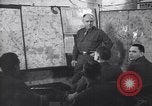
Colonel from G-2 (Intelligence) briefs Commander, 29th Infantry Division, and his staff, during World War II
Major General Charles Gerhardt, Commanding General, U.S. 29th Infantry Division, with members of his staff, at their Headquarters in occupied Germany, during World War 2. He stands in front of a series of maps and discusses the status and plan for the Allied offensive in Germany since the securing of bridgeheads across the Ruhr River. A Colonel from G-2 (Intelligence) explains the enemy capabilities and other details to the officers. He also answers General Gerhardt's questions.
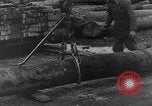
Colonel Damon Gun briefs Allied officers about the mindset of German people after bing defeated in World War II.
Allied Military Government activities in Europe after World War II. Men work in a saw mill. Planks of wood piled up as men work at the mill. A steel plant with production underway. A map of Germany. Damaged buildings. U.S. Colonel Damon Gun addresses Allied officers in Germany. He talks about the mindset of the Germans who have been cheated and led to defeat in World War II.
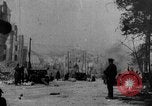
German civilians are instructed to clean up the streets of Berlin by the Russian Army.
Fall of Berlin, Germany in Battle of Berlin during World War 2. Russian Army attacks Germany. Flames and smoke rise from buildings. Russian soldiers fire artillery and run through the streets of Berlin. Survivors read signs in German language posted on the walls. The signs instruct the German civilians to clean up the streets. Old people carry bricks. Women shovel debris. Hand carts on the streets. Past events show people crowded on streets and cheering as the Nazi soldiers pass by. The civilians fight for bread and wait in line for soup. An old woman walks on the street as a building burns.
U.S. officials investigate atrocities, torture implements, and possessions of prisoners in the Ohrdruf Concentration Camp
The different implements and torture devices in the liberated Ohrdruf Concentration Camp operated by Nazi Germany in World War II. The gas chambers in the concentration camp in Germany. The shower in the bathroom through which the poisonous gas, Zyklon, was inducted when the prisoners took a shower. The blast furnaces used for cremation of dead bodies of prisoners. The garments of the prisoners being inspected by the officials. Women's clothes, infant shoes, toys and dolls in a room. The storage room in the mills with sacks of prisoner's hair packed. Prisoner's jewelry, watches and wedding rings in the room. The instruments used to pull out the teeth of the prisoners. An official holds a set of teeth.