


 Francais
 Deutsch
 Italiano
Refine Your Search
+"Germany" +1945 stock footage and images
- Showing 1795 to 1800 of 2006 results more
more Hide
Hide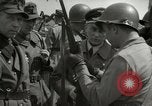
American 405th Infantry copes with large numbers of surrendering German soldiers at end of World War II in Europe
The American 405th Infantry Regiment receiving large numbers of surrendering German soldiers and officers at the end of World War 2 in Europe. A U.S. Army soldier standing with surrendered German officer and soldiers. He holds a rifle and discusses it with the officer. An American field grade army officer gives instructions to a German officer who then joins other German soldiers crossing a battle-damaged bridge over the Elbe River at Tangermünde, Germany. German soldiers join hundreds of others in a large outdoor area. More German soldiers cross the Elbe and are herded toward marshaling areas. One is deliberately tripped by an American soldier, as he passes. Another is stopped by an American soldier who pulls his SS insignia out of his jacket so it can be seen. The "Death Head" insignia is seen on his cap. Closeup of two German SS soldiers. Closeup of open area filled with German soldiers . St. Stephan's church in the background. Back at the bridge, surrendered German soldiers continue pouring across the river. A U.S. Army soldier hits, prods and strikes some of the German soldiers with the stock end of a sub-machine gun, as they pass. Closeup of a German SS officer being stopped by an American soldier, who removes a binocular case from him. German soldiers who have surrendered are resting on the ground covered by blankets. Others lounge about near a pile of personal gear including mess kits. A wooden wagon filled with straw stands behind them. Closeup of civilians including a woman and a child with head bandages, who are sitting in the wagon. View shifts to other side of the Elbe river where many civilians are gathered. The castle and St. Stephan's church is seen on the opposite shore. German soldiers standing near an open car door next to a jumble of bicycles and packs. A German officer resting on a motorcycle. Crowd of German soldiers queued up at the bridge. One German soldier carrying a Panzer Faust (hand-held anti tank weapon) crosses the field full of other German soldiers and civilians. A hatless German soldier holds a Luger automatic pistol. Several German soldiers resting on the ground with their rifles and gear. An American field grade army officer stands in front of a sign reading: "405 Inf" (405th Infantry Regiment of the 102nd Infantry Division). A sign in multiple languages is also seen. The American officer is next seen conversing with German officers, including Nazi German SS-Brigadeführer Jürgen Wagner (with the "Death Head" insignia on his cap).
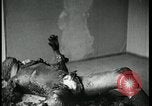
Burned body of Nazi German officer examined by Soviets during Battle of Berlin.
Burned body of a Nazi officer displayed in a room in area of Fuher bunker, in Berlin Germany, during battle of Berlin by Soviet Russian forces. A burned pistol grip hand gun is displayed next to the body. Soviet officers gathered to examine the body.

German spectators attend ice show in bomb damaged Berlin Sportpalast (WW2)
Nazi German administration organized an ice show for the war weary populace in the Berlin Sports Palace or Sportpalast (Ehemaliger Standort Sportpalast Berlin, Potsdamer Str. 172B, 10783 Berlin, Germany) in World War II. A woman ice skater is seen figure skating on the large ice rink of the Berliner Sportpalast. The stadium is roofless from bomb Allied bombing since January 1944. The narrator calls it "burned out." The steel skeleton of the roof supports is visible. The stadium seating is filled with spectators dressed in warm clothing. Some also use blankets. The audience includes many German soldiers in uniform, on whom the camera focuses during the film. German figure skater Lydia Veicht performs some spins to complete her performance, as the audience applauds enthusiastically. The audience clapping their hands. A man and woman perform next, dancing together on the ice. Finally, a troupe of women skaters perform on ice.
United States Generals Dwight Eisenhower, Omar Bradley, George S. Patton and Manton Eddy, inspect Ohrdruf Concentration Camp with the 4th Armored Division and concentration camp survivors, German civilians forced to tour camp during WW2
Survivors show United States soldiers around Ohrdruf Concentration Camp, part of the Buchenwald Concentration Camp network in Thuringia, Germany, after its liberation during World War 2. A group of concentration camp survivors talk to a United States soldier. A concentration camp survivor talks, behind him a fellow survivor smokes a cigarette. United States Generals Dwight Eisenhower, Omar Bradley, George S. Patton and Manton Eddy, inspect Ohrdruf Concentration Camp with the 4th Armored Division and concentration camp survivors. Surviving inmates show the concentration camp whipping post to United States Army soldiers and Generals Eisenhower, Patton, Bradley and Eddy. A United States soldier photographer takes pictures of the whipping post to collect war crime evidence. Generals Eisenhower, Patton, Bradley and Eddy walk ahead of American soldiers in Ohrdruf Concentration Camp. A woodshed containing piles of lime-covered bodies. Close view of bodies, starved with some riddled with bullets. View of George Patton, disgusted from the pile of dead bodies, as he inspects the woodshed a few feet away. General Dwight Eisenhower speaks with General Manton Eddy (center) and another United States General. Former inmates demonstrate to the United States Army how the Nazis torture them using a rack. United States Army and generals find fresh corpses of prisoners, gunned by Nazis shortly before the United States Army captured Ohrdruf. Corpse lying face down, with anal area covered in blood. General Dwight Eisenhower and other generals inspect the crude woodland crematory made out of railway tracks by the Nazis to dispose dead prisoners. Charred bodies and skeletons of inmates are on grill. General Dwight Eisenhower and General Omar Bradley inspect the crematory. United States Army trucks arrive in Ohrdruf Concentration Camp with German civilians. German civilians, with some are prominent Nazi Party members, are led by the United States soldiers on a forced tour of the concentration camp. A German medical major, tasked to accompany the German civilians during tour, stands next to jeep with red cross flag. Colonel Hayden Sears speaks to German civilians and American soldiers. United States general speaks to German medical officer. German civilians are led to courtyard of the camp, where there are 30 fresh corpses of prisoners who were killed shortly before the camp’s liberation. United States soldiers lead a group of former slave labor bosses to join their tour. United States soldiers show the German civilians the woodshed containing piles of quicklime-covered bodies. German civilians enter the woodshed upon insistence of Colonel Hayden Sears. German civilians walk away, some covering their noses with handkerchief, from the woodshed. Nazi slave labor bosses enter the woodshed upon insistence by United States Army. German medical officer and slave labor bosses leave the woodshed. German civilians and slave labor bosses tour the camp with United States Army. A German slave labor boss denies his knowledge about the atrocities against the prisoners. German civilians are made to see the charred remains of prisoners in crude woodland crematory. A United States soldier reads to German civilians and officers a list of atrocities committed against prisoners in the Ohrdruf Concentration Camp. Charred remains of a prisoner. German civilians listen to United States soldier.
U.S. Army Sherman M-4 tanks move along road, U.S. infantry engage in battle in a German town, white flags and prisoners of war.
United States Army M-4 Sherman tanks, carrying United States troops, roll along road toward Worms, Germany during World War 2. United States infantry soldiers engage in battle in a German town. United States infantrymen lead German prisoners of war out of building to the street. A United States M-4 Sherman tank rolls through town as infantrymen follow. German civilians on the street. White flags draped from windows of German houses as sign of surrender. United States M-4 Sherman tanks, carrying United States soldiers, roll through roadblock. German prisoners, with their hands in their heads, march out of town in a long POW line.
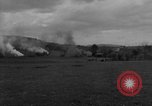
German troops surrender to United States troops, Polish prisoners of war in prison camp during WW2
116th Cavalry Regiment, 12th Armored Division, XXI Corps, Seventh US Army move toward Weilheim in Oberbayern during World War 2. Burning farmhouses in Bavarian countryside. German soldiers run across a field, raising their hands to surrender. At Werdenfelser barracks ( Oflag VII-A ) POW camp for Polish Army officers, Polish prisoners wave their hands to welcome United States troops. United States soldiers enter prison camp gate. Behind barbed wire wall, Polish prisoners greet US troops. German soldiers with raised hands, running from camp. Corpses of two executed SS men, Colonel Max Teichmann and Captain Widmann (some sources claim one body is that of Ernst Otto Fick) shot at approx. 3 pm that day by U.S. 1st Tank Division forces as they attempted to leave Murnau. United States Army vehicles enter Murnau Germany.