


 Francais
 Deutsch
 Italiano
Refine Your Search
+"Germany" +1946 stock footage and images
- Showing 175 to 180 of 181 results more
more Hide
Hide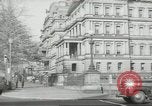
Lieutenant General Lucius Clay and officials discuss issues during a meeting at State Department Building in Washington DC.
Officials in a meeting at the State Department Building (Old Executive Office Building, 1650 17th St NW, Washington, DC 20006, United States) in Washington DC. Vehicles drive past the State Department Building. Officials in a meeting with a map on the wall in the background. Lieutenant General Lucius Clay (Military Governor of American Zone in Germany), Lieutenant General Sir Brian Robertson (Military Governor of British Zone) and Sir William Strang (Political Advisor to British Control). Edmond Hall-Patch (British Undersecretary of State) and Major General John H Hildring (American Assistant Secretary of State for Occupied Areas) in a meeting. The officials discuss issues during the meeting.
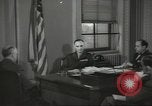
American Lieutenant General Lucius Clay speaks to reporters at State Department Building in Washington DC.
American Lieutenant General Lucius Clay (Military Governor of American Zone in Germany) makes statement to the press in Washington DC. American Lieutenant General Lucius Clay seated in the office with reporters. The General speaks to reporters as they take notes. One of the reporters questions General Lucius Clay.
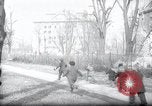
Black market crowd in Berlin post war.
People and children walking on a snow-clad road. Area around the Berlin Tiergarten with jeeps and car parked on the road. Brandenburg Gate (Brandenburger Tor) seen in background. Black market crowd seen in front of the Reichstag- the seat of the German Government in Berlin. Policeman directing the traffic. Soldier trying to click the picture of Russian War Memorial. Russian soldier bartering with a German civilian in post World War 2 Berlin.
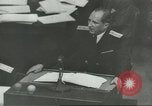
Hans Frank describes the atrocities inflicted on prisoners by the Nazis; Hoess testifies; footage of atrocity evidence.
During Nuremberg trial Hans Frank describes the Nazi policies of exterminating Poles and others. Atrocities inflicted on prisoners in Ourador Sur Glane, France in Bande, Belgium in Catacombe, Italy and in Czechoslovakia. Nazi German soldiers engaged in destruction following massacre of many residents in town of Lidice, Czechoslovakia in 1942 (retaliating for the assassination of SS officer Reinhard Heydrich.) Dead bodies in Nazi concentration camps, including Auschwitz, in 1945. Bones visible in crematory ovens. Victims inside crowded barracks including women prisoners who have been liberated. Large piles of items taken from victims before their deaths, including luggage, hair locks, toothbrushes, shaving cream brushes, shoes, clothing. Bones of victims piled at a concentration camp. Rudolf Franz Ferdinand Höss (sometimes spelled Höß or Hoess or Hess) describes concentration camps at Auschwitz in Poland during testimony. Victims in hospitals are shown, as words of Hess describe medical experiments include lowering the body temperature, injecting the body with poisons and infectious diseases and subjecting victims to high altitude pressure chambers. View of mutilated corpses. Sign that reads, "Arbeit Macht Frei" over the Auschwitz concentration camp gated entrance. Corpses of victims in the concentration camps.
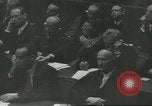
During Nuremberg trial Nazi leaders questioned by prosecution
During Nuremberg trial attorneys of Nazi leaders defend them. Nazi leaders Kaltenbrunner and others testify. Prosecution asks questions. Rosenberg, Kietel, Reader, Joachim von Ribbentrop, Goring. Walther Funk and Schirach make final statements.
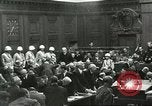
End of Nuremberg trials after World War II
Courtroom begins to empty as Nuremberg trials conclude. Military policeman in the Nuremberg Prison, just north of the Palace of Justice, checks prison cell of Hermann Goering (who later committed suicide). Guard checks cell of Joachim von Ribbentrop and Arthur Seyss Inquart in the prison in Nuremberg, where they were held during trial. Views of Military guards walking their posts, inside the main prison block corridors and outside the prison on roof top. Views of exterior windows of Nuremberg Prison. Guard on parapet and near towers of the prison. A crucifix statue of Christ with cross behind.