


 Francais
 Deutsch
 Italiano
Refine Your Search
+"Germany" +1947 stock footage and images
- Showing 37 to 42 of 50 results more
more Hide
Hide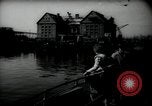
Docks of Berlin, Germany.
The Westhafen (West Harbor) of Berlin. A woman hangs laundry on the railing fence in Westhafen, a port connected by the Berlin-Spandauer Schifffahrtskanal and the Westhafenkanal to the Oder and Elbe rivers. The BEHALA (Berliner Hafen- und Lagerhaus AG) warehouse is seen. Closer view of the BEHALA warehouse and a container crane. Ships docked in Westhafen. Trains moving away from the platform near Westhafen.
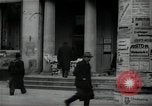
People at news stand in Kurfurstendamm in Berlin, Germany.
People buying from a newsstand in Kurfurstendamm, in the British Occupied Zone of West Berlin after World War 2. The building where the newsstand is located shows damage sustained from bombings. An advertising column (“Litfaßsäule” in German) stands in front of the building. People buy newspapers from the newspaper stand.
An enactment about U.S. Air Force personnel Carl W. Kramer as he prepares to go on a duty to a foreign land.
'To a Foreign Land' an enactment depicts duty on to a foreign land (Germany) of U.S. Air Force personnel Carl W. Kramer from the United States. Wife of Carl W. Kramer reaches and enters into her house. She receives a call of an officer. Officer tells her about overseas duty of her husband in Germany. On next morning, Carl reports in the office of U.S. Air Force personnel. Carl and officer talk about overseas journey and rental charges in Germany. Carl seeks permission to bring his wife and daughter overseas. Carl seated at a table and his wife cleans utensils. She talks to Carl. Their daughter 'Jenny' comes with her pet. Carl and his wife report at the office of USAF personnel. Personnel types a document and gives it to Carl's wife. Mrs Carl and her daughter pose in front of a camera to get a passport sized photo clicked in a photo lab. They go at a dispensary. Doctor examines Jenny. Dentist examines Carl. Carl works in his office. Carl signs a power of attorney of House and other things, by making Jenny and his wife beneficiaries. Carl and his wife discuss a problem at the office of USAF personnel. Carl meets overseas project officer. Carl and his family takes dinner. Their daughter gets upset. Mother explains to her. Carl and his wife realize separation in their married life.
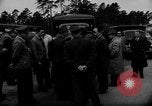
Following World War II, prisoners are repatriated to Soviet Zone of Occupation from the British zone.
Soviet and British officials hold discussions at the border between Russian and British zones of occupation in Germany, following World War II. Prisoners to be repatriated to the Soviet zone aboard several police vans. A prisoner displays a sandwich from the barred windows of a van. A guard raises the barricades on the British side and the vans proceed across a bridge into the Soviet zone.
M A. Musmanno calls three defendants for trial and B. Ferencz makes his opening speech at The Einsatzgruppen Case in Nuremberg.
The Einsatzgruppen Case in Nuremberg, Germany war crimes trials after World War 2. Judge Michael A. Musmanno announces that three defendants are to be arraigned separately because they were ill when the remainder of the prisoners were arraigned. The prosecutor, Ben Ferencz, makes his opening speech in which he says that the court is not looking for vengeance but rather a plea of humanity to law.
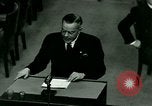
General Telford Taylor in courtroom and prosecution reads, the crimes done by the Einsatzgruppen, during a trial in Nuremberg.
The Einsatzgruppen Case in Nuremberg, Germany. General Telford Taylor in a courtroom. A member of the prosecution reads in part the description of the mass murders committed by the Einsatzgruppen. He also describes how the displaced persons, or DPs, were put into a van and gassed to death. One Einsatzgruppen detachment while making a report states that 121, 817 Jews were killed and that at one place they arrested all Jews over 16 and with an exception of the doctors and the elders all of them were executed. The leader of Einsatzgruppen reports that 15,000 Jews were executed in Schrewindt.