


 Francais
 Deutsch
 Italiano

Refine Your Search
+"Germany" +1954 stock footage and images
- Showing 37 to 42 of 54 results more
 Hide
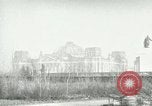
Incendiaries destroy the Reichstag dome in Tiergarten, Berlin, Germany.
Destruction of the Reichstag dome in Tiergarten, Berlin, Germany, which had been partially destroyed in World War 2. View of the Soviet War Memorial (Straße des 17. Juni 10623 Berlin) in the British zone of Berlin. The old Reichstag Building in the background. Incendiaries, tied to metal girders of the 50-ton dome, ignite and burn away the structure. Flames arise as the structure burns and collapses. A cameraman films people and cars moving across the street in front of the Brandenburg Gate (Brandenburger Tor).
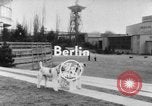
People bring their dogs from various countries for the International Dog Show to be held in Berlin, Germany.
Dogs from various countries at the International Dog Show held in Berlin, Germany. A German shepherd wears glasses, cap and jacket. Men and women come out of a car with dogs. Dogs inside the hall for the dog show.
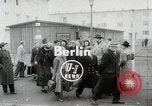
Refugees arrive and eat on dining tables in the refugee registration center opened with aid of U.S. in Berlin, Germany
A refugee registration center opens with aid of the United States in Berlin, Germany. Refugees arrive at the camp. The refugees enter a building. A man directs people. People sit with the registration forms. Men eat on dining tables in the refugee center.
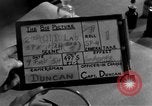
Laboratory technicians examine scissors and operate a vacuum type dust and lint extractor in Frankfurt, Germany.
The 27th Criminal Investigation Department (CID) laboratory in Frankfurt, Germany. Hands holding a magnifying glass focus on a pair of scissors. A laboratory technician with the magnifying glass examines the scissors. The laboratory technician operates a vacuum type dust and lint extractor over an olive drab (OD) uniform jacket. The nozzle of the vacuum type dust extractor as it is run over a sleeve and the shoulder of a coat. A sign on a door reads 'Chemistry Laboratory'.
Technicians operate an enlarger on a bullet hole sample in a fabric and develop prints in Frankfurt, Germany.
The 27th Criminal Investigation Department (CID) laboratory in Frankfurt, Germany. A CID technician makes time exposure on a bottle. The technician operates an enlarger on a bullet hole sample in fabric. A laboratory technician puts paper positive prints in a developing solution. The technician puts wet prints through a large drum drier.
A technician undertakes a bullet rifling test and technicians examine large prints in Frankfurt, Germany.
The 27th Criminal Investigation Department (CID) laboratory in Frankfurt, Germany. A CID technician examines a 45 type automatic making a bullet rifling test through a cotton filled drain. The technician moves up behind the drain, fires a round into a pipe like opening and immediately thereafter recovers the bullet from the cotton waste. A technician operates a machine. A sign reads 'Firearms identification section, Ammunition, No smoking'. Two CID technicians examine large 11x14 prints of grooves and rifling marks on teat bullets. A hand rests on a photograph of groove markings on bullet samples. Pen indicated a similarity in various photos.