


 Francais
 Deutsch
 Italiano
Refine Your Search
+"Hawaii USA" +1941 stock footage and images
- Showing 13 to 18 of 107 results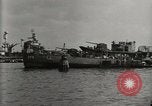
Ship wreckage at Pearl Harbor, Hawaii following Japanese attack of December 7,1941.
The Japanese attack on Pearl Harbor in Hawaii during World War 2 leads to destruction of U.S. Navy warships. A dock area. Destroyer USS Shaw (DD-373) partially submerged in floating drydock with USS Pennsylvania BB-38 in the background. The camera travels around the wreck of Shaw in the drydock. Men at work in the dock area. Various debris in water. A close up view of Shaw's damaged bridge area. Smoke comes out of a ship's stack.
P-40 aircraft peeling off, diving, and performing aerobatics in flight over Hawaii.
Views of 18 U.S. Army Curtiss-Wright P-40B aircraft (sometimes termed Tomahawk or Warhawk, though Warhawk properly applies to later variants than these) from Pursuit Squadrons at Wheeler Field, in formation flight over Hawaii. They are filmed from an airborne B-17D Flying Fortress. The P-40s peel off, one at a time. One P-40 performs aerobatics, executing two rapid rolls for the camera. During those rolls it is evident that, in addition to fuselage insignia, the aircraft displays national insignia only on its lower right and its upper left wings, in accordance with a scheme adopted in February, 1941. Footage is from before America's entry into World War 2.
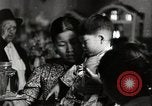
Japanese and Japanese American civilians at school, and working in offices and banks in Hawaii
School, office and bank in Hawaii in approximately 1941-1942 showing people of Japanese descent around the time that relocation centers for Japanese civilians were opened in the USA. A woman sits with a child. A woman shows cloth to other women. Man points to a diagram of building to other men. A Teacher in a school writes on a blackboard. Men in an office discuss. Man at bank counter gives a packet. A man and woman work in office. Exterior view of the Iolani Palace in Honolulu.
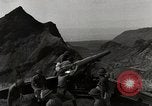
Japanese people worship in temples and salute the United States flag in Hawaii.
American soldiers practice with anti-aircraft artillery in Hawaii circa 1941-1942. People of Japanese descent visit a Shinto shrine and show respect to the United States flag. Flags of United States and Japan on display at entrance of a shrine or temple. Japanese civilians visit a Shinto shrine. They walk through a torii gate. Girls in kimono worship at the Shinto shrine. Priest bows in temple. A family of Japanese descent worships in shrine together. Japanese children carry the United States flag and hold hands over their hearts as the flag passes by during a civic ceremony. Woman serves punch at a social gathering. Men stand and talk. (World War II period, just before time of opening of internment camps and relocation centers for civilians iof Japanese descent).
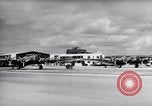
B-17 bombers of the U.S. 19th Bombardment Group arrive at Hickam Field after flying from San Francisco
Twenty one New B-17B bombers of the U.S. Army Air Corps 19th Bombardment Group are parked at Hickam Field in Honolulu, after flying 2400 miles from San Francisco, on May 31, 1941. Several views of the B-17s on the field. One simply displays the number 96 on its tail. A momentary glimpse of a Lockheed P-38 aircraft taxiing away, past parked B-17s. (World War II period).
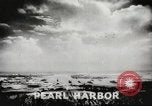
Japanese air attack on Pearl Harbor blows up U.S. battleships and destroyers in Honolulu, Hawaii during World War II.
A 1943 film about the December 7, 1941 Japanese air attack on Pearl Harbor in Honolulu, Hawaii during World War II. Film blends dramatized scenes with actual historic footage from the event. Formations of Japanese bombers approach Pearl Harbor. USS Arizona (BB-39) bombed. U.S. personnel aboard USS Arizona as the ship is bombed. Smoke billows up from the explosion. U.S. sailors aboard USS Oklahoma (BB-37). USS Oklahoma and USS California (BB-44) are bombed by Japanese aircraft. U.S. troops fire machine guns at Japanese aircraft. USS Cassin (DD-372), USS Downes (DD-375), and USS Pennsylvania (BB-38) bombed in the dry dock of Pearl Harbor. Ships in flames. USS Oglala CM-4 sinks after being attacked. Air raid alarms sound in Honolulu. Japanese people in Honolulu as the Japanese air raid on Pearl Harbor continues. A Japanese man being interviewed after air raid says he cannot think that Japanese aircraft attacked Pearl Harbor.