


 Francais
 Deutsch
 Italiano
Refine Your Search
+"Hungary" +1944 stock footage and images
- Showing 1 to 6 of 14 results more
more Hide
Hide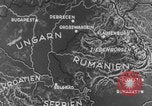
German aircraft attack Soviet tanks on Eastern front, and German forces invade Hungary in World War II
Film begins with a map of the South Eastern part of Europe, including countries of Hungary,Croatia,Serbia, and Romania. Then a German Air Force officer is seen dispatching aircraft to attack Soviet tanks on the Eastern front. Next are views from a cockpit of German Junkers Ju 87 (Stuka dive bombers) in flight. Closeup of a Stuka airplane inflight. It is equipped with a machine guns under its wings. More views from a cockpit of smoke rising from the ground, and then of Ju 87s strafing Soviet tanks. Narrator states that more than 300 Soviet tanks were destroyed. Scene changes to German soldier in a defensive position in Hungary, during the German invasion of that country in March, 1944 (Operation Margarethe). View of explosions in the distance. Brief closeup of a German soldier. German infantry leaving their defensive positions and advancing along a hill crest where they are silhouetted against the light sky. Artillery firing from hidden position near trees. Several scenes of burning buildings. German gun crew holding their ears as they fire a heavy artillery piece. A burning tank.
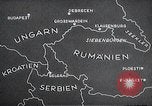
German 23rd Panzer Division engages Soviet and Romanian forces in Hungary (Northern Transylvania) on Eastern Front in World War II
Battle of Grosswardein, precursor to Battle of Debrecen, in World War 2. In late September, 1944, the German 23rd Panzer division was ordered to clear Grosswardein (aka Oradea or Nagyvárad) and environs occupied by Soviet and Romanian forces (who had switched sides a month earlier). In late September, 1944, the German 23rd Panzer division was ordered to clear Grosswardein (aka Oradea or Nagyvárad) and environs occupied by Soviet and Romanian forces (who had switched sides a month earlier). This was prelude to the World War 2 Battle of Debrecen, in October, 1944. Map shows areas of interest and reflects German treatment of Grosswardein and Debrecen as part of Hungary (Northern Transylvania), A German 88mm artillery piece is seen being towed uphill by a SdKfz 6 half-track. Battery of German 15 cm schwere Feldhaubitze 18 cannons being fired from high ground. Their shells striking at edge of wooded area. View of shells being loaded. Chalk writing on one "trotzdem siegen win" or in English "We will win despite all this". German Panther medium tanks move at the head of a column that includes Stug III and other armor. A Stug III camouflaged with tree branches. German armor advancing across and open field. Two tanks parked, and their crew members watching the battlefield. Explosions in the field. German machine gunners firing against Soviet infantry. Romanian soldiers surrendering in a grove of trees, are searched and processed as prisoners of war. German infantry moving through field of corn stalks, along with armored personnel carriers (Schutzenpanzerwagen SdKfz 250/10 Neu). A truck burning in the field, with a field piece attached on a towbar.

U.S. shuttle-bombing of German positions and military installations under Operation Frantic during World War II.
Film title slate indicates "Operation Titanic" but it, in fact, depicts "Operation Frantic" with U.S. shuttle bombing operations over Germany from bases in Great Britain, Italy and Russia during World War II. United States Army Air Force B-17 Flying Fortresses in flight. Aerial view of bombers in flight with several aircraft flying in formation leaving behind contrails. View inside bomber aircraft with bombardier preparing to drop bombs. View of bomb bay door opening and closeup of hand near bomb drop switch. Bombs awawy view as bombs are dropped from American aircraft. German defenses are bombed along the invasion coast of France (just prior to D-Day) on June 2, 1944. Aerial views of B-24 and B-17 bombers also in flight bombing German military installations in German-occupied northwestern Europe. Aerial view of a target area. Smoke rising up from bombardment. Two different U.S. Army Air Force B-17 Liberator aircraft are seen falling from the sky toward crashes after being hit by German enemy fire. One of them has smoke trailing from it, and the other is in a free fall. Railroad and marshaling yards are also bombed over Debrecen, Hungary on June 2, 1944, with aircraft continuing on (shuttle bombing) rather than returning to base. United States Army Air Forces B-24 Liberator flying in formation on June 21, 1944. Aerial view as they bomb the Focke-Wulf Fw 190 engine aircraft factory near Basdorf, Germany. German factories are bombed. B-17 aircraft on the same date are seeing in formation and bomb railway stations, freight yards, and factory targets, along with the Nazi German Ministry of War, Ministry of Propaganda, and Gestapo headquarters in Berlin, Germany. Heavy flak bursts seen in the air near the aircraft. Dogfight scenes as several German airplanes are shot down. Machine gunners aboard U.S. bomber aircraft firing at German fighter aircraft and shooting down 43 of them, according to narrator. Aerial view of ball turret rotating below bomber and firing guns at German fighter aircraft. The B-17s and B-24s bombing the targets. Synthetic oil plants and refineries are bombed at Ruhland Germany, east of Leipzig. Planning for the operation was done on December 7, 1943. A document about the operation is typed. Animated map shows Nazi positions and method of shuttle-bombing, allowing American aircraft to bomb from Soviet bases, and allies broadly to bomb German targets from bases in the United Kingdom, Italy, and Soviet Ukraine.
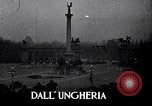
Hungarian military units parade on the streets of Budapest, Hungary during World War II
Hungarian troops in World War 2 gather for a parade in Heroes' Square (Budapest, Hősök tere, 1146 Hungary) at the end of Andrássy Avenue, in Budapest, Hungary. Millennium Memorial visible (also known as Millenary Monument). Monument pedestal visible with text AZ EZERÉVES HATÁROKÉRT, which means "For the Millennium Boundaries". Royal Hungarian Army soldiers and officers in cars, seated atop armored cars, and marching on foot. German Dornier DO-17 bombers in flight overhead. View of German military and Hungarian political dignitaries on stage, including Hungarian Prime Minister László Bárdossy. Officer fastens flag of the Kingdom of Hungary to the instrument of a trumpeter. Formations of Motorcyclists lead a parade along a main thoroughfare. Many open trucks carrying troops take part. Some tow light field artillery pieces. Military members and civilians (almost all women) stand on either side of the road to witness the event. The civilians wave and cheer. Many Hungarian 39M Csaba armored scout cars assembled in front of the Museum of Fine Arts Budapest (Budapest, Dózsa György út 41, 1146 Hungary) beginning to join the parade. A Japanese boy and girl are seen in the crowd smiling and displaying a Japanese flag. Clip ends showing vehicles towing 40mm Bofors anti-aircraft guns on wheeled mountings.
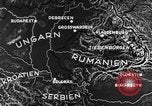
German Luftwaffe Ju-87 Stuka dive bombers attack Soviet tanks. German troops on the ground in Hungary during World War II
German Air Force engages Soviet ground forces in Hungary during World War 2. Opening scene shows map of Hungary, Croatia, Serbia, Romania. Next, in view from cockpit , a loose formation of German Ju-87 Stuka dive bombers is seen in flight. They bomb and strafe Soviet tanks on the ground. (Narrator states that German aircraft flew thousands of missions destroying more than three hundred Soviet tanks.) German soldiers are seen in trenches in Hungary. Next, are scenes of fires and of German soldiers near a burning Soviet tank.
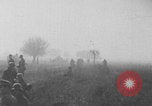
Operation Margarethe, the German occupation of Hungary in World War II
As film opens, German troops invading Hungary in World War 2, are seen informally gathering as two Sturmgeschütz III (Stug III) assault guns pass them along a dirt road in Hungary. German Officer lying in grass looks through binoculars. View of a Sturmgeschütz IV (Stug IV) assault gun with side protectors moving past a towed piece of field artillery. German infantry walking across a field as two Stug IVs pass them. German officers pointing at possible targets. Crew member standing in Marder II (Sd.Kfz.131) anti-tank gun as it fires its gun in the direction of a fire burning in the distance down the street. A soldier peers through binoculars. A vehicle is seen in flames. A German soldier hunkers down next to a wall. A destroyed truck in the background. A dead Hungarian soldier lying in a ditch. A burning truck on the street next to him. German soldiers move a Hungarian soldier hiding among the dead, who turns and holds his hand up. German infantry behind Stug and walking through garden gates and fences in back yards of homes, and along muddy road. German soldier waves his hand through top access hatch. German infantry soldiers fire rifles and German armored vehicles fire their guns.