


 Francais
 Deutsch
 Italiano
Refine Your Search
+"Iraq" +1945 stock footage and images
- Showing 1 to 5 of 5 results
Effects of the atomic bombing of Hiroshima, Japan, in World War II, and early international efforts to control atomic weapons
Film showing city of Hiroshima, Japan, before and after the August 6, 1945 dropping of the atomic bomb over the city in World War 2. Sequence opens on what the narrator says is August 5, 1945, the day before the event (but the footage is likely from before that date). Camera pans over the city of Hiroshima before the atomic bomb destroyed the city. Japanese air raid lookouts are seen on watch for allied bombers. View of atomic bomb detonation as seen from aircraft high overhead (this is actually a view of the Nagasaki blast, not the Hiroshima blast despite narrator's comments). Next, the complete destruction of the city of Hiroshima is seen from camera at low altitude showing the four and one half square miles of the city flattened and burned. A Japanese hospital still functioning, with red cross flag on it. Hospital workers retrieving wounded victims of the bombing. Ambulatory victims clustered in doorways and halls. Shadow image of a large industrial valve wheel burned onto wall behind it. Similar image of a ladder burned onto a wall. The decorative pattern on a woman's dress burned onto skin of her back. Japanese physicians treating victims of thermal and radiation burns. Views of various victims, including some children, and their respective injuries. Scene shifts forward one year, to August 6, 1946. Children are lined up outside a school building, and then seen inside their classroom. Disfiguration and wounds on children resulting from injuries are still evident on the children at their desks. Sequence shifts again, this time to an early United Nations meeting with delegates grappling with the issue of controlling nuclear power and atomic weapons. Closeup view of American delegates, including James F. Byrnes (Secretary of State)and James B. Conant, President of Harvard University in the assembly. Closeups of representatives from South Asian nations. Closeup of USSR delegation, headed by Foreign Minister, Vyacheslav Molotov. Signs identifying delegates from Colombia, Egypt, Iraq, Bolivia, China. Final sequence shows several U.S. atomic scientists in their respective laboratories, including Enrico Fermi and Vannevar Bush. United States representative to the UN, Warren Austin, speaking about the so-called Baruch Plan, for international control of atomic weapons. (Principal author, Bernard Baruch, is standing behind speaker's left shoulder.) USSR delegation, headed by permanent representative, Andrei Gromyko, who is seen presenting the Soviet plan. View of explosion and mushroom cloud during U.S. Operation Crossroads atomic bomb test in the Pacific.
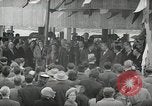
Iraq Petroleum Company (IPC) facilities post World War II
Iraqi and British officials at an event involving visitors at a facility of the Iraq Petroleum Company, following World War 2. Officials emerge from a warehouse building. One official wears sunglasses and holds a tobacco pipe. British officials accompanied by wives, walk along a boardwalk to a gangplank, where they climb aboard a ship. Change of scene shows a. street scene at a bridge where several street vendors display their wares. City buildings across the bridge, in background. A man wearing keffiyeh walks past. Camera moves to the wellhead inside an oil drilling rig, where Iraqi "roughnecks" are working with Byron Jackson Company oil drilling equipment. They insert a new section of pipe and proceed with drilling. Views up and down of the drill rig in operation. Views of other areas at the petroleum complex. Two huge pipes lying parallel. A worker climbs stairs of oil tank no. 235. Technicians work on large pieces of piping. View of a ship docked near the facility, on the Shat Al-Arab. At this point, the scene switches completely to the Persian Gulf City of Dubai and a waterfront scene dominated by Ali Bin Abi Talib mosque. (This is number 3, of three mosques by that name in the area, and is located on the creek in the old Bur Dubai part of the city.)
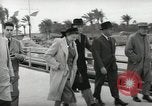
Operations at Iraq Petroleum Company (IPC) facility after World War II
Brief glimpse of British visitors walking toward a ship, after a postwar visit to an IPC facility in Iraq. Scene shifts to an oil derrick and drilling rig rising above oil storage tanks at a sandy site. Camera pans up the derrick. Change of scene shows gathering of British people with IPC officials at some kind of event. Next, a group of officials is seen briefly, outside a facility warehouse. Two men greet each other. A military officer stands nearby. Camera then jumps to inside the oil rig, shown earlier where Iraqi "roughnecks" wrestle pipe, insert a new section, and continue drilling. View of worker walking among oil tanks at the facility. Views of natural gas compressors; large transmission pipes; and a worker closing one, in a set of valves at the site. Broad view from the derrick, showing supplies and equipment laid out in the sand and a vista of miles, with distant structures including (possibly) worker housing and support facilities.
Traces the route of lend lease activities of American goods bound for Russia via Iran and Iraq
Lend lease activities at American outposts in Iran. Traces routes of American shipments from United States to Iran. Cargo unloaded from ships at ports in Basra, Iraq and Khoremshar, Iran. Exterior views of U.S. military base building complex in Iran. Group of local civilians crouched and breaking a pile of rocks into smaller pieces. Aerial view of harbor area. Dock-side view of ships harbor offloading supplies. Boxes including a food box labeled "Pork Luncheon Meat" from the American company Armour and Company, and many others are unloaded and stacked at port by African American personnel. Line of African American soldiers or sailors on dock receiving food in a chow line. Railroad engines and train cars being unloaded at port. A Soviet military officer walks with a checklist and checks the shipments. Massive piles of supplies including food, tires, trucks received from America. Soviet officer reviewing supplies with an American officer.
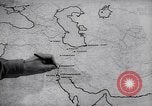
Lend-Lease material to Russian seen in Iran and Iraq; and view of General Motors plant in Khoremshar, Iran (WW2)
World War II Lend-Lease activities to Russia via American outposts in Iran and Iraq. Traces routes of American shipments from Basra to other positions in Middle East. A convoy of trucks takes war material under lend lease activities from Basra. An officer checks the papers of the shipment. Freight trains carry shipment. A map traces route of war material shipment from Basra to Tehran. Workers at General Motors assembly plant in Khoremshar, Iran.