


 Francais
 Deutsch
 Italiano
Refine Your Search
+"Italy" +1918 stock footage and images
- Showing 7 to 12 of 23 results more
more Hide
Hide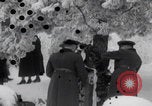
Tsar Boris III and King Alexander I pay their respects in front of a war memorial and meet in Belgrade
State visit of Bulgarian Tsar Boris III in Belgrade, Yugoslavia. King Alexander I (Aleksandar I) of Yugoslavia meets Tsar Boris III of Bulgaria. Tsar Boris III and King Alexander I and other officials walk in the snow together. The two monarchs salute in front of a monument and lay a wreath at the base of the memorial. (Based on text descriptions, this is possibly the original, smaller memorial to the Unknown Serbian Soldier, which was later replaced by the Monument to the Unknown Hero that was built atop the demolished Žrnov and completed in 1934. The original memorial, near Žrnov at the Avala mountain, was completed in June 1922. It reportedly had a plaque that read, "To the fallen heroes in the wars for liberation and unification 1912-1918, this monument is erected by the thankful people of the Vračar District. Consecrated on 1 June 1922." Another inscription read: "Unknown Serbian soldier confirmed by the commission on 29 November 1921". The text descriptions of the form and size of the 1922 memorial appear to match the memorial seen in this footage.) Honor guard of Yugoslavian soldiers depart the snow covered memorial area carrying a flag bearing the greater coast of arms of Yugoslavia. In next scene, Tsaritsa Giovanna of Italy, wife of Tsar Boris III, and Queen Maria of Yugoslavia leaving the royal residence in Belgrade. Final scenes show a car arriving in front of the royal residence and officers emerge. Another car arrives and women emerge to enter the residence. A brief frame or two of the film around timecode 02:29 shows four young children posing for the camera. The one on the far left, in the wide brim hat, is possibly Peter II Karađorđević, later King Peter II of Yugoslavia. Final scenes show the officials royalty emerging from the residence again and posing on the front steps.
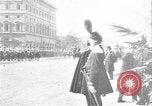
King Peter I of Serbia and Victor Emmanuel III, King of Italy, share a carriage in Rome, Italy (WW1)
High ranking military officials review a parade of military units from in front of the Palace of Justice (Palazzo di Giustizia, Piazza Cavour, 00193 Roma RM, Italy) in Rome, Italy, during World War I. Potted plants decorate the Palace entrance. King Peter I and King Victor Emmanuel III of Italy, step into a royal carriage. The two converse briefly while they wait for the footmen to take their places in the back of the carriage. The carriage then proceeds with King Peter I and King Victor Emmanuel III. Scene shifts to front of the Palace, again, where many civilian dignitaries have gathered to watch the military parade.
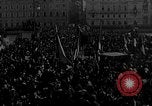
Troops returning to ports in Italy and France at end of World War I.
Montage of scenes with soldiers returning to Italy and France at end of World War 1. A large troop ship docked at a port in Italy, carrying returning Italian soldiers. Huge crowd assembled on the wharf. Supplies being unloaded from a ship. A few U.S. soldiers are seen. A field kitchen set up on the wharf and Italian troops being fed. American and Italian flags fly above the wharf shelter roof. Crowds on streets in France. French General Petain enters a car and is given a large bouquet of flowers (which he promptly gives to an officer accompanying him in the front seat of the car). French President Poincare joins Petain in the back seat of the car and they drive away. Scene shifts to the port in Italy, again. Men wave the Italian Naval ensign flag.
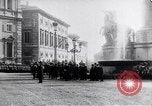
King Peter I of Serbia and King Victor Emmanuel III of Italy travel to the Quirinal Palace in Rome during World War I
The Cuirassiers Regiment (Reggimento corazzieri) honor guards escort a Royal Carriage carrying King Peter I of Serbia and King Victor Emmanuel III, in Rome, Italy, during World War 1. They proceed past the Quirinal Palace (Piazza del Quirinale, 00187 Roma RM, Italy). The procession also moves past the Fontana dei Dioscuri, fountain in the Piazza del Quirinale, and into the entrance of the Quirinal Palace (Palazzo del Quirinale). Several other carriages follow, also with the Cuirassiers Regiment escorts.
King Peter I, of Serbia, King Victor Emmanuel III, of Italy and his Queen (Elena of Montenegro) on a balcony in World War I
Attendants spread a cover across a balcony above the main entrance of the Quirinal Palace (Palazzo del Quirinale) in Rome, Italy, during World War 1. Then, King Peter I, of Serbia, King Victor Emmanuel III, of Italy and his Queen (Elena of Montenegro) appear on the balcony. A huge crowd of people cheer them from the plaza below (Piazza del Quirinale),
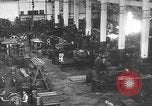
Manufacture and assembly of army trucks at war plant in Italy
Italian workers manufacture and assemble army trucks at a war plant in Italy. Heavy mechanical parts are moved with hoists in the assembly area. Women at sewing machines make canvas covers for army trucks Finished trucks line up and drive away from the plant. (World War I; World War 1; WWI; WW1)