


 Francais
 Deutsch
 Italiano
Refine Your Search
+"Italy" +1921 stock footage and images
- Showing 1 to 5 of 5 results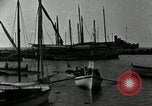
Enrico Caruso and his family at an Italian port.
Enrico Caruso with his wife arrive in a boat. Caruso and other debark. Caruso and his wife at the dock. Stationary boats in the background.Caruso plays a hand-clapping game with several women. His wife goes into the water to swim. He teases her. Caruso picks up a chair and approaches the cinematographer threatening, playfully, then sets chair down and sits on it, backwards. He engages in fun, joke boxing with a young man. Caruso hold his daughter and his wife stands next to him. [Note: These are last known surviving moving images of Enrico Caruso, taken in Italy 1921, only a few weeks before his untimely death. His daughter Gloria (seen in the film) was born in December 1919, and was a year and a half. Enrico Caruso died from pleurisy in Sorrento on August 2nd, 1921, aged 48.]
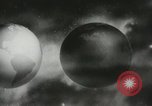
Rise of Fascism in Italy and Germany after World War I
Animated map depicts the spread of Fascism in Japan, Germany and its neighboring countries, and Italy. Views of Italian Fascist "Black Shirts" marching bearing flags and rendering the fascist Roman Salute. Fascists participating in the famous "March on Rome" (“Marcia su Roma”) in October 27, 1922. Spectators line the sidewalks and side of the road. Brief (jerky) views of unrest and desperate crowds of citizens in post-war Italy circa 1919 and 1920 following World War I, due to unemployment and hard times. Italian people getting food at an outdoor soup kitchen. Fascists promising better times are seen parading and riding in jammed open cars. Benito Mussolini, who was elected to Parliament in 1921, is seen in a top hat, arms akimbo, standing with other officials. Glimpse of Black Shirts marching in front of the Palazzo Venezia (Via del Plebiscito, 118, 00186 Roma RM, Italy). Back to Mussolini, again, who now makes some remarks to those standing with him and expresses himself with exaggerated body language. Another glimpse of Black Shirts marching. Film transitions to Germany, where Adolf Hitler is seen walking through a dense crowd of supporters and some brownshirts or SA stormtroopers. Hitler's clothes resemble a military uniform. Next, scenes illustrating the terrible post-World War 1 hyperinflation suffered by Germany during the Weimar Republic. Various Deutschmark (Deutsche Mark) banknotes in ridiculous denominations are shown. Baker puts a 460 billion Deutschmark price on bread. People trying to buy groceries during this period. German militaristic marchers. Fascists giving arm salutes as they parade in a city street. General Field Marshal Paul von Hindenburg (President of Germany) is seen standing in front of Germany's top military leaders. Directly behind him is Marshal August von Mackensen, in a fur busby hat with Totenkopf (death head) insignia. Other Generals wear pickelhaube spiked helmets. Hindenburg's closest associate, General Erich Ludendorff stands just behind and to the left of Hindenburg. Glimpse of German soldiers in more modern uniforms. Next, Hindenburg is seen reviewing troops in the company of their commander. Next, Hitler is seen with a group of German civilian industrialists whose interests he promises to support. Alfred Krupp Jr. sits, with his legs crossed, next to Hitler. Glimpse of Hitler, in uniform, waving from a window. People running as a cadre of mounted police canter in formation down the street.
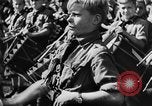
Fascism growth despite pre-World War 2 disarmament efforts including Washington Disarmament Conference, Nine-power treaty.
The background of World War II. German Hitler Youth children march with rifles, flags and a band beneath a camp entrance named Nordmark Lager 1935. Flag with Nazi symbol. Japanese flag and Japanese youth march in military exercises, followed by teenage Japanese forces. Italian fascist troops in uniform march in Torino Italy led by a band. Views of various German and Nazi forces parade and goose step in various cities. Units include brownshirts, goosestepping Storm Troopers, Wehrmacht. Civilians give a salute. Mostly sad looking men women and children watch the parades. The world globe. U.S. Capitol Building in Washington DC. French, Japanese and United States dignitaries attend the Washington Disarmament Conference or Washington Naval Conference at Memorial Continental Hall in Washington DC in 1921. View of the Washington Naval Treaty naval fleet reduction treaty book with signatures on it. Officials sign the Nine-Power Treaty that guarantees the integrity of China (per the John Hay "Open Door Policy"). Japanese delegation is shown at signing ceremony for the Nine-Power Treaty. Next scene shows 1928 signing ceremony in Paris of the Kellogg-Briand Pact renouncing war as a means of settling international disputes. French Foreign Minister Aristide Briand is seen speaking, and American Secretary of State Frank Kellogg is also seen at the treaty signing which was signed by 47 nations including Germany and Japan. In a 1930 scene, U.S. Secretary of State, Henry Stimson hands the London Naval Treaty to President Herbert Hoover. Scene of a U.S. Navy ship being blown up and scrapped in accordance with the treaty terms. View of American citizens in small town parades with floats marching as anti-war and isolationist groups.
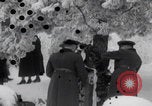
Tsar Boris III and King Alexander I pay their respects in front of a war memorial and meet in Belgrade
State visit of Bulgarian Tsar Boris III in Belgrade, Yugoslavia. King Alexander I (Aleksandar I) of Yugoslavia meets Tsar Boris III of Bulgaria. Tsar Boris III and King Alexander I and other officials walk in the snow together. The two monarchs salute in front of a monument and lay a wreath at the base of the memorial. (Based on text descriptions, this is possibly the original, smaller memorial to the Unknown Serbian Soldier, which was later replaced by the Monument to the Unknown Hero that was built atop the demolished Žrnov and completed in 1934. The original memorial, near Žrnov at the Avala mountain, was completed in June 1922. It reportedly had a plaque that read, "To the fallen heroes in the wars for liberation and unification 1912-1918, this monument is erected by the thankful people of the Vračar District. Consecrated on 1 June 1922." Another inscription read: "Unknown Serbian soldier confirmed by the commission on 29 November 1921". The text descriptions of the form and size of the 1922 memorial appear to match the memorial seen in this footage.) Honor guard of Yugoslavian soldiers depart the snow covered memorial area carrying a flag bearing the greater coast of arms of Yugoslavia. In next scene, Tsaritsa Giovanna of Italy, wife of Tsar Boris III, and Queen Maria of Yugoslavia leaving the royal residence in Belgrade. Final scenes show a car arriving in front of the royal residence and officers emerge. Another car arrives and women emerge to enter the residence. A brief frame or two of the film around timecode 02:29 shows four young children posing for the camera. The one on the far left, in the wide brim hat, is possibly Peter II Karađorđević, later King Peter II of Yugoslavia. Final scenes show the officials royalty emerging from the residence again and posing on the front steps.
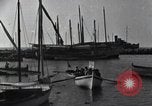
Enrico Caruso, an Italian opera singer on a ship with his family in Italy.
Enrico Caruso in a boat at a harbor in Italy. He talks to his wife. She swims. He holds her baby and talks to her. His wife stands near him.