


 Francais
 Deutsch
 Italiano
Refine Your Search
+"Italy" +1934 stock footage and images
- Showing 1 to 6 of 13 results more
more Hide
Hide
Abyssinian Border disputes and the beginning of the Second Italo-Ethiopian War
Start of the 2nd Italo-Ethiopian War (Second Italo-Abyssinian War).Map shows Red Sea, Arabian peninsula, and Africa, and highlighting Ethiopia and its capital, Addis Ababa, along with Djibouti and the regions of Erythree (Eritrea) and Somalie Italienne (Italian Somaliland). Following border controversies, Narrator states the matter came to a head when Italian and Ethiopian elements clashed at Welwel oasis (aka Walwal, or Ual-Ual).on November 26, and again, on December 4, 1934. Views of League of Nations council reviewing the situation. (They later concluded, on October 7, 1935, that Italy violated Article 12 of the League Covenant, by its invasion on October 3rd.) Crowds are seen demonstrating in Ethiopia. Italian forces are seen embarked on a ship as part of Italy's force buildup. Italian forces, including armor and infantry, are seen in their wholesale invasion from Eritrea, into Ethiopia, on October 3, 1935. With war declared, Ethopian troops muster in areas of the Capital, Addis Ababa. Ethopian tribesmen are seen answering the call to arms
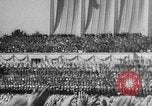
Growth of the German Nazi party and military might (German remilitarization) during the 1930s leading up to World War II
Nazi rally in Nuremberg, Germany ca.1934. Massed Storm troopers and spectators salute Hitler. An artillery piece is fired. Hitler personally recognizing loyal Storm troopers. Animated map of Asia, showing Japanese occupation of Manchuria, and Italian occupation of Ethiopia. Newspaper headlines describe Britain and France hesitating to support League of Nations oil sanctions against Italy; and U.S. increasing its oil exports to Italy by 600% (ca. 1935). Hitler and Hermann Goering looking pleased in Hitler's private railroad car. Adolf Hitler at a planning table covered with maps. German citizens traveling abroad and Joachim von Ribbentrop visiting London, as ambassador to Great Britain, in 1936. View of Léon Degrelle and his Catholic-fascist, Rexist party in Belgium (ca. 1936). View of Colonel Francois de la Rocque speaking at a Cross of Fire (Croix-de-Feu) party night rally in France. Konrad Henlein, leader of the Sudeten German Party in Czechoslovakia. Arthur Seyss-Inquart, Austrian National Socialist official, seen in an automobile during a parade. Sir Oswald Mosley addressing followers and defending Hitler. Street scenes of public disorder attributed to Nazi sympathizers in France and Belgium. Mass meeting of the German American Bund in Madison Square Garden, New York City,1939. U.S. flags and picture of George Washington decorate stage. Fritz Julius Kuhn addresses the gathering and members rough up a protester. Views of heavy industry in Germany, especially steel manufacturing for remilitarization. Persons working at a German concentration camp. Dramatized execution by machine gun. View of Heinrich Himmler. German President Paul von Hindenburg. German national conscription of 1935 during military mobilization efforts. German youth training pilots with gliders. German paratroopers, Junkers 52 aircraft, German soldiers goosestep, views of German tanks. Ju 87 Stuka plane. German invasion of Rhineland, 1936. Construction of Siegfried Line. Antitank barriers, bunkers, dragons teeth. Hitler visiting Westwall. German military parade.
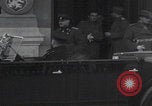
King Alexander I of Yugoslavia, Tsar Boris III of Bulgaria, and their wives meet officials in Belgrade, Yugoslavia
King Alexander I (Aleksandar I) of Yugoslavia and Tsar Boris III of Bulgaria board a car in front of a building during the Bulgarian tsar’s state visit to Belgrade, Yugoslavia. Tsaritsa Giovanna of Italy, wife of Tsar Boris III, and Queen Maria of Yugoslavia are seen with other government officials in front of the building. The coats of arms of Yugoslavia and Bulgaria are seen in columns. Tsaritsa Giovanna of Italy and Queen Maria of Yugoslavia talk to King Alexander I, Tsar Boris III and officials before they are seen in a car together. Tsar Boris III, King Alexander I, and their wives walk together. Yugoslav troops stand at attention in snow on snow covered road. Yugoslav civilians cheering during a parade for Tsar Boris III in Belgrade. Yugoslav troops holding a flag bearing the Greater coat of arms of Yugoslavia. Tsar Boris III and King Alexander I arrive at a monument. Snow covered monument with floral wreaths. Name of monument is inscribed in Serbian Cyrillic. Troops stand at attention. (Based on text descriptions, this is possibly the original, smaller memorial to the Unknown Serbian Soldier, later replaced by the Monument to the Unknown Hero that was built atop the demolished Žrnov and completed in 1934. The original memorial, near Žrnov at the Avala mountain, was completed in June 1922. The form and size of the 1922 memorial appear to match the memorial seen in this footage.) Next scene is back in Belgrade, as Yugoslav men are waving their hats on the street. Yugoslav troops stand at attention and march on snowy street. Tsaritsa Giovanna and Queen Maria shake hands with officials. King Alexander I of Yugoslavia and Tsar Boris III of Bulgaria and their wives climb down from their car. Tsar Boris III’s siblings, Kiril, Prince of Preslav and Princess Eudoxia, and an unidentified man are also seen with them. A footman assists Tsaritsa Giovanna.
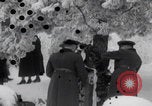
Tsar Boris III and King Alexander I pay their respects in front of a war memorial and meet in Belgrade
State visit of Bulgarian Tsar Boris III in Belgrade, Yugoslavia. King Alexander I (Aleksandar I) of Yugoslavia meets Tsar Boris III of Bulgaria. Tsar Boris III and King Alexander I and other officials walk in the snow together. The two monarchs salute in front of a monument and lay a wreath at the base of the memorial. (Based on text descriptions, this is possibly the original, smaller memorial to the Unknown Serbian Soldier, which was later replaced by the Monument to the Unknown Hero that was built atop the demolished Žrnov and completed in 1934. The original memorial, near Žrnov at the Avala mountain, was completed in June 1922. It reportedly had a plaque that read, "To the fallen heroes in the wars for liberation and unification 1912-1918, this monument is erected by the thankful people of the Vračar District. Consecrated on 1 June 1922." Another inscription read: "Unknown Serbian soldier confirmed by the commission on 29 November 1921". The text descriptions of the form and size of the 1922 memorial appear to match the memorial seen in this footage.) Honor guard of Yugoslavian soldiers depart the snow covered memorial area carrying a flag bearing the greater coast of arms of Yugoslavia. In next scene, Tsaritsa Giovanna of Italy, wife of Tsar Boris III, and Queen Maria of Yugoslavia leaving the royal residence in Belgrade. Final scenes show a car arriving in front of the royal residence and officers emerge. Another car arrives and women emerge to enter the residence. A brief frame or two of the film around timecode 02:29 shows four young children posing for the camera. The one on the far left, in the wide brim hat, is possibly Peter II Karađorđević, later King Peter II of Yugoslavia. Final scenes show the officials royalty emerging from the residence again and posing on the front steps.
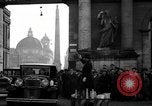
Citizens in Rome Italy give Christmas gifts to traffic policemen and people crowd on streets in Rome, Italy.
Gifts given to traffic policemen in Rome, Italy. A historical building in the background. People crowd on a street. A man gives gifts to the traffic police. The gifts are kept at the center of the road in a growing pile beside a policeman on duty. From a December 14, 1959 newsreel recounting events 25 years earlier.
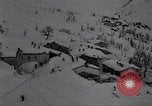
People remove snow from houses after avalanches in Northern Italy.
Destruction due to avalanches in Northern Italy. Snow covered buildings and huts. People remove snow with spades. People remove snow from a damaged house. Heavy snow on the ground and houses. People struggle to clear it and search for avalanche survivors. From a March 12, 1959 newsreel featuring events from 25 years earlier.