


 Francais
 Deutsch
 Italiano
Refine Your Search
+"Italy" +1943 stock footage and images
- Showing 31 to 36 of 477 results more
more Hide
Hide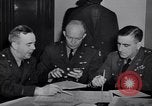
General Dwight D Eisenhower and Allied forces capture North Africa and Sicily, receives the French Legion of Honour medal (WWII)
General Dwight D Eisenhower from the North Africa campaign to the D-Day Normandy landings during World War II. Eisenhower with other military officers in the War Plan Office discusses strategy. A mural covering the west wall of the Eisenhower Museum in Abilene, Kansas. An animated map shows plan to seize key positions in North Africa. Fight in Algiers and Casablanca. Allied troops fire artillery, bombarding a North African coastal town. Troops advancing from beachhead, engage in street fighting with Vichy French troops in Casablanca, Morocco. A flare gun is fired. Unfavorable weather conditions delay the troops advancing towards Tunis and Bizerte. Allied troops fighting at nighttime. Allied soldiers walk through mud, allied military vehicles pass through water on the roads. Troops fire artillery under a canopy, hitting the side of a hill. Thick clouds of smoke cover a hill. U.S. General Omar Bradley and his troops capture Bizerte, Tunisia and the British 1st Army captures Tunis. German and Italian prisoners raise their hands up upon surrender. Animated map shows the surrender of the Axis troops. A ceremony commemorates the victory. North African cavalrymen join the parade. General Eisenhower and Free French Forces General Henri Giraud review a military parade. Henri Giraud bestows to General Eisenhower the French Grand Cross of the Legion of Honor. A mural on a wall of the Eisenhower Museum depicts the Allied invasion of Sicily. Allied troops march into Sicily in 1943.Civilians in the streets to celebrate. A mural on the wall of Eisenhower Museum depicts invasion of Italy. Allied troops land ashore and march into Italy. U.S. General Mark Clark 5th Army at Salerno. A sign reads Napoli. Eisenhower comes out of a tent. U.S. President Roosevelt visits the troops in the combat area with Eisenhower. United States President Roosevelt, British Prime Minister Winston Churchill, and Joseph Stalin in Cairo, Egypt. Another mural on the wall of the Eisenhower Museum. Eisenhower with other officers. Dramatization of German troops guarding and preparing the defenses of Normandy before the Allied landings. Eisenhower reviews training of the troops as they prepare for the invasion of France. Allied troops undergo physical training though obstacle courses. Churchill inspects the troops. Eisenhower reviews the troops on the eve of invasion. Eisenhower speaks to airborne troops wearing blackened camouflage face paint.
U.S. shuttle-bombing of German positions and military installations under Operation Frantic during World War II.
Film title slate indicates "Operation Titanic" but it, in fact, depicts "Operation Frantic" with U.S. shuttle bombing operations over Germany from bases in Great Britain, Italy and Russia during World War II. United States Army Air Force B-17 Flying Fortresses in flight. Aerial view of bombers in flight with several aircraft flying in formation leaving behind contrails. View inside bomber aircraft with bombardier preparing to drop bombs. View of bomb bay door opening and closeup of hand near bomb drop switch. Bombs awawy view as bombs are dropped from American aircraft. German defenses are bombed along the invasion coast of France (just prior to D-Day) on June 2, 1944. Aerial views of B-24 and B-17 bombers also in flight bombing German military installations in German-occupied northwestern Europe. Aerial view of a target area. Smoke rising up from bombardment. Two different U.S. Army Air Force B-17 Liberator aircraft are seen falling from the sky toward crashes after being hit by German enemy fire. One of them has smoke trailing from it, and the other is in a free fall. Railroad and marshaling yards are also bombed over Debrecen, Hungary on June 2, 1944, with aircraft continuing on (shuttle bombing) rather than returning to base. United States Army Air Forces B-24 Liberator flying in formation on June 21, 1944. Aerial view as they bomb the Focke-Wulf Fw 190 engine aircraft factory near Basdorf, Germany. German factories are bombed. B-17 aircraft on the same date are seeing in formation and bomb railway stations, freight yards, and factory targets, along with the Nazi German Ministry of War, Ministry of Propaganda, and Gestapo headquarters in Berlin, Germany. Heavy flak bursts seen in the air near the aircraft. Dogfight scenes as several German airplanes are shot down. Machine gunners aboard U.S. bomber aircraft firing at German fighter aircraft and shooting down 43 of them, according to narrator. Aerial view of ball turret rotating below bomber and firing guns at German fighter aircraft. The B-17s and B-24s bombing the targets. Synthetic oil plants and refineries are bombed at Ruhland Germany, east of Leipzig. Planning for the operation was done on December 7, 1943. A document about the operation is typed. Animated map shows Nazi positions and method of shuttle-bombing, allowing American aircraft to bomb from Soviet bases, and allies broadly to bomb German targets from bases in the United Kingdom, Italy, and Soviet Ukraine.
Joseph Stalin, Franklin Roosevelt and Winston Churchill at Tehran conference; also Yugoslavian and French resistance fighters.
General Secretary of the Communist Party Joseph Stalin, President Franklin D Roosevelt of the U.S. and Prime Minister Winston Churchill of the UK seated on porch of Soviet Embassy building in Tehran, Iran, 28 November 1943, during World War 2. Scene shifts to group of Yugoslav Partisans and closeup of their leader, Marshal Tito, at their mountain headquarters. Yugoslavian Marshal Tito smoking a pipe while standing on the porch of his headquarters with American Office of Strategic Services (OSS) Officer, Army Major Linn M. Farish, U.S. Liaison to the Partisans, and British Brigadier General Fitzroy Maclean, Winston Churchill's special envoy to the Yugoslavia leader. Next scene shows French resistance fighters with their flag on a mountaineer's pick. It reads,""Vaincre ou Mourir"" and displays a cross of Lorraine. Closeups of French resistance fighters at attention and also relaxed, smiling, and singing. Scenes of various such groups joining in the June 6, 1944 Allied invasion at Normandy, France. Aerial glimpse of D-day task force crossing the English Channel. Animated map shows Germany being attacked by Russian forces from the East, by the other allies from Britain in the West and from Italy, in the South. Allied forces moving across a pontoon bridge and engaging German forces in France. A U.S. M3 Gun Motor Carriage firing its 75mm gun. American troops firing machine guns, carrying wounded on stretchers and using flame throwers. Troops, including ambulatory wounded moving under enemy fire. Paratroopers of the 101st Airborne Division in France. One carries a wounded buddy. American troops firing a variety of artillery from under camouflage netting. French underground forces engaged in Paris. Closeup of one wearing a French Adrian helmet firing a rifle. Another throws a grenade out an apartment window. An American tank moving under the base of the Eiffel Tower as French Resistance fighters run across the area. French citizens celebrating the liberation of Paris. View from an American jeep as French people cheer. Closeups of French people. A bombed out bridge. A battlefield cemetery. Destruction and death in the wake of combat. Fallen French civilians lying on pavement. A U.S. tank slowly driving through a masonry wall. Soviet forces advancing through destroyed buildings. Chinese troops marching along the Great Wall. British troops on parade in tropics. Asian ally troops marching. Huge formation of marching U.S. soldiers. United Nations flags in the breeze.
Mob uprisings against Fascists in Europe, during the end of World War II. The Third Moscow Conference of the Allied occupying powers. The Belsen trials.
A mob, seeking revenge against Fascist leaders, fills a city square. They pound on steel gates of a government building. Soldiers and police attempt to protect various persons from the mobs. Others are unprotected and suffer beatings and death. Bodies of Benito Mussolini and his Mistress Clara Petacci are seen hung upside down by Italian Partisans in Milan, Italy, on 28 April 1945. Scene shifts to image of postwar occupying powers, United States, Soviet Union, and Great Britain, whose flags are displayed in the center of a conference table during the Third Moscow Conference. Principals signing agreements, in November, 1943, providing, among other things, for lawful and orderly trials of war criminals, following World War 2. Seen signing are: Soviet Foreign Minister Vyacheslav Mikhailovich Molotov; U.S. Secretary of State, Cordell Hull; and British foreign Secretary, Sir Anthony Eden. View of General Dwight D. Eisenhower, leading a contingent of American wartime Generals on a mission to document Nazi atrocities at liberated German concentration camps. Closeup of a man directing local German citizens who were forced to observe the horrors of the camp. Closeup of an oven used to dispose of bodies of victims. Dead bodies of concentration camp victims strewn in a heap. A room filled with documentary evidence to be analyzed and used in war crimes trials. the body of German General Admiral Hans-Georg von Friedeburg , and of Heinrich Himmler, both of whom committed suicide. A hand holding cyanide capsules. Body of Leipzig City Council deputy mayor Dr. Ernst Kurt Lisso slumped over his desk, following suicide. Body of his daughter, Regina Lisso also a suicide victim. Nazi war criminals being rounded up by Allied military.One being carried on a stretcher. Another, a German officer, is taken into custody. Next, Josef Kramer, the Commandant of Bergen-Belsen concentration camp is seen under guard by a British soldier. British soldiers guarding the court room of the second Belsen trial, convened by the Allied occupational forces, in the Gymnasium building of Luneburg. View of the courtroom with defendants wearing numbers. Closeup of numbers 1 and 2, Josef Kramer, and Fritz Klein, respectively. View of Allied military officers sitting in judgment. Closeups of women defendants, including Irma Grese (number 9) and Elisabeth Volkenrath (number 11). Camera pans around the courtroom.
Trials of war criminals in Germany after World War Two. Belsen local trial.
"The Guilty." Animation depicts person being hanged. View of an angry crowd on a road. People beat captured German soldiers and collaborationists. Mob of Italian partisans in Italy raising dead bodies of Mussolini and others up to hang from their heels in public after their execution. Foreign Minister Vyacheslav Molotov and British Foreign Secretary Sir Anthony Eden signing the Moscow Declaration in November, 1943. The declaration is signed to preserve the authority of law in Europe and to ensure fair and orderly trials for war criminals. Next scene shows Allied soldiers at a liberated Concentration Camp near the end of World War 2 in Europe. Military jeeps in the background. Military photographer takes pictures as officials arrive to tour the concentration camp. Man opens a crematorium oven, revealing bones of a corpse inside. Pile of dead victims of a concentration camp. Elevated view of a room full of documents that are in review for war trials. Officials search documents to identify war criminal suspects. Nazi officers and officials who committed suicide are shown, including a German admiral, the body of Heinrich Himmler, and the bodies of the Mayor of Leipzig and his wife. War criminals being summoned for the various war crime trials. Scenes from the Belsen Trial in September 1945, held in a Lüneburg gymnasium, to decide the fate of German guards and SS officials from the Auschwitz and Bergen-Belsen concentration camps. A defendant being brought to trial on a stretcher. Soldiers guard the court room. View of defendants including many women SS-Gefolge members. German Commandant Josef Kramer during his trial, and German doctor Fritz Klein beside him. The court trial underway for the war criminals. Guilty war criminal brought to the gallows to be hanged, black cover placed over his head and he is hanged. View of dead bodies of concentration camp victims. View of a crowd amassed at a hanging execution of several German officers, possibly in the Soviet Union.
Brenner Pass rail line smashed in Trento and Bolzano.
Brenner Pass rail line smashed in September 2, 1943. Bomb group in flight. Official in bomber. Aerial view of Trento. Bombs dropped over Brenner Pass. Bombing over Brenner Pass in Bolzano. Bomb explosions. Smoke rises over target. (World War II period).