


 Francais
 Deutsch
 Italiano

Refine Your Search
+"Italy" +1944 stock footage and images
- Showing 607 to 612 of 650 results more
 Hide
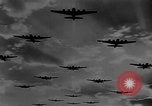
Lt. Gen. Carl Spaatz and Maj. Gen. F. L. Anderson plan 'Operation Frantic' at a USAAF headquarters in the European Theater.
A film on U.S. shuttle bombing operations over Germany from bases in Great Britain, Italy and Russia during World War II. Animated diagram shows the advantages of using Soviet airfields during the operation. United States Army Air Force Lieutenant General Carl Andrew Spaatz seated at a desk in his office. Deputy Commanding General for Operations Major General F. L. Anderson discusses the plans with other officers in his office. They plan 'Operation Frantic' at a USAAF headquarters. Ships at a British port are loaded with supplies including food, gasoline, bombs, ammunitions, trucks, jeeps and other equipment. A man watching through binoculars from the deck of a ship. A convoy passes through the Arctic Ocean. Supplies are unloaded in Russia. These are transported by train to a headquarters in Russia.
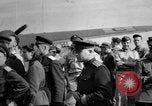
Russian and American pilots and crew talk and shake hands at an airfield in Russia during Operation Titanic.
A film on U.S. shuttle bombing operations 'Operation Titanic' over Germany from bases in Great Britain, Italy and Russia during World War II. U.S. bombers land on an airfield in Russia. Crew disembarks from the airplanes. They shake hands and talk to Russian pilots. Officers interrogate the fliers about the mission. Russian and U.S. crewmen service the airplanes. The crew eat in an outdoor kitchen. They sleep in tents.
American bomber crewmen play games and visit town near Soviet base in Poltava during Operation Frantic.
A film on U.S. shuttle-bombing operations in "Operation Frantic" over Germany, operating from bases in Great Britain, Italy and the Soviet Union during World War II. Aircraft parked at an air base in Poltava, Ukraine, Soviet Union. Nose art and painted insignias on the U.S. Army Air Force aircraft. American crewmen standing near the bomber aircraft. They sleep in tents. They wake up and get ready. A group of Soviet civilian workers walks by with farming tools. A man shaves. Others wash their faces. American Colonel Albert Kepler and Russian officers confer for their next bombing mission. They select target areas for the bombardment. Gasoline, bombs, ammunition and other supplies are provided to the crew. American and Russian crewmen of a bomber aircraft play baseball and cards and interact. Some American soldiers write letters home. Others milk a cow with a Soviet soldier. Crewmen drive in a jeep to visit the nearby town where German bombing campaigns have destroyed many buildings in Poltava. They view a destroyed leather industry factory, and the grave of Ukrainian writer Vladimir Korelenko. They see only rubble remaining of the birth home of Korolenko. Damaged buildings and rubble in the area. People walking on a street. The American soldiers interact with the Ukrainian civilians of the town. Women and children of the town are seen. Closeup view of the hand of a a U.S. Army soldier as he hands out chewing gum candy to eager Ukrainian children. On the way back to the base the soldiers view the Column of Glory in Poltava, honoring the 1709 Battle of Poltava.

Corsican women outside a dispensary at Alto Air base during the Allied invasion of southern France in World War II.
Allied invasion of southern France during World War II. Corsican women and soldiers outside a dispensary at Alto Air Base in Corsica, France. A young girl wearing a hat outside the dispensary. U.S. Army trucks and jeeps on a road towards Bologne, Italy.
Toscanini conducts the NBC symphony orchestra accompanied by Jan Peerce and Westminster Choir after Mussolini's downfall.
A documentary depicts Italian conductor Arturo Toscanini in the United States. A radio broadcast room. An emergency news item comes in. News being broadcast about the removal of Benito Mussolini as the Prime Minister of Italy. Toscanini plays a piano. He works on musical notes of Forza del Destino. At NBC broadcasting station preparations being made to put the music of Forza del Destino on the air in radio broadcast. Jan Peerce and Westminster Choir at a recording studio. NBC Symphony Orchestra at NBC Studio in New York. Toscanini conducts the orchestra. Westminster Choir sings as Toscanini conducts the music. Jan Peerce sings.

Attack on Pearl Harbor,and U.S. Secretary of State Hull and Japanese Ambassador to U.S. Kichisaburo Nomura in the United States.
A film titled 'The war' about military activities in the United States during World War II. A bomb explosion on the Christmas eve. A wounded child cries. A blind man walks past the bombed houses. Soldiers present arms. People cry and walk as they are rendered homeless. The German troops march. People cry near the dead bodies. An animation of a globe depicting German,Italy and Japan occupation through out the world. The Japanese troops cheer. The United States Secretary of State Cordell Hull tries to stop the conflict. Newspapers stacked in a printing machine. The Japanese Ambassador to the United States Kichisaburo Nomura disembark from aircraft in Washington DC. The officials enter a building. The officials come out of a building. A Japanese aircraft carrier at sea. The Japanese aircraft bomb Pearl Harbor. A damaged aircraft. The dead bodies of the U.S. Navy men.