


 Francais
 Deutsch
 Italiano

Refine Your Search
+"Italy" +1944 stock footage and images
- Showing 31 to 36 of 650 results more
 Hide
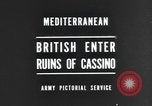
Re-enactment of British forces occupying the town of Monte Cassino, Italy, in World War II
Montage of scenes recorded after the Battle of Monte Cassino in World War 2. Opening scene shows New Zealand 19th RHQ tank in Mignano Montelungo, as the 24th New Zealand Battalion re-enacts its entry into the ruins of Monte Cassino, on March 26, 1944. In this restaging, 24th Battalion infantrymen are shown moving through rubble of destroyed town, firing small arms and one throwing a hand grenade. Narrator identifies "Hangman's Hill," (which was held by the 1st battalion 9th Gurkha Rifles) at Monte Cassino. In this restaging , New Zealanders, scramble over rubble, and dig out a "wounded" comrade, while explosions occur in background. Medics "attend" to him. Other NZ troops fire small arms from behind rubble barriers. A huge explosion occurs in background. A British artillery piece (obscured by debris) fires rounds. Infantrymen fire small arms. A camouflaged British tank fires its gun. In change of scene, other British troops advance cautiously near a damaged building and take several German soldiers prisoner. View of the destroyed Monte Cassino monastery and castle on Castle Heights. Ruins of building adjacent to the "Hotel Excelsior,"below the castle. Several medics with Red Cross flag in distant rubble. Views from destroyed Monastery atop the mountain. (World War II; WW II; World War 2; World War Two)
People pray to Mother Mary and demonstrate with the statue and Mount Vesuvius erupts in Naples, Italy.
The eruption of Mount Vesuvius in 1944. Lava in the city. Smoke rises from lava. People pose. Crowd gathers near lava. Civilians kneel in prayer as church services are held before an outdoor shrine. The crowd praying around a Virgin Mary statue. Candles lit in front of statue and priest speaks. Lava flow interrupts services. A man pushes lava rock with a stick. The crowd breaks up and carries the shrine forward. Men carry statue and priest go with them. View of city with cloud of smoke in the background.
Japanese 1931 aggression in Manchuria condemned by the League of Nations. Continued Japanese aggression in the Pacific, through World War II
Japanese international activities during 1931-1945. Opening scene shows Japanese troops embarking on ships bound for an invasion of Manchuria, in 1931. Officers walking on the dock, amongst the departing troops. Scenes of explosions and destruction. Views of Shanghai during Japanese attacks in 1937. Destroyed buildings. Civilian dead lying in the streets. Japanese soldiers racing along a street in a three wheeled motorcycle vehicle. Change of scene shows Japanese diplomat Yosuke Matsuoka addressing a League of Nations meeting in 1933, after that body adopted a report blaming Japan for events in Manchuria. He objects to that action and then leads his delegation in walking out of the meeting. View of Japanese delegates in top hats and bowler hats exiting the building. Scene shifts to Japanese forces firing artillery and machine guns in Manchuria.They wave large Japanese flag victoriously after a battle. The next scene shows Italian forces occupying Ethiopia and raising the flag of the Kingdom of Italy, as Italian troops salute, presenting arms of rifles with fixed bayonets. Axis leaders celebrate the 1940 Tripartite Pact between German, Italy and Japan. The festivities take place in a hall displaying the three nation's flags on the walls. A large number of persons attend including Japan's Prime Minister, General Hideki Tojo, seen with two celebrants. Scene reverts to China with Chinese civilian people trying to escape from invading Japanese forces. The refugees carry their belongings as they flee. Occasional shell burst is seen among advancing Japanese troops as Chinese soldiers put up resistance. Chinese soldiers firing artillery. In the U.S., Japanese envoys Kichisaburō Nomura and Saburō Kurusu are seen walking together into a building and entering a room inside. Next, are views of the Japanese attack on Pearl Harbor, with huge plumes of smoke obscuring the bombed U.S. battleships in the harbor. U.S. battleships in line formation in the Pacific during World War 2. Aerial view of U.S. warships moving in parallel. British ships augmenting the U.S. warships. Naval guns firing. U.S. amphibious assaults on Japanese held islands in the Pacific. Prisoners of the Japanese who suffered in the Philippines. General Douglas MacArthur mingling with former prisoners and internees upon his return to Manila in 1944. Aerial views of Iwo Jima. Naval bombardment and amphibious assault of Iwo Jima. Numerous fallen Japanese soldiers. The iconic American flag raising by U.S. Marines on Iwo Jima. View of Lieutenant General Simon Bolivar Buckner Jr. during the campaign on Okinawa, where he was killed in action. A Soldier being carried on a stretcher. Another throwing a hand grenade. U.S. soldier firing at a Japanese defender who falls out of his bunker. Large numbers of Japanese prisoners of war assembled in a field. Japanese Kamikaze attacking U.S. warships off Okinawa. The sky filled with antiaircraft flak clouds. View of 40mm Bofors antiaircraft cannon firing and a Japanese plane falling and exploding on impact in the ocean.
Navy film about amphibious assaults. German films about the building of the German coastal defenses known as the "Atlantic Wall."
U.S. Navy film entitled, "the Battle for the Beaches." Several Higgins boat landing craft arrive at a shore and U.S. soldiers leave them to run ashore. Scene is then overlayed by the title slate. View of the White Cliffs of Dover, England. British civilians preparing defenses during World War 2. Civil Youth loading sand bags and erecting sand bag parapets around buildings. Home guard troops march up a road carrying rifles. British defenders occupying fortified positions They stand along a coastline looking out at sea. Street scene in an English village. Guards walking up along a barbed wire fence erected on the outskirts of the village. Film shifts to the German coastal Atlantic Wall defenses. German troops march along sandy shores containing all manner of obstacles at the water's edge. German officers stand on an overlooking cliff, and peer through binoculars. German sentry and large coastal gun barrel under camouflage net are silhouetted against light sky. Three German officers confer over plans for coastal defenses. View from above of slave laborers working and shoveling sand as they build defenses. German soldiers dismantling wooden forms around completed concrete fortifications. Glimpse of a huge German coastal gun being raised by a crane with heavy steel cables, as it is steadied by dozens of workers with hands on its barrel. German troops manning a machine gun in coastal defense position where a twin mounted antiaircraft gun is also seen. Momentary view of two German soldiers walk past rotating barrel of a huge coastal defense gun under a camouflage net. Workers, with shovels, placing fresh concrete to build up a section of concrete barriers along the coast. Allied troops storming a sandy shore from landing craft, as shells explode near them; possibly related to 1944 D-Day. One contingent are British soldiers. American troops landing at a beach from landing craft. Dead allied soldiers lying in the surf. Film shifts abruptly to U.S. Lieutenant General Mark Clark with some officers in Italy. In another switch of war theaters, General Douglas MacArthur is seen congratulating crew of a B-25 named "Smiling Jack." U.S. troops, in a training exercise, storming ashore from Higgins boats directly and closeup at the camera. They take up defensive positions in the sand, and move a jeep towing a field artillery piece.
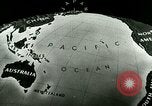
African American soldiers engaged on all fronts in World War 2
Film opens with map of the world showing the various theaters of operation in World War II. Narrator refers to Allies liberating town after town, as they advance. View of American troops being welcomed in a European town during an advance (probably Italy in 1944). Next, African American troops are seen boarding troop transport ships. A huge convoy of ships is seen from the air. Huge piles of war materiel on a dock. Ammunition being delivered by landing craft from the transport ship USS Hunter Liggett (APA-14) to American troops at a beachhead in the Pacific. An African American sailors directs the lowering of a piece of artillery from a ship into a landing craft. Construction equipment being used to clear the way for a new landing field. Docks, roads, and bridges being built as the Allies advance. American troops in the swamps of the South Pacific. American Army engineers clearing trees to build the Alaska Highway (ALCAN Highway) in 1942. Corps of Engineers building the Ledo Road (from India to China) during the war. African American soldiers building a bridge across a river in Europe. A U.S. Army truck under fire, driving along a dirt road in Europe as shells burst all around it. U.S. troops firing various kinds of field artillery and tank guns. U.S. infantryman using a flame thrower. Closeup of African American soldier using a bayonet and others firing small arms. A tank being blown up by artillery fire. A Japanese Mitsubishi A6M3 Zero aircraft maneuvers overhead in the Pacific theater. An African American soldier runs to man his Browning .50-caliber, water-cooled antiaircraft machine gun, and begins firing as the Zero fighter plane strafes his position. Closeup of Japanese pilot in his cockpit and his machine guns firing from leading edges of his plane. His rounds strike all around the U.S. gunner, who turns and follows him with more fire. His tracers show behind the plane. Closeup of the African American gunner as he continues firing. View of the Japanese airplane rolling over and diving. Next the Japanese plane, aflame, crashes on a tropical island and explodes. (Note: It is apparent that some of these combat scenes have been made up of clips from other sources, edited into this film.) (World War II; WW II; World War 2; World War Two)
Joseph Stalin, Franklin Roosevelt and Winston Churchill at Tehran conference; also Yugoslavian and French resistance fighters.
General Secretary of the Communist Party Joseph Stalin, President Franklin D Roosevelt of the U.S. and Prime Minister Winston Churchill of the UK seated on porch of Soviet Embassy building in Tehran, Iran, 28 November 1943, during World War 2. Scene shifts to group of Yugoslav Partisans and closeup of their leader, Marshal Tito, at their mountain headquarters. Yugoslavian Marshal Tito smoking a pipe while standing on the porch of his headquarters with American Office of Strategic Services (OSS) Officer, Army Major Linn M. Farish, U.S. Liaison to the Partisans, and British Brigadier General Fitzroy Maclean, Winston Churchill's special envoy to the Yugoslavia leader. Next scene shows French resistance fighters with their flag on a mountaineer's pick. It reads,""Vaincre ou Mourir"" and displays a cross of Lorraine. Closeups of French resistance fighters at attention and also relaxed, smiling, and singing. Scenes of various such groups joining in the June 6, 1944 Allied invasion at Normandy, France. Aerial glimpse of D-day task force crossing the English Channel. Animated map shows Germany being attacked by Russian forces from the East, by the other allies from Britain in the West and from Italy, in the South. Allied forces moving across a pontoon bridge and engaging German forces in France. A U.S. M3 Gun Motor Carriage firing its 75mm gun. American troops firing machine guns, carrying wounded on stretchers and using flame throwers. Troops, including ambulatory wounded moving under enemy fire. Paratroopers of the 101st Airborne Division in France. One carries a wounded buddy. American troops firing a variety of artillery from under camouflage netting. French underground forces engaged in Paris. Closeup of one wearing a French Adrian helmet firing a rifle. Another throws a grenade out an apartment window. An American tank moving under the base of the Eiffel Tower as French Resistance fighters run across the area. French citizens celebrating the liberation of Paris. View from an American jeep as French people cheer. Closeups of French people. A bombed out bridge. A battlefield cemetery. Destruction and death in the wake of combat. Fallen French civilians lying on pavement. A U.S. tank slowly driving through a masonry wall. Soviet forces advancing through destroyed buildings. Chinese troops marching along the Great Wall. British troops on parade in tropics. Asian ally troops marching. Huge formation of marching U.S. soldiers. United Nations flags in the breeze.