


 Francais
 Deutsch
 Italiano
Refine Your Search
+"Italy" +1945 stock footage and images
- Showing 13 to 18 of 175 results more
more Hide
Hide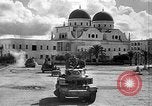
UN Commissioner Adrian Pelt and members of an Advisory Council meet people and the Emir of Cyrenaica in Libya.
A film depicts steps in Libyan independence. Allied soldiers on tanks during World War II. A tank goes past a ruined building. People gathered look as the Union Jack is unfurled. People read a proclamation pasted on a wall. Ruins of World War II. A meeting in the United Nations in 1945 where it is suggested that Libya be placed under temporary UN trusteeship. A resolution in the UN on 21st November, 1949 to create an independent Libya. The Russian delegate to the UN states his disagreement. The United Kingdom delegate speaks in favor of the resolution. A UN aircraft lands and taxis in Libya. Advisory Council members, led by Mustafa Qasim Mizran, who is first to exit the plane and is head of the National Party and Director of the School of Arts and Trades in Tripoli, are joined by UN Commissioner in Libya Adrian Pelt as they are greeted by dignitaries. The headquarters of the Commissioner and the Advisory Council in Tripoli. A sign reads 'Office of the United Nations Commissioner in Libya'. Members of the Advisory Council include representatives from Tripolitania, Cyrenaica, Fezzan, Egypt, France, Italy, Pakistan, the United Kingdom, the United States and a minority group delegate. Cars carrying the representatives drive out of the gates of the headquarters. They meet people to become aware of their problems. People greet the UN Commissioner and the members of the Advisory Council. A visit to Benghazi where they meet the Emir of Cyrenaica. People holding placards in front of the Emir's palace to greet the Advisory Council. They meet the Emir, who is the religious Muslim leader, in his place. The headquarters of the Commissioner and the Advisory Council, where Mustafa Qasim Mizran is seen touching his face, as he stands behind king Idris,
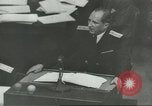
Hans Frank describes the atrocities inflicted on prisoners by the Nazis; Hoess testifies; footage of atrocity evidence.
During Nuremberg trial Hans Frank describes the Nazi policies of exterminating Poles and others. Atrocities inflicted on prisoners in Ourador Sur Glane, France in Bande, Belgium in Catacombe, Italy and in Czechoslovakia. Nazi German soldiers engaged in destruction following massacre of many residents in town of Lidice, Czechoslovakia in 1942 (retaliating for the assassination of SS officer Reinhard Heydrich.) Dead bodies in Nazi concentration camps, including Auschwitz, in 1945. Bones visible in crematory ovens. Victims inside crowded barracks including women prisoners who have been liberated. Large piles of items taken from victims before their deaths, including luggage, hair locks, toothbrushes, shaving cream brushes, shoes, clothing. Bones of victims piled at a concentration camp. Rudolf Franz Ferdinand Höss (sometimes spelled Höß or Hoess or Hess) describes concentration camps at Auschwitz in Poland during testimony. Victims in hospitals are shown, as words of Hess describe medical experiments include lowering the body temperature, injecting the body with poisons and infectious diseases and subjecting victims to high altitude pressure chambers. View of mutilated corpses. Sign that reads, "Arbeit Macht Frei" over the Auschwitz concentration camp gated entrance. Corpses of victims in the concentration camps.
Damaged buildings at a harbor and American soldiers visit places including St Mark's Basilica in Venice, Italy at end of World War 2.
War damaged buildings in Venice, Italy after World War II. Aerial view of a harbor in Venice. A sunken ship off the harbor of Venice. Damaged buildings and ruins. A man near wreckage. Men in boats. A man rows a boat under a bridge. Containers carried on a boat. American soldiers aboard a gondola. The Basilica di Santa Maria della Salute (Dorsoduro, 1, 30123 Venezia VE, Italy) is seen nearby. Allied soldiers on leave ride a motorboat around Venice. The United States flag hangs in front of a building. Gondoliers are rowing gondolas with United States troops and boats carrying barrels. St. Mark's Campanile at St. Mark's Basilica on Piazza San Marco (P.za San Marco, 30100 Venezia VE, Italy). View of the Doge’s Palace (Palazzo Ducale, P.za San Marco, 1, 30124 Venezia VE, Italy). People including two soldiers feed pigeons.
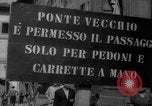
Civilians cross the Ponte Vecchio Bridge in Florence, Italy.
The Ponte Vecchio Bridge in Florence, Italy, in World War 2. A sign in Italian reads “Ponte Vecchio é permesso il passaggio solo per pedoni e carrette a mano” (“Ponte Vecchio is allowed to pass only for pedestrians and handcarts” in English). The sign reads 'Ponte Vecchio' in Italy near Arno River. People of Florence cross the ruined Ponte Vecchio Bridge (Ponte Vecchio, 50125 Firenze FI, Italy). Several buildings lined on a side of the bridge. Men walk with bicycles. People walk through a mine cleared path approaching Ponte Vecchio Bridge. Italian refugees escape from German concentration camps near Florence. U.S. Brigadier General Edgar E. Hume, 5th Army, talks to the refugees. Several refugees stand in a group. A United States soldier distributes cigarettes to Italian men. Men smoking. Shops in the background.
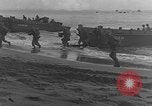
U.S. soldiers use natural vegetation to camouflage artillery and hide vehicles behind bare trees in Italy during World War II.
A film underlines the importance of tactical exploitation and counteraction of shadows and use of nets, underbrush and other camouflage during World War II. U.S. soldiers land on an island in Guadalcanal, Solomon Islands. The soldiers try to eliminate the black hole made by a tent opening by using a blanket. U.S. 5th Army in Italy. To remove shadows of oil tanks, engineers use steel wool on chicken wire. Soldiers use natural vegetation to camouflage artillery in Anzio, Italy. In Casino, U.S. soldiers use bare trees to hide vehicles. U.S. soldiers in Sicily. A garnished fish net is draped over a tank to hide it. At Anzio beach troops dig a trench to hide a tank and then cover it with hay. Soldiers try to camouflage a jeep.
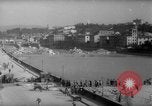
Ponte Vecchio Bridge on Arno River and Tuscan Hills in Italy.
The Arno River in Italy during World War 2. People cross the river by a weir. Destroyed bridges across Arno River. Ruins near Ponte Vecchio (Ponte Vecchio, 50125 Firenze FI, Italy). Several people stand near the river. Tuscan Hills in the far background. People climb improvised stairs from the weir. People walk through the streets in Florence. A curfew sign in the background reads “Curfew for all troops 2100 hours”.