


 Francais
 Deutsch
 Italiano
Refine Your Search
+"Iwo Jima" +1945 stock footage and images
- Showing 79 to 84 of 406 results more
more Hide
Hide
Rabbi Chaplain Leon Rosenberg conducts services for Jewish Marines on Iwo Jima in World War II
Rabbi, Lieutenant Leon Rosenberg of the Chaplain Corps, conducts services on March 11 (D-day + 20) for Jewish Marines of the 4th Marine Division, on Iwo Jima, during World War 2. He stands in front of a makeshift altar containing a pair of candles and a cloth displaying the Star of David. He reads aloud from a small book. Marines are seated on the ground in a group. A truck in background drives away as a Marine photographer in background takes a picture of the seated marines. While Chaplain Rosenberg is reading, a jeep and another vehicle drive past in background. After break in sequence, the seated marines are seen with individual prayer books containing Hebrew script. They refer to the books during the service. In final sequence, the Chaplain continues to lead the service, with the marines now standing. (Note: Chaplain L. W. Rosenberg was the first Jewish chaplain to see actual combat with the Marines.. He went overseas with the Fourth Marine Division and was the, only Jewish chaplain to receive the Purple Heart, having been wounded on Tinian, 25 July 1944. Chaplain Rosenberg was in more Marine amphibious landings than any other chaplain. Among these were,assaults on Saipan, Tinian, and Iwo Jima.
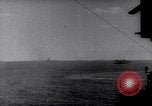
U.S. warships fire moving barrage of naval gunfire to support amphibious assault on Iwo Jima in World War II
World War 2 invasion of Iwo Jima by U.S. amphibious forces. U.S. warships continue bombardment of Japanese fortifications on Iwo Jima, but cease temorarily, allowing U.S. air strikes. U.S. dive bombers attacking Japanese positions.The Cruiser USS Indianapolis (CA-35) is seen maneuvering close to shore. U.S. gunboats firing barrages of rockets that saturate the beach with explosions. Diagram illustrates the way heavy naval gunfire overhead is coordinated with advancing amphibious craft. Views of landing craft and battleships firing overhead in a moving barrage. Landing craft arriving at the beach.
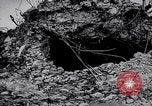
Japanese fortifications destroyed by U.S. naval gunfire on Iwo Jima, Japan, during World War II..
Post-invasion views of Japanese fortifications destroyed by U.S. Naval gunfire prior to the U.S. amphibious assault on Iwo Jima in World War 2. Remains of Japanese defensive positions on Iwo Jima. Steel-reinforced concrete fortifications, including pill boxes, heavy gun emplacements, and block houses, destroyed by U.S. naval heavy guns. A marine stands near destroyed concrete bunker. U.S. Flag flies high above the scene. U.S. battleships underway at sea.
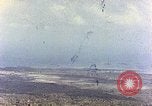
Aerial shots of auxiliary shipping and central airfield in Iwo Jima, Japan.
Aerial shots of auxiliary shipping and ships underway including off the coast in Iwo Jima, Japan. Aerial shots of a central airfield on Iwo Jima. A transport plane drops supplies over the airfield. A Douglas airplane parked on the airfield.
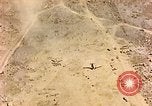
Aerial shots of Iwo Jima, Japan.
Aerial shots of a Douglas airplane parked on a central airfield on Iwo Jima in Japan. View of the Iwo Jima islands and fumes arising from several active volcanoes. A TBM aircraft flies close to the sea laying a smoke screen.
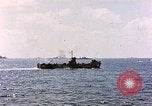
U.S. Naval Forces at Iwo Jima in Japan.
A Landing Ship Medium (LSM) underway off the coast in Iwo Jima, Japan. Battleship, probably BB-38 USS Pennsylvania fires. Smoke rises from bow. A heavy cruiser and destroyer can be seen on horizon in background. Formation of planes in flight above the sea. View of the Iwo Jima beach as some tracked landing vehicles (LVTs) make their way towards the beach. Smoke from gun fire seen. Destroyer from port quarter, a second destroyer in the background. An Amphibious Force Command Ship (AGC) with a landing craft alongside. U.S. Navy officers use perolis on bridge of a ship. (World War II period).