


 Francais
 Deutsch
 Italiano
Refine Your Search
+"Japan" +1931 stock footage and images
- Showing 7 to 12 of 18 results more
more Hide
Hide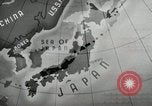
Benito Mussolini and his troops invade Ethiopia; war and unrest leading up to World War 2.
Actions of Italy leading up to World War II. Animated map shows Japan and the Sea of Japan on world globe. Benito Mussolini gives a speech. Italian troops invade Ethiopia. Ethiopian Emperor Haile Selassie addressing the League of Nations. Ethiopian native leaders and tribal soldiers gather with Emperor Selassie and pledge allegiance to him and Ethiopia at a rally against the Italian invasion. Ethiopian fighters with spears and bare feet battling well-armed Italian soldiers in vain. Newspaper heading reads 'Mussolini invades Ethiopia'. Italian aircraft drops bombs on Ethiopia. President Franklin Roosevelt in his speech denounces the Italians invading Ethiopia, noting that civilians including women and children "were being ruthlessly murdered with bombs from the air." Animations depicting the rapid speed at which the earth can be traveled by air compared to formerly by ship. Thatch roofs huts being burned by Italian soldiers in Ethiopia. Similar scenes of civilian dwellings being burned by Japanese forces in Manchuria circa 1931. Mussolini, Hitler, and Goering meeting and discussing plans over a map. The three leaders are seen smiling and laughing. Camera view from low near Hitler's feet showing Adolf Hitler raising his hand in a Nazi salute. Brief scenes of fire burning through buildings in a war torn city; German forces digging ditches or foundations; Civilians waiting in line for food relief; children putting on gas masks and raising rifles while in prone position during a training exercise; dead bodies of war victims in China.

Japanese invasion of Manchuria (Mukden Incident), forming Manchukuo, as part of the Second Sino-Japanese War.
A Japanese militaristic propaganda film about the material and spiritual strength of Japan. Narration by General of the Imperial Japanese Army Baron Sadao Araki. Map of Asia. Image of an artillery shell followed by animation of large blotch marks covering large sections of Asia. Scenes of Japanese troops marching in countryside and on railway beds. Sign in English 'Soochow'. Troops loaded into open rail cars and a steam engine pulling the train out of a station. Troops resting along a roadway, with civilians walking by among them. Some of the soldiers water and care for the horses. Many signs in Japanese in an urban center. Some depict warfare and conquering of territory. It appears to depict the 1931 Japanese invasion of Manchuria known as the Mukden Incident or the Manchurian Incident, part of the Second Sino-Japanese War. A parade on a city boulevard, with leaflets dropped everywhere blowing on the ground. A dragon costume controlled by many people. Children marching in a group. A regiment of Japanese soldiers marching in formation. An entrance way covered by the angled, draped flags of Japan and Manchukuo.
2nd Sino-Japanese war, precursor to World War II in the Pacific. Pearl Harbor attack. Early phase of Pacific conflict between Japan and the U.S.
The film 'Sea power in the Pacific' showing Japanese dominance in China and at start of World War 2. Then it chronicles U.S. efforts to build Navy and fight back on sea and in the air. Opening scene shows Japanese Mitsubishi G3M (Type 96) bombers high overhead, and then closeup in formation. View from bomber of bomb bays open with bombs falling and view from ground of explosions and destruction. Overlay on film says: "China---1931." (This is not correct. The G3M bomber was not yet in service.) This film depicts Japanese attacks during second Sino-Japanese War, commencing 1937, Chinese civilians running to escape Japanese bombing of Singapore. Buildings destroyed and on fire. Next, Japanese troops, carrying the Rising Sun flag, are seen establishing a beachhead in an Amphibious assault. More scenes of Japanese infantry advancing through Singapore, ad it is being destroyed and burned. Soldiers charging along an alleyway, with pagoda in background. Next, Japanese soldiers are seen attacking Nanking, and committing atrocities and killing Chinese during the so-called "Rape of Nanking," in December, 1937. Chinese civilians being summarily shot and dumped into a large open grave after execution. Two Chinese prisoners with hands bound, being executed by rifle fire. Jubilant Japanese troops celebrating their victory. Map shows areas of China occupied during second Sino-Japanese war and the East Indies to the South. View of oil tanks; an open pit tin mine; a native cutting rubber tree bark to collect latex. Flags on map show regions of English, French, and Dutch colonial interest. It also shows Islands to the East, fortified by the Japanese. Cartoon shows Japanese soldier opposed by and American sailor (representing U.S. Sea Power). Next, famous images of the Japanese attack on Pearl Harbor, Hawaii, December 7, 1941, are shown, including the USS Arizona burning and sinking. Hawaii, Midway, Wake, and the Philippines Islands, are highlighted on a map and Japanese control of the Pacific is illustrated. Japanese soldiers are seen displaying a captured American flag. U.S. Lieutenant General Jonathan M. Wainwright is seen surrendering the garrison at Corregidor, on May 6, 1942. View of Japanese General Masahara Homma discussing surrender terms with Wainright. Map shows interlocking web of Japanese fortified bases in Pacific and need for seapower to oppose it. View of American shipyard with hundreds of workers, employed to build ships for the war effort, in World War 2. Views welding, metal fabrication, and other shipbuilding activity. A new ship going down the ways and a woman christening a new ship with splash from bottle of champagne. A new "Liberty Ship," the Richard Bassett, going down the ways at Bethlehem-Fairfield Shipyard Inc. Baltimore, Maryland. Closeup view as the stern of another ship enters the water upon launching. View of it from a distance. Shipyard workers knock supports from under what may be a landing craft, as it is launched. Japanese warships underway in the Pacific and firing their naval guns. Explosions on a shoreline from naval bombardment. Japanese infantry wading ashore during an amphibious assault. Map shows where Japanese forces attempt an amphibious assault on Southern New Guinea, thwarted by the U.S. Navy in the battle of the Coral Sea of May, 1942. In June, 1942, a Japanese attempt against Midway Island, was again checked by the U.S. Navy in the Battle of Midway. View of USS Wasp (CV-7) carrier deck filled with airplanes, including Grumman F4F Wildcats. A Douglas SBD Dauntless dive bomber being cleared for takeoff from the Wasp. Gun camera film showing Japanese airplanes being shot down by pursuing U.S. aircraft.
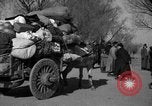
Students demonstrate against Chiang's diplomacy with Japan and call for war against Japan
Chinese students march with white bands around their arms in China. Students and horse-drawn carriage cross bridge. Students hold white flags and march on dirt road. They pass on a street and civilians in the background watch them. Students march towards bridge in the background.They protest the Chiang policy of appeasing Japan and call for war against Japan. A camel driver passes through their procession.
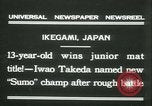
13 year old Iwao Takeda, wins sumo wrestling Junior mat title in Ikegami, Japan.
13 year old, Iwao Takeda, wins Junior mat title in Ikegami, Japan. Japanese people gather to watch sumo wrestling. Junior participants wrestle on ground. Wrestling winner, Iwao Takeda, named the new Sumo champion.
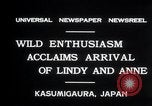
Charles Lindbergh and Anne Morrow Lindbergh arrive in Kasumigaura, Japan after flying from Siberian coast
Aviator couple in Kasumigaura, Japan. Pontoon equipped airplane lands in water and slows down near shore. Other small and large boats in sea water visible in the background. Thousands of cheering Japanese spectators gather across the harbor. Colonel Charles A. Lindberg gets off the plane. Mr. and Mrs. Lindberg escorted by guards walk along the crowd and climb up a balcony. Dignitaries and Lindberg couple sit together in the hall. Japanese performers in kimonos entertain the group. Women play stringed instruments as other women dance with parasols in hand. Dignitaries and children greet the Lindberg couple and present gifts. Lindberg couple in the car moves slowly along the streets past cheering crowd assembled on the street sides.