


 Francais
 Deutsch
 Italiano
Refine Your Search
+"Japan" +1938 stock footage and images
- Showing 13 to 18 of 45 results more
more Hide
Hide
Electric Power Generation in Japan prior to World War II
A look at various sources of energy in Japan prior to World War 2. Japanese coal miners ride railcars down into a mine. View of miner using pneumatic drill to cut away coal at the face. Steam shovel bucket loading bituminous coal into open rail car. Animated map showing locations of Japan's coal mining areas in Kyushu and Hokkaido and small deposits in Honshu. Scene shifts to a river and water power generation site. View of turbines in water-powered electric generating plant. Generator buildings at side of river. Electric power transmission facilities. View from below a dam of a hydroelectric plant in central Honshu. Pipes carrying water down a mountainside. Reservoirs for storing water. Animated map depicting meager oil deposits in Japan and showing some of its oil processing and storage facilities.
Canned crab tins displayed in Japan.
Steamers underway at sea in Japan. The flag of Japan at steamer. Logo of Three Diamond Brand on steamer. Various countries signs on map. The map explains the data of cases of USA, Hawaii, Canada, England, Australia, France, Germany, Denmark, Sweden and others countries for year of 1924-1927. Tins of 'Three Diamond, Fancy CrabMeat'. Tins of 'Icebond Brand, Selected CrabMeat' displayed. Three Diamond Brand of canned crab and logo of Three Diamond.
Agricultural scenes in Japan which is self-sufficient in food production prior to World War II.
Views of Japanese farmers at work in rice paddies and other agricultural fields in Japan before onset of World War 2. A line of women, in straw hats, labor in a rice field as a man pumps water into the paddy using a foot operated wheel. Rice being harvested and processed in the field. Farmers working in other fields containing grains such as wheat, barley, and oats and in vegetable patches. Japanese soldiers using grain straw to patch roofs. Other Japanese workers using such material for screens, parasols, and hats. Women harvesting fruit, in which Japan is 95% self-sufficient. Workers harvesting tea leaves. Workers at a seashore gathering salt evaporated from seawater. They carry some in wheelbarrows and some in containers using shoulder yoke.
Commercial fishing industry of Japan before World War II
Animated map of fishing grounds around Japan that provide one fourth of the world's catch. Movement of the seasonal catch is tracked as it moves Northward during the year. Men and women engaged in commercial fishing, gathering in nets teeming with fish. Fishing boats plying waters of an inland sea. Fishing boats moored along the shores. Larger seagoing fishing boats leaving to operate along the coast of Honshu. Fishermen letting out nets from these boats and using cable winches to retrieve them. Views of refrigerated Japanese fishing ships that also freeze their catches, operatiing in the Siberian maritime provinces and in Alaskan and Arctic waters. Fishing boats, operating before World War 2, are seen pulling crabs aboard. View inside a floating cannery ship where salmon and crabmeat are being canned for export to places like the U.S.A. Closeup of a can displaying "ICEBOUNDBRAND" and text reading: " World Renowned Floating Cannery Pack Fresh from the Deep Sea Waters of Northern Japan. Net contents 13ounces. SELECTED CRABMEAT." Japanese wading in a river, and using trained cormorants, to catch fish. View of fisherman taking fish from his cormorant and placing them into a large jug. view of edible seaweed being harvested and laid out in the sun, in racks. Animated illustration of Japanese man and items included in his dinner of rice, soybean, fish, sea slugs, sea urchins, octopus, lily bulbs, bamboo shoots, bean curd and pickled fruits and vegetables, accompanied by a little saki (rice wine).
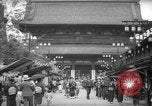
Women sew Senninbari belts and burn incense sticks to god Rokujizo in Sensō-ji, Asakusa, Tokyo, Japan.
Sensō-ji (also known as Asakusa Kannon Temple) in Tokyo, Japan. People in front of the Sensō-ji temple (2 Chome-3-1 Asakusa, Taito City, Tokyo 111-0032, Japan). Women sew Senninbari belts which are to be sent to soldiers in China. A woman with a child on her back also sews in the Buddhist temple. In Senko Booth, women burn incense to god Rokujizo who symbolizes pity. A woman prays. Japanese soldiers of the Young Men Youth Movement parade through the streets coming from the temple.
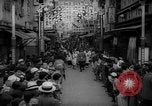
Women of the National Defense Association parade to Sensō-ji temple in Asakusa, Tokyo, Japan.
Sensō-ji (also known as Asakusa Kannon Temple) in Tokyo, Japan. Women of the National Defense Association parade to Sensō-ji temple (2 Chome-3-1 Asakusa, Taito City, Tokyo 111-0032, Japan) for service. Women in the front of the parade are carrying flags. The parade nears the Buddhist temple, stops and bows.