


 Francais
 Deutsch
 Italiano
Refine Your Search
+"Japan" +1938 stock footage and images
- Showing 31 to 36 of 45 results more
more Hide
Hide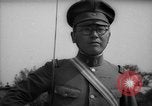
Japanese officers look as soldiers practice field tactics in Japan.
Japanese soldiers in Japan. A Japanese drill master shouts orders. Soldiers coming out of the gateway to barracks. Japanese offices seated at a table. Soldiers practice bayonet tactics. An officer supervises the session. Soldiers standing in formation. Soldiers march. Officers seated at the table look at the marching soldiers. The soldiers practice field tactics. Soldiers carrying bayonets march. Soldiers standing in formation in front of the barracks. They scramble to enter the barracks. The soldiers practice fighting. Soldiers lying in prone position practice rifle shooting.
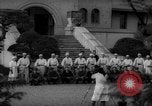
One legged soldiers pose for pictures and walk away with bicycles at a Japanese Army hospital in Japan.
A Japanese Army hospital in Japan. One legged soldiers pose for pictures with bicycles. Nurses also pose with the soldiers. A photographer clicks pictures. A close up of a nurse and a soldier. A close up of a foot showing an iron leg. A few soldiers ride the bicycles. Others walk away with the bicycles. Nurses and patients walking on a path on the hospital grounds. A soldier walks on crutches.
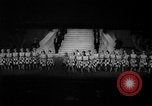
Actors and dancers performs in a Japanese Play called 'March-On-Time' at Takarazuka Revue Theater in Japan.
A play 'Cavalcade' is performed at the Takarazuka Revue Theater in Takarazuka, Japan. The play 'Cavalcade' is reconstructed into a Japanese play called 'March-On-Time'. Chorus girls dance and men stand on the sides of stairs. The lead actress sings in the middle of the stage. Two actresses sing. Musicians play music as women dance. 'Marriage' written on the stage. The performers dance. People leave the theater at night. They climb down stairs after the show finishes.
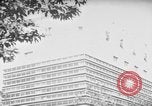
The Takarazuka Theater and the Imperial Theater in Tokyo, Japan.
Theaters in Tokyo, Japan. The Takarazuka Theater and the Imperial Theater. Traffic in front of the theaters. A tree in the foreground.
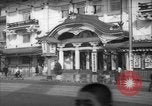
A sentry keeps vigil at the entrance of a Japanese Army Headquarters in Tokyo, Japan.
A Japanese Army Headquarters in Tokyo, Japan. Exterior of the headquarters. Vehicles drive past the headquarters. A sentry at the entrance of the headquarters keeps vigil as army vehicles move in and out of the gate.
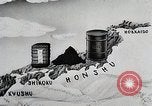
Japanese natural resources related to Second Sino-Japanese war and World War II
Animated map illustrating shortage of indigenous raw materials in Japan. As stockpiles vanish during Second Sino-Japanese war, Japan's domestic sources supply only 10% of the nation's needs for war. Animated sequence shows lack of steel, aluminum, copper, and power generation for the conduct of war. But one of the nation's greatest resources is the population of skilled Japanese workers, who are shown at various high tech jobs, as well as on the farms and in the fishing industry. Japanese workers are seen who work for the Zaibatsu (four ruling families of Japan). Banks of Japanese women typists and women in a factory. Young women painting faces on a "Kewpie doll." A Japanese family at dinner time. Women engaged in fabric spinning. Animated graphic illustrates Japan's war-related resources for World War 2, by showing a Japanese soldier standing astride map of Japan with lines extending to sources of needed raw materials from Japanese possessions in Korea, Manchuria,Formosa, China,Indochina,Malaya, and its network of Pacific Islands. Final scene displays copy of Los Angeles Times newspaper with headline reading: "Jap Supply Lines Blasted." It also features a story that appears to refer to the U.S. 6th Army invasion of Leyte in the Philippines, in October, 1944 (when General MacArthur waded ashore and stated,"I have returned"). (Note: Although produced during World War 2, this film shows prewar scenes of Japan. The animated illustrations and maps and, of course, the newspaper shown at the end, date from World War II.)