


 Francais
 Deutsch
 Italiano

Refine Your Search
+"Japan" +1941 stock footage and images
- Showing 1 to 6 of 84 results more
 Hide
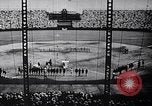
US baseball players visit Japan in 1931; also anti-Japanese propaganda circa 1941-1942 during World War 2.
Huge crowd attends baseball game between visiting American players and Japanese team in Tokyo, 1931. Lou Gehrig, Al Simmons and Lefty Grove mentioned by announcer but not seen. American representatives walk out to pitcher's mound to greet pitcher. Shots of Babe Ruth hitting. Shots of Japanese player rounding third, sliding safely into home. Film suddenly morphs into anti-Japanese propaganda circa 1941-1942; shows Japanese newspaper publisher who was murdered. Scenes of sumo wresting and judo and kendo seen and compared to alleged acts of Japanese diplomatic and military treachery and spying. Shots of fishermen, tourists, barbers and others said to be spies and soldiers for Tokyo. Closeup of a Japanese man gardening. Japanese men on small fishing boats, raising boat sails, and pulling in heavy loads of tuna fish in nets. Japanese tourists supposedly taking photographs of American ships in Hawaii. Female Japanese barbers giving haircuts. Japanese military officials in Japan organizing papers, films, and incoming information. Japanese industrialist figure emerging from car. Scenes of Japanese industry supporting war preparations: Exterior views of Japanese factories in Osaka, textile mill operations in Tokyo, chemical plant operations in Nagoya, steel mills, and a large newly completed ship being launched in Nagasaki. Overhead view of steel mill operations. View of a slum town area in Japan and simple living arrangements of Japanese citizens. Japanese laborers at work in small home factories for textiles, pottery, and other goods, said to be in "semi-slavery." Workers include men, women, and child labor. Shows production of goods said to be produced in other countries that are pirated, mislabeled by Japan, and dumped at low prices abroad to undercut competitors. Products shown include factories and production lines for spark plugs, scotch whiskey, matches, silk, cotton, bottled beer, toothbrushes, hair brushes, hair combs, and American flags produced in Japan and offered for sale at lowest prices in the United States. Shipping dock areas in Japan showing large ships at docks, cranes in use, and importing of oil, rubber, scrap iron, tin for war materiel.
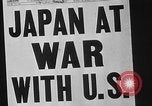
United States declares war on Japan, December 8, 1941, marking U.S. entry in World War 2
New York Daily News headline reads 'Japan at war with U.S.' Journal American newspaper headline reads:'US votes war'. Boxes of M-1 ammunition being off-loaded from a ship by African American soldiers, and placed on a roller conveyer. U.S. Army tank, trucks, and aircraft ready for shipment overseas.
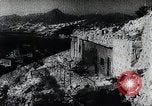
Japanese troops occupy Hong Kong after British forces surrender on Christmas day 1941 (WWII)
The Japanese occupation of Hong Kong following British surrender on Christmas day, 1941 (World War II). Japanese propaganda newsreel, narrated in accented English: Japan occupies the entirety of Hong Kong and British surrender on December 25, 1941. Destroyed British island defenses including bunkers and pill boxes. Wrecked buildings and oil storage tanks in Hong Kong. Japanese troops pose as a group and shout “Banzai” for the camera. Destroyed British tanks and artillery. British military prisoners gathered in a courtyard. Japanese officer inspects captured artillery. Japanese troops pile up shells from surrendered British forces. Captured British soldiers and sailors crowd British officers exit the "New Oriental Building" (Formerly 2 Connaught Road, Central, Hong Kong) after surrender discussions with Japanese forces. White flag hoisted on top of the New Oriental Building. Aerial view of Hong Kong area. Japanese aircraft in formation over the city making their formal occupation entry. Japanese troops parade through the streets with commanding officers on horseback.

President Roosevelt addresses congress after attack on Pearl Harbor in 1941; civilians enlist in U.S. military for World War 2
World-wide wartime activities during 1941 and 1942. President Roosevelt addresses Congress after the attack on Pearl Harbor in 1941. Crowd applauds. Citizens and cars stopped in busy New York listening to the news on the radio being broadcast regarding the declaration of war against Japan. Long queues and lines of civilian men get registered in the U.S. army as recruits are called up. Men taking oath of U.S. military service in New York and Washington DC (on U.S. Capitol steps) and other cities in mass recruitment events. New recruits stand in line in a city to register for U.S. Navy or U.S. Army service. New recruits shown include baseball star Joe Dimaggio, boxer Joe Louis, John Aspinwall Roosevelt (who was President Roosevelt's youngest son), Tyrone Power, Clark Gable, Douglas Fairbanks Junior, and Warren Pershing (son of famed General John Pershing) all seen registering to enter military service. Justice Frank Murphy of the U.S. Supreme Court is seen operating a machine gun during training. Another scene with a mass group of recruits standing and taking an oath of military service.
Japanese troops in streets of Shanghai, China following occupation by Japan in December 1941 of World War II.
Activities of Japanese soldiers in Shanghai China occupying international settlement areas of Shanghai right after the Japanese attack on Pearl Harbor in World War 2. Shanghai residents crowd on the streets near a waterfront. Japanese soldiers unload from a truck. The troops stand near the entrance to a building. The soldiers walk down a street. Wartime street scenes of city under Japanese attack. Japanese armored vehicle go down a street. The soldiers carry a battle flag. A Japanese river gunboat. A flag flying from the gunboat. The Japanese gunboat at a harbor of Shanghai.
Tripartite Pact signed by Germany, Italy and Japan in Berlin, Germany. Ensuing attacks by Germany and Japan in World War II
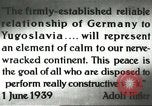
This film is a scattering montage of World War 2 scenes from 1939 through 1945. Part of an agreement between Nazi Germany and Yugoslavia is shown in English. It is dated June 1, 1939 and ostensibly signed by Adolf Hitler. Next, German Ju 87, Stuka dive bomber aircraft are shown peeling off from formation, on April 6, 1941, to attack Yugoslavia. Bombs bursting on the ground. Closeup of a Stuka airplane in a dive, making its characteristic whine, and dropping bombs. Bombs exploding just outside some concrete walls. German infantry running along railroad tracks and entering backyard of house in a village. German soldiers observing from overlooking hill; climbing over rubble; and marching along a road toward a village. Animated map showing German invasion areas early in World War II, extending through most of Europe and into Norway, by 1941. Animated map shows further invasions into France, Belgium, low countries, the Balkans, and Eastern front towards the Soviet Union. Map highlights Tokyo, Rome, and Berlin. Delegations walking in hall of Reich Chancellery in Berlin, to sign Tripartite pact, on September 27, 1940. The group is led by by Count Galeazzo Ciano (Italian Foreign Minister, and Mussolini's son-in-law); Joachim von Ribbentrop, Germany's Foreign Minister and Japan’s Ambassador Saburō Kurusu. The diplomats are seen, next, standing near a table as Adolf Hitler enters rendering Nazi salute. He shakes hands with Count Ciano and Ambassador Kurusu. Hitler is seated to watch the proceedings. Von Ribbontrop is seen signing for Germany. Next scenes show German armored units heading East in Operation Barbarossa (June of 1941). A sign identifies the town of Eydtkau (Eydtkuhnen) on the German-Lithuanian border. German armor and artillery moving eastward. German troops destroying international crossing barriers. German troops firing siege guns. Montage with glimpses of German battle scenes showing tanks, guns, rockets in action with attendant explosions, fires, and destruction. Formations of German warplanes in flight, including Junkers Ju-52s that carry troops, including paratroops. View from above of Junkers Ju-87 Stuka dive bombers in formation. Battle of Britain scenes, with view of St. Paul's Cathedral in London, England (which miraculously survived the Blitz). The Tower Bridge in London, seen through a haze following blitzkrieg. German Junkers 87 Stuka dive bombers peeling off from formation to attack. British anti-aircraft searchlights shining beams skyward. Diving bombers illuminated by the lights. Anti-aircraft guns firing. Nighttime scenes showing gunfire flashes, explosions, tracer bullets and fires in London. British fire brigades fighting fires in London buildings as some collapse from the German bombing during the so-called "Blitz." Scene shifts to Pearl Harbor, December 7, 1941, as a Japanese bomb explodes on a U.S. Navy warship. The USS Arizona billowing smoke and listing as it succumbs to Japanese bombing. Another view of the Arizona sinking. Smoke rising from Battleship Row, at Pearl Harbor. Glimpse of postwar Nuremberg trial.